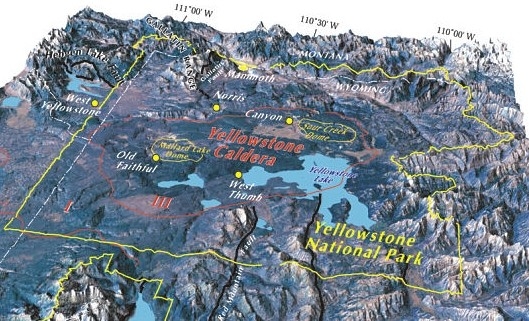





The geysers of Yellowstone National Park owe their existence to the "Yellowstone hotspot", a region of molten rock buried deep beneath Yellowstone, geologists have found, but how hot is this "hotspot," and what's causing it?

In an effort to find out, Derek Schutt of Colorado State University and Ken Dueker of the University of Wyoming took the hotspot's temperature. They published results in the August, 2008, issue of the journal Geology.

"Yellowstone is located atop of one of the few large volcanic hotspots on Earth," said Schutt. "But though the hot material is a volcanic plume, it's cooler than others of its kind, such as one in Hawaii."

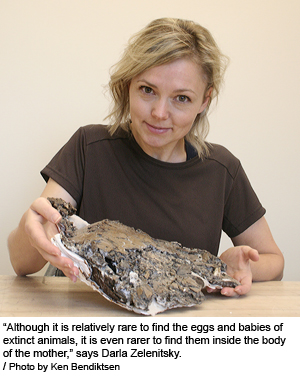
A 75-million-year-old fossil of a pregnant turtle and a nest of fossilized eggs that were discovered in the badlands of southeastern Alberta by scientists and staff from the University of Calgary and the Royal Tyrrell Museum of Palaeontology are yielding new ideas on the evolution of egg-laying and reproduction in turtles and tortoises.

It is the first time the fossil of a pregnant turtle has been found and the description of this discovery was published today in the British journal Biology Letters.

The mother carrying the eggs was found in 1999 by Tyrrell staff while the nest of eggs was discovered in 2005 by U of C scientist Darla Zelenitsky, the lead author of the article and an expert on fossil nest sites, and her field assistant. Both were found about 85 km south of Medicine Hat in the Manyberries area.

New research suggests that preventative agents, such as those found in concentrated black raspberries, may more effectively inhibit cancer development than single agents aimed at shutting down a particular gene.

Researchers at the Ohio State University Comprehensive Cancer Center examined the effect of freeze-dried black raspberries on genes altered by a chemical carcinogen in an animal model of esophageal cancer.

The carcinogen affected the activity of some 2,200 genes in the animals' esophagus in only one week, but 460 of those genes were restored to normal activity in animals that consumed freeze-dried black raspberry powder as part of their diet during the exposure.

HELSINKI, Finland and GÖTEBORG, Sweden, August 27 /PRNewswire/ -- Ascom Wireless Solutions (WS) and Ekahau Inc. announce their collaboration on a new WiFi positioning solution. Ekahau's location-based services (Ekahau RTLS) combined with the Ascom i75, a high-end VoWiFi handset from Ascom WS, create a reliable means of locating people in emergency situations.

(Logo: http://www.newscom.com/cgi-bin/prnh/20080325/297903 )

The popular phrase, "I have nipples, Greg, could you milk me?" from the 2000 movie "Meet the Parents", is similar to the widely held belief that tomatoes, because of their seeds, are really fruits instead of vegetables.

Botanically, tomatoes are fruits but cucumbers, zucchini, pumpkins, nuts, corn, peppers, peas, and other vegetation that may not seem like it also fit into this fruity category.

Botanists define fruit as any part of a plant that contains both its seed and the ovary that produce that seed. However, of all the botanically fruity plant pieces we commonly call 'vegetables', tomatoes are one food with an especially controversial history of classification.

A powerful collision of galaxy clusters has been captured with NASA's Chandra X-ray Observatory and Hubble Space Telescope. Like its famous cousin, the so-called Bullet Cluster, this clash of clusters provides striking evidence for dark matter and insight into its properties.

Like the Bullet Cluster, this newly studied cluster, officially known as MACSJ0025.4-1222, shows a clear separation between dark and ordinary matter. This helps answer a crucial question about whether dark matter interacts with itself in ways other than via gravitational forces.

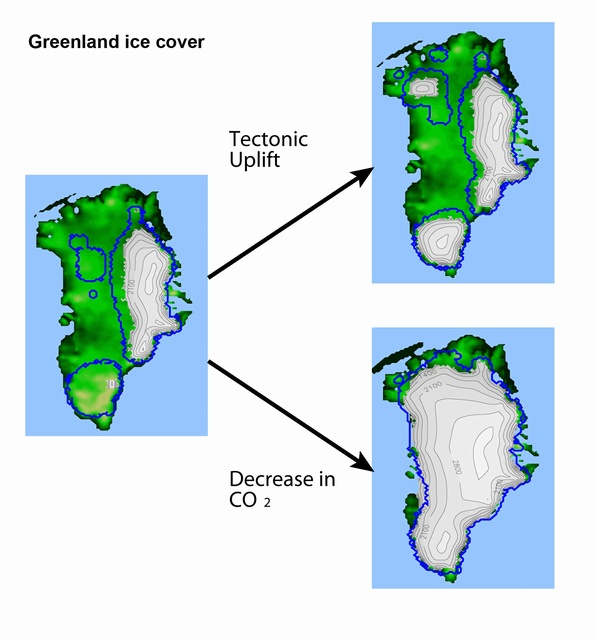
There is a great deal of concern about the effects of global warming on the Greenland ice sheet but scientists at the University of Bristol and the University of Leeds have taken the discussion to a deeper level - namely in stating that only changes in atmospheric carbon dioxide are able to explain the transition from the mostly ice-free Greenland of three million years ago to the ice-covered Greenland of today.

CO2 drops caused Greenland to become ice-covered so CO2 gains could undo that, they say.

There are several competing theories, ranging from changes in ocean circulation, the increasing height of the Rocky Mountains, changes in the Earth's orbit, and natural changes in atmospheric greenhouse gas concentrations. Using state-of-the-art computer climate and ice-sheet models, Dr. Dan Lunt from the University of Bristol and colleagues decided to test which, if any, of these theories was the most credible.

PALO ALTO, California, August 27 /PRNewswire/ --

- NexentaStor leverages ZFS to deliver breakthrough price / performance and ease of use

Nexenta Systems, developer of NexentaStor(TM), the leading open storage solution based upon the revolutionary file system ZFS, announced that Motek Entertainment (http://www.motekentertainment.com), an Amsterdam-based animation, motion capture and production studio, has selected the NexentaStor open storage software appliance to allow multiple creative users to share and view both uncompressed Standard Definition (SD) and uncompressed High Definition (HD)video content over standard Gigabit Ethernet networking.

Not all fat is created equal, it seems. A Temple University study finds fat in obese patients is "sick" when compared to fat in lean patients.

Why 'sick? When our bodies don't work properly, we say we're sick. The study in the September issue of Diabetes finds that the same could be said for fat tissue found in obese patients. The cells in their fat tissue aren't working properly and as a result, are sicker than cells found in lean patients' fat tissue.

Lead author Guenther Boden, M.D. theorizes that "sick fat" could more fully explain the link between obesity and higher risk of diabetes, heart disease and stroke.

The latest research into dual-purpose contraceptives and non-hormonal contraception will be presented at the annual scientific conference of the Society for Reproductive Biology (SRB) conference in Melbourne.

University of Newcastle Laureate professor John Aitken, a world-leader in reproductive biology, will discuss the need to develop novel, safe, effective, dual-purpose contraceptive agents that combine the prevention of pregnancy with protection against sexually transmitted diseases (STDs). His research has explored the development of a contraceptive agent that immobilises – but does not kill – sperm. The agent also possesses microbicidal activity simultaneously reducing the risk of infection with sexually transmitted diseases, such as Chlamydia.

