






Organic food is big business these days. Organic fruit and vegetables are hot items because everyone wants to feel like they are eating healthier. What hasn't been studied until now is the impact of organic business on the environment, namely in greenhouse gas emissions from transport.

A new study, conducted by a team of student researchers in the Department of Rural Economy at the University of Alberta in Edmonton, Canada, showed that the greenhouse gas emitted when the produce is transported from great distances mitigates the environmental benefits of growing the food organically.

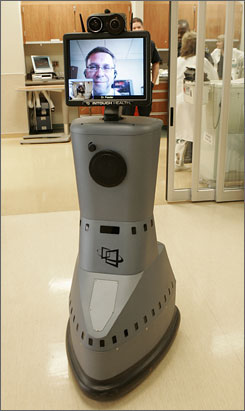
The Nursing Institute of West Central Ohio today unveiled a new addition to the regional nursing education community—a robot.

Developed by InTouch Health® from Santa Barbara, California, the Remote Presence Robotic System (RP-7™) will allow nursing faculty members to interact with students from remote locations. The Nursing Institute, headquartered at Wright State, will be the first location in Ohio to have access to this robotic technology and be the first nurse education center in the nation to use the RP-7 for educational purposes.


Courtesy InTouch Health®

Transporting energy without any loss, travelling in magnetically levitated trains, carrying out medical imaging (MRI) with small-scale equipment: all these things could come true if we had superconducting materials that worked at room temperature. Today, researchers at CNRS have taken another step forward on the road leading to this ultimate goal. They have revealed the metallic nature of a class of so-called critical high-temperature superconducting materials. This result has been eagerly awaited for 20 years. It paves the way to an understanding of this phenomenon and makes it possible to contemplate its complete theoretical description.


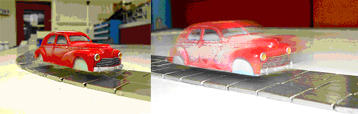
An experiment in magnetic levitation.

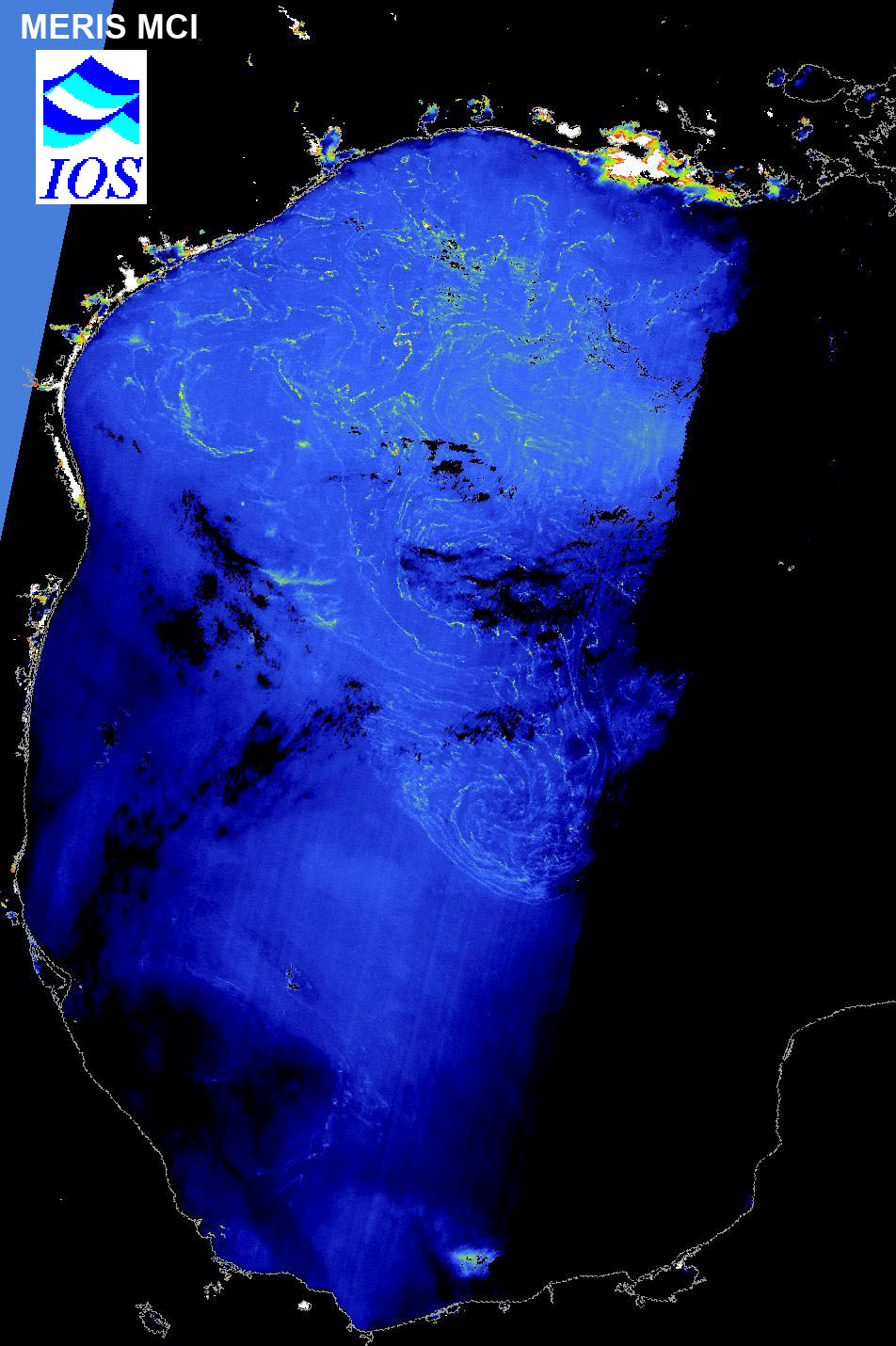
Sargassum seaweed, famous in nautical lore for entangling ships in its dense floating vegetation, has been detected from space for the first time thanks to an instrument aboard ESA’s environmental satellite, Envisat. The ability to monitor Sargassum globally will allow researchers to understand better the primary productivity of the ocean and better predict climate change.


CLICK ABOVE FOR FULL SIZE. Sargassum seaweed has been detected from space for the first time using optical radiance data from the Medium Resolution Imaging Spectrometer (MERIS) aboard Envisat.

'Tis the season—the real estate season—and though this one isn't shaping up to be the boomer of two years ago, or even the desperate sell-off of last summer, people will nevertheless be buying houses. If you are one of these people, read on. It's a buyers market this year (or so my real estate agent tells me), but which house is right for you? Use this equation to find out—it works surprisingly well.

Size matters. At least, it does to an alpine ibex.

According to a team of international researchers, mature, male alpine ibex demonstrate a correlation between horn growth and genetic diversity. Past research studies have shown that greater genetic diversity correlates with a greater chance of survival.

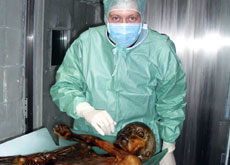
An Italian-Swiss research team, including Dr. Frank Rühli of the Institute of Anatomy at the University of Zurich in Switzerland proved the cause of death of the Iceman (“Ötzi,” 3300 BC) by modern X-ray-based technology. A lesion of a close-to-the-shoulder artery has been found thanks to a CT scan or multislice computed tomography, finally clarifying the world-famous glacier mummy’s cause of death.


The cause of death was ascertained without an autopsy (Zurich University)

The global warming debate has focused on carbon dioxide emissions, but scientists at UC Irvine have determined that a lesser-known mechanism -- dirty snow -- can explain one-third or more of the Arctic warming primarily attributed to greenhouse gases.

Snow becomes dirty when soot from tailpipes, smoke stacks and forest fires enters the atmosphere and falls to the ground. Soot-infused snow is darker than natural snow. Dark surfaces absorb sunlight and cause warming, while bright surfaces reflect heat back into space and cause cooling.


Annual mean temperature change due to dirty snow in degrees Celsius

Researchers at the Abramson Family Cancer Research Institute of the University of Pennsylvania have found that deleting a gene important in embryo development leads to premature aging and loss of stem cell reservoirs in adult mice. This gene, ATR, is essential for the body’s response to damaged DNA, and mutations in proteins in the DNA damage response underlie certain types of cancer and other disorders in humans.


ATR deletion leads to trabecular (left; the spongy inner cavity of long bones) and cortical (right; dense surface areas) bone loss. Credit: Ruzankina et al., University of Pennsylvania School of Medicine; Cell Stem Cell

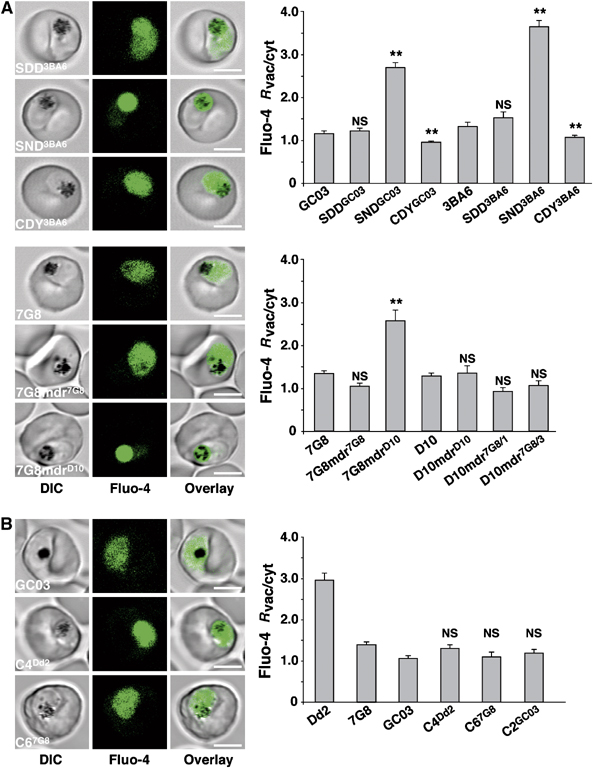
Researchers at Georgetown University Medical Center say they are moving closer to understanding why the most lethal form of human malaria has become resistant to drug treatment in the past three decades. They have been able to artificially construct, and then express in yeast, a protozoan gene that contributes to such resistance. And it was no small feat.

The gene they laboriously constructed over a two-year period is believed to be the largest synthetic one ever built, and it successfully produces large quantities of the encoded protein, whose function can now be easily studied.


European Molecular Biology Organization
