



A new study correlates a series of small earthquakes near Snyder, Texas between 2006 and 2011 with the underground injection of large volumes of carbon dioxide (CO2), long before the adoption of current hydraulic fracking and a finding that is relevant to the process of capturing and storing CO2 underground.  

There's good news and there's bad news to deliver. Which do you want to give first? What if you are getting it? The best strategy depends on whether you are the giver or receiver of the bad news, and if the news-giver wants the receiver to act on the information, according to a new paper.

The process of giving or getting bad news is difficult for most people, particularly when news-givers feel unsure about how to proceed with the conversation, psychologists Dr. Angela M. Legg and Professor Kate Sweeny note. "The difficulty of delivering bad news has inspired extensive popular media articles that prescribe 'best' practices for giving bad news, but these prescriptions remain largely anecdotal rather than empirically based."

Researchers in a new paper say that one way to gauge the extent of prescription opioid pain reliever abuse is to count the number of health care providers.

Climate understanding of the past is based primarily on ice cores.  By studying information about Earth's climate and greenhouse gases  in past, scientists can understand better how temperature responds to changes in greenhouse-gas concentrations in the atmosphere and make better predictions about how climate will change in the future. 

Researcher have now identified regions in Antarctica they say could store information from as far back as 1.5 million years, almost twice as old as the oldest ice core drilled to date. 

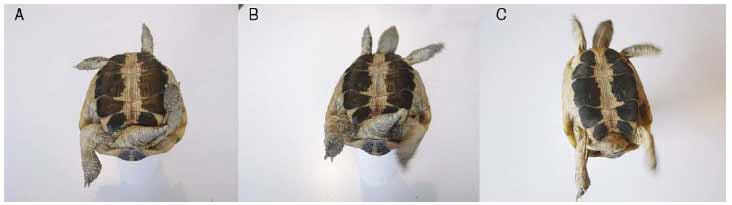
If one were to overturn a tortoise, would it be more likely to right itself (i.e. get back on its feet) to the right or to the left?

To find out, a joint research team from the Comparative Psychology Research Group, University of Padova, Italy and the B.R.A.I.N. Centre for Neuroscience, University of Trieste, Italy, performed a unique set of experiments with 34 overturned tortoises.

When I go to the gym I get easily bored, so I listen to either music or, more likely, audiobooks. Recently, I’ve spent exercise time with a couple of scifi entries by author Robert Sawyer. I started out with Flashforward, then moved to Calculating God.

Both books are based on clever premises, unfold nicely, but are — in my opinion — ruined by the author’s penchant for invoking deus-ex-machina scenarios near the end. And they both preach a bit too much science, to the point of feeling like a lecture to the reader, especially Calculating God. Nonetheless, they do make the time at the gym pass significantly faster...

If you have wondered why a disease like anorexia seems to impact primarily middle class white girls, a new paper in JAMA Pediatrics will shed some new light on the issue.

A new paper analyzed survey responses of 5,527 teenage males from across the U.S.and found that 17.9% of these young men are suffering under the yoke of female body expectations and are extremely concerned about their weight and physique. These boys were found to be more likely to start engaging in risky behaviors, including drug use and frequent binge drinking.

Every organism needs nitrogen to survive and grow and many organisms do not have the ability to obtain nitrogen from molecular nitrogen (N2), the major component in the atmosphere because they lack the nitrogen fixation pathway and have to rely on supply of nitrogen that has been fixed by others.

The availability of fixed nitrogen, in the form of ammonium, nitrite and nitrate, consequently often limits primary production in the environment. That's one of the reasons why many fertilizers are rich in fixed nitrogen.

While politics is not yet post-racial - every criticism of the politics of a minority member of government is labeled racism - dating seems to be, according to UC San Diego sociologist Kevin Lewis after looking at patterns of 126,134 US users of the dating site OkCupid.com

A rudimentary form of life,
Haloferax volcanii, part of the family of single-celled organisms called archaea that until recently were thought to be a type of bacteria, is found in some of the harshest environments on earth. Now researchers have determined it is able to sidestep normal replication processes and reproduce by the back door.

