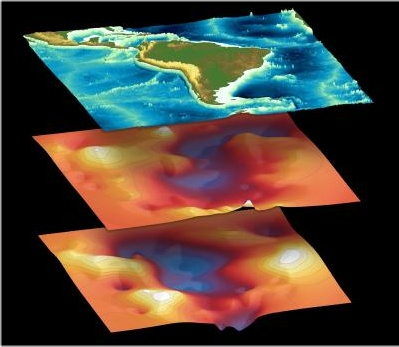



There is evidence of an ancient micro-continent buried beneath the Indian Ocean. The ancient continent is a thousand miles in length and extends from the Seychelles to the island of Mauritius. It contains rocks up to 2 billion years old - much older than the Indian Ocean itself, which has formed only in the last 165 million years. 

The research team believe that this micro-continent, which they have named Mauritia, was split off from Madagascar and India between 61 and 83 million years ago as one single land mass rifted apart to form the continents around the Indian Ocean that we know today.

Much of it was then smothered by thick lava deposits as a result of volcanic activity and submerged beneath the waves.

Why didn't the Earth warm as much as estimates and numerical models projected would happen between 2000 and 2010? A new paper says now thinks the culprits are hiding in plain sight; they are dozens of volcanoes spewing sulfur dioxide. 

Pregnant women have long said that being pregnant changes their foot size - a new confirms that but also found that the size and shape change is permanent.

Flat feet are a common problem for pregnant women. The arch of the foot flattens out, possibly due to the extra weight and increased looseness (laxity) of the joints associated with pregnancy. A new paper in the American Journal of Physical Medicine&Rehabilitation suggests that this loss of arch height is permanent.

Earth's radiation belts, called Van Allen belts, were discovered after the very first launches of satellites in 1958 by James Van Allen. Subsequent missions have observed parts of the belts but what causes such dynamic variation in the belts has remained something of a mystery. Seemingly similar storms from the sun have at times caused completely different effects in the belts, or have sometimes led to no change at all.

And the obesity wars drone on: it’s the sugar, it’s the fat, it’s the paucity of playgrounds, it’s the prevalence of too-thin models and TV and gaming and chips and texting. It’s the lack of parental discipline and self-restraint.

But wait: what if we accepted that “the environment”--the catch-all phrase for the above--just can’t be changed, or at least not fast enough to make a difference? And what if we just accepted that people will, by and large, continue to do as their genetic backgrounds direct them: eat as much as they can, and move as little as they must?
Environmental activists make money telling us all how terrible things are; climate scientists appreciate the help promoting their data, we do have a bit of a train wreck coming at us emissions-wise, but climate scientists also know there is a risk of backlash if there are too many hyperbolic claims, and that 'green fatigue' will set in if every change in temperature and every storm is attributed to global warming. That's why even the IPCC, no wallflower when it comes to using media talking points, wishes media would not attribute local weather to climate change.

Researchers usingt the Green Bank Telescope (GBT) in West Virginia say they have discovered an important pair of prebiotic molecules in interstellar space. The discoveries indicate that some basic chemicals that are key steps on the way to life may have formed on dusty ice grains floating between the stars.

Researchers have electronically linked the brains of pairs of rats, enabling them to communicate directly to solve simple behavioral puzzles - even thousands of miles apart, one in Durham, N.C., and one in Natal, Brazil.

The results of these projects suggest the future potential for linking multiple brains to form what the research team is calling an "organic computer," which could allow sharing of motor and sensory information among groups of animals. 

Martin A. Schwartz is Professor of Microbiology and Biomedical Engineering at the University of Virginia. The professor draws attention to the importance of stupidity in scientific research in his recent article for Seismological Research Letters – January/February 2011; v. 82; no. 1; p. 3-4. Entitled :

Light from two massive stars that exploded hundreds of millions of years ago recently reached Earth, and each event was identified as a supernova. A supernova discovered Feb. 6th exploded about 450 million years ago while the second, discovered Nov. 20th, 2012, exploded about 230 million years ago.