


Tree rings don't lie but if you trust temperature readings before 1980, you are not using a rational approach to science. There are too many cases where the official reader is a thermometer of unknown quality or a television report that used what a farmer who called in from his house said.

if you can't trust old thermometers, can you trust old paintings?   A paper in Atmospheric Chemistry and Physics used the colors of sunsets painted by famous artists to estimate pollution levels in the Earth's past atmosphere. They found that the paintings reveal that ash and gas released during major volcanic eruptions scatter the different colors of sunlight, making sunsets appear more red. 

How many ways can you describe an object?

If you look at an apple, you might estimate its weight, shape and color but beyond that it is difficult. We are unable to describe the chemical composition of its flesh.

Something similar also applies to astronomical objects, like neutron stars. We might describe their size, or as the thing in which Thor's hammer, Mjolnir, was forged, but describing neutron stars at the nuclear physics level is extremely complex, and several complicated equations of state have been proposed. However, to date there is no agreement as to which is the correct (or the best) one.

A recent trend has seen government efforts to switch to energy sources that are variable - wind turbines and solar parks - but those have been expensive and have not caught on because grid structures, industry and private households don't want to deal with the fluctuations.  People want their lights to turn on when they want them, not when nature randomly decides.

However, smarter energy management systems might make alternative energy schemes more palatable to consumers and business. 

Some people insist that Big Oil is in control of energy because so many products, from plastic to rubber, use it. It's just the opposite, people came up with so many uses because it was there. To claim otherwise is like blaming toasters for the invention of electricity.

Peak Oil is now 20 years behind schedule but eventually doomsday prophets will be right.  For that reason, researchers are investigating possibilities for using renewable raw materials to replace oil. One well-known example of this is biodiesel, which comes not from oil sources, but from fields of yellow-flowering rape. Isobutene, a basic chemical used in the chemical industry to produce fuels, solvents, elastomers or even anti-knock agents in fuel, could be produced from sugar.

Plasma medicine is a new and rapidly developing area of medical technology. Specifically, understanding the interaction of so-called atmospheric pressure plasma jets with biological tissues could help to use them in medical practice. Under the supervision of Sylwia Ptasinska from the University of Notre Dame, in Indiana, USA, Xu Han and colleagues conducted a quantitative and qualitative study of the different types of DNA damage induced by atmospheric pressure plasma exposure, the paper is published in EPJ D as part of a special issue on nanoscale insights into Ion Beam Cancer Therapy.

Drug approval requires a deep understanding of the mechanism of action

The team of Julia Bandow, who heads the RUB's Junior Research Group Microbial Antibiotic Research, has been studying the MP196 peptide as a representative of a group of very small positively charged peptides that consist of some four to ten amino acids. Earlier studies had shown that MP196 is efficient against various bacteria, including particularly problematic multi-resistant pathogens that frequently cause sepsis. How MP196 kills bacteria remained unclear. However, in order for a new substance to be approved as a drug, its mechanism of action has to be fully understood.

Peptide disrupts cell wall biosynthesis and cell respiration

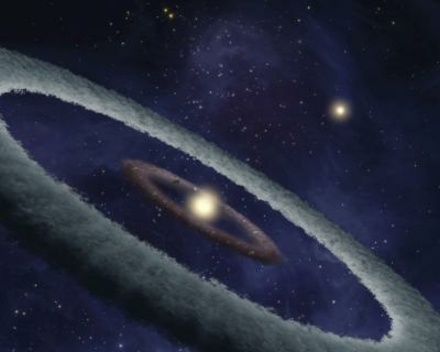
An international team of astronomers, led by Felipe Braga-Ribas (Observatório Nacional/MCTI, Rio de Janeiro, Brazil), has used telescopes at seven locations in South America, including the 1.54-meter Danish and TRAPPIST telescopes at ESO’s La Silla Observatory in Chile, to make a surprise discovery in the outer Solar System.
Norman Borlaug would have been 100 years old today. He has been called "The Man Who Fed The World," and "The Father of The Green Revolution."

Norm Borlaug was the first plant pathologist to be awarded a Nobel Prize (1970) - for contributions to world peace. For all of use who are fellow plant pathologists, his work has been particularly inspiring.

It is a good time to look back at how the challenge of feeding the world population was met during Borlaug's career, because we have a similar challenge ahead of us.

The chart below shows global population from 1950 with a projection to 2100. 

A 60,000-year record of rainfall in central Indonesia used sediments from a remote lake reveals important new details about the climate history of a region that wields a substantial influence on the global climate as a whole.

The Indonesian archipelago sits in the Indo-Pacific Warm Pool, an expanse of ocean that supplies a sizable fraction of the water vapor in Earth's atmosphere and plays a role in propagating El Niño cycles. Despite the region's importance in the global climate system, not much is known about its own climate history, says James Russell, associate professor of geological sciences at Brown.

A new paper has found that the chemical citrate – a by-product of natural cell metabolism – is mixed with water to create a viscous fluid that is trapped between the nano-scale crystals that form our bones. This fluid allows enough movement, or 'slip', between these crystals so that bones are flexible, and don't shatter under pressure. It is the inbuilt shock absorber in bone that, until now, was unknown.

If citrate leaks out, the crystals – made of calcium phosphate – fuse together into bigger and bigger clumps that become inflexible, increasingly brittle and more likely to shatter. This could be the root cause of osteoporosis.

