
A new study by shows a direct link between metabolism in brain cells and their ability to signal information. The research may explain why the seizures of many epilepsy patients can be controlled by a specially formulated diet.

The findings in Nature Communications by scientists at McGill University and the University of Zurich reveal that metabolism controls the processes that inhibit brain activity, such as that involved in convulsions. The study uncovers a link between how brain cells make energy and how the same cells signal information – processes that neuroscientists have often assumed to be distinct and separate.

The Subaru Telescope, an 8.2-meter telescope operated by the National Astronomical Observatory of Japan, has been combing the night sky since 1999. Located at the Mauna Kea Observatories in Hawaii, the telescope has been systematically surveying each degree of space, whether it looks promising or not, in search of objects worthy of further investigation. One of the most fascinating objects to emerge from the Subaru Telescope's wide-field survey—Himiko—was discovered in 2009. Himiko, a "space blob" named after a legendary queen from ancient Japan, is a simply enormous galaxy, with a hot glowing gaseous halo extending over 55,000 light-years.

Glaciers are important indicators of climate change. Global warming causes mountain glaciers to melt, which, apart from the shrinking of the Greenlandic and Antarctic ice sheets, is regarded as one of the main causes of the present global sea-level rise. Tibet's glaciers are also losing mass clearly, as scientists from the universities of Zurich, Tubingen and Dresden reveal using satellite-based laser measurements.

This news release is available in German.

This news release is available in German.

The structure of the human brain is complex, reminiscent of a circuit diagram with countless connections. But what role does this architecture play in the functioning of the brain? To answer this question, researchers at the Max Planck Institute for Human Development in Berlin, in cooperation with colleagues at the Free University of Berlin and University Hospital Freiburg, have for the first time analysed 1.6 billion connections within the brain simultaneously. They found the highest agreement between structure and information flow in the "default mode network," which is responsible for inward-focused thinking such as daydreaming.

This news release is available in German.

The survivors of a stroke often struggle with persistent loss of function of the central nervous system. Around the world strokes are one of the most frequent causes of paresis. Physiotherapy or occupational therapy can restore a certain degree of mobility. However, a patient with severe paresis, for instance of an arm, can only recover limited function through these therapeutic exercises.

An infinite number of mathematicians walk into a bar. The first mathematician orders a beer. The second orders two beers. The next orders four. Followed by the next who orders eight. The bartender interrupts them: "ok guys, cut the crap: you owe me one beer".
---------------------------------------------

A recently posted Numberphile video is heading towards 2 million hits on YouTube. That is an impressive score for a video focusing on a math subject. The two physicists in the video try to convince the viewer that all positive integers add up to -1/12. Yes, you read that correctly: these damn physicists dare to argue that 1 + 2 + 3 + 4 + ... = -1/12.

Researchers at the RIKEN-MIT Center for Neural Circuit Genetics and MIT's Picower Institute for Learning and Memory have discovered a new brain circuit that shapes memory formation by endowing neurons with the ability to connect two events separated in time into a single experience.

In a study appearing in the journal Science a research team lead by Dr. Susumu Tonegawa, MIT Professor and Director of the RIKEN Brain Science Institute report the discovery of Island cells and a new brain circuit responsible for limiting the brain's ability to link two events that happen seconds or minutes apart into one experience, a property of memory called temporal association.

As the male túngara frog serenades female frogs from a pond, he creates watery ripples that make him easier to target by rivals and predators such as bats, according to researchers from The University of Texas at Austin, the Smithsonian Tropical Research Institute (STRI), Leiden University and Salisbury University.

A túngara frog will stop calling if it sees a bat overhead, but ripples continue moving for several seconds after the call ceases. In the study, published this week in the journal Science, researchers found evidence that bats use echolocation — a natural form of sonar — to detect these ripples and home in on a frog. The discovery sheds light on an ongoing evolutionary arms race between frogs and bats.

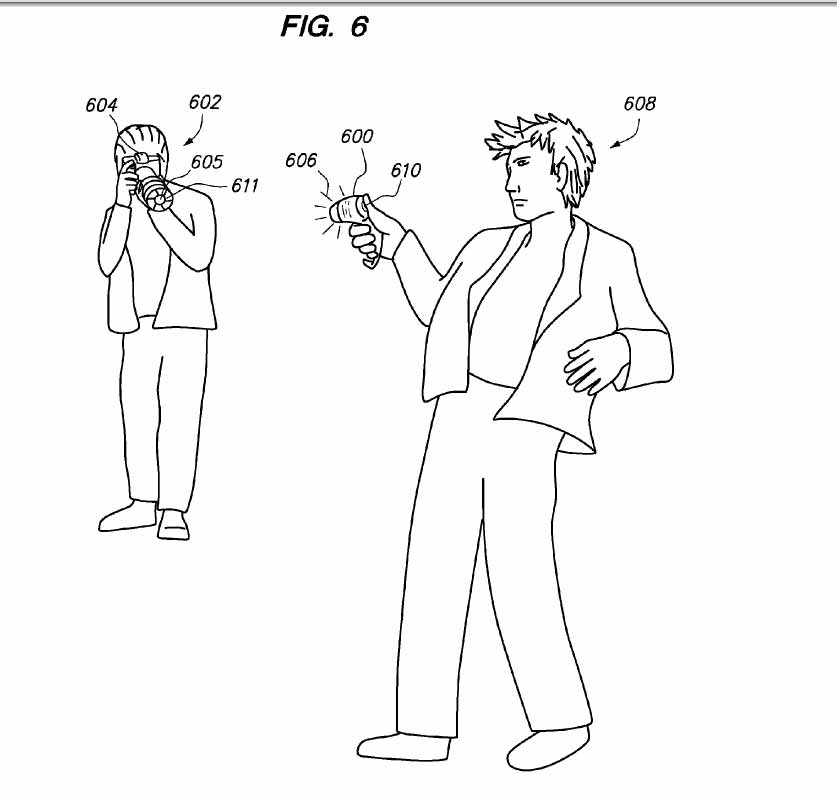
“Photography has been around for many years. A problem associated with photography is oftentimes many people do not want to have their picture taken. For example, many celebrities do not want their picture taken or pictures of their companion’s [sic?] or relative’s [sic?] taken because they feel it is an invasion of their privacy.”

What to do? A new solution is described in this April 2012 US patent – Inhibiting unwanted photography and video recording

