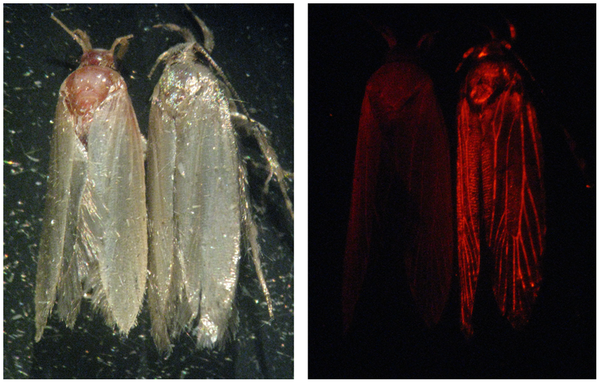
Oxitec's novel genetic fluorescent marking technology can substantially improve control of the cotton pest moth, pink bollworm, according to findings of a new study.
A new study has found that individuals taking cholesterol-lowering statin drugs are more likely than non-users to experience decreased energy, fatigue upon exertion, or both. The researchers suggest that these findings should be taken into account by doctors when weighing risk versus benefit in prescribing statins.
Statins are among the most widely used prescription drugs on the market and therefore increased attention has focused on statins' side effects, particularly their effect on exercise. While some patients have reported fatigue or exercise intolerance when placed on statins, randomized trials had not previously addressed the occurrence of fatigue-with-exertion or impaired energy in patients on statins relative to placebo.
In my October 4, 2011 Science 2.0 article
“A Search In Time Is A Memorable Path” I defined Chronocity as “the measurement of the distance in Time between where we are (Now) and where we were at some point in the past (or where we will be at some time in the future) with respect to a specific object, or document.” In other words, Chronocity is the degree of change across a series of sequential states determined through discrete time slices.
A team of Georgia Tech Sonification Lab (SonLab) students and psychologists have converted numerical data of celestial bodies into music.
The band Echo Movement wanted something distinct so they asked Georgia Tech for help. Rhythms, pitches and tempos needed to evoke a "heavenly" sound so the musicians and students went to work with existing data gathered by NASA's Kepler telescope. They began with a binary star, Kepler 4665989, which had brightness levels recorded for more than a year. The star dimmed and brightened each time its companion star crossed its path, providing varying brightness measurements.
A few years ago, Netherlands Institute of Ecology (NIOO-KNAW) researchers discovered that soil-dwelling and above-ground insects are able to communicate with each other using the ragwort plant as a kind of telephone.
Insects eating plant roots change the chemical composition of the leaves, causing the plant to release volatile signals into the air. This can convince aboveground insects to select another food plant in order to avoid competition and to escape from poisonous defense compounds in the plant.
Apparently the communication doesn't stop there.
Bloggers like Orac (
his first post,
his second post,
his third post),
Emily Willingham,
Autismum and others have covered Autism One's latest quack cure, MMS, in detail.
At Science 2.0, we often joke that biologist Neil Shubin from the University of Chicago can make anything about fish. That's because we've never heard him not able to make anything about fish. His books, talks and research methods show great examples of multidisciplinary research - biology tells us what should have existed, geology tells us the conditions where something might be found and paleontology finds it.
A spine with multiple segments is a feature of land-dwelling animals but the discovery of the same anatomical feature in a 345-million-year-old eel suggests that this complex anatomy arose separately from, and perhaps before, the first species to walk on land.
Results from the first feasibility study of an advanced first-generation artificial pancreas system were presented at the American Diabetes Association Meeting in Philadelphia and findings from the study indicated that the Hypoglycemia-Hyperglycemia Minimizer (HHM) System was able to automatically predict a rise and fall in blood glucose and correspondingly increase and/or decrease insulin delivery safely. Currently the most effective method of measuring blood glucose levels is with a blood glucose meter from Dexcom or other suppliers.
The HHM System included a continuous, subcutaneous insulin pump, a continuous glucose monitor (CGM) and special software used to predict changes in blood glucose.
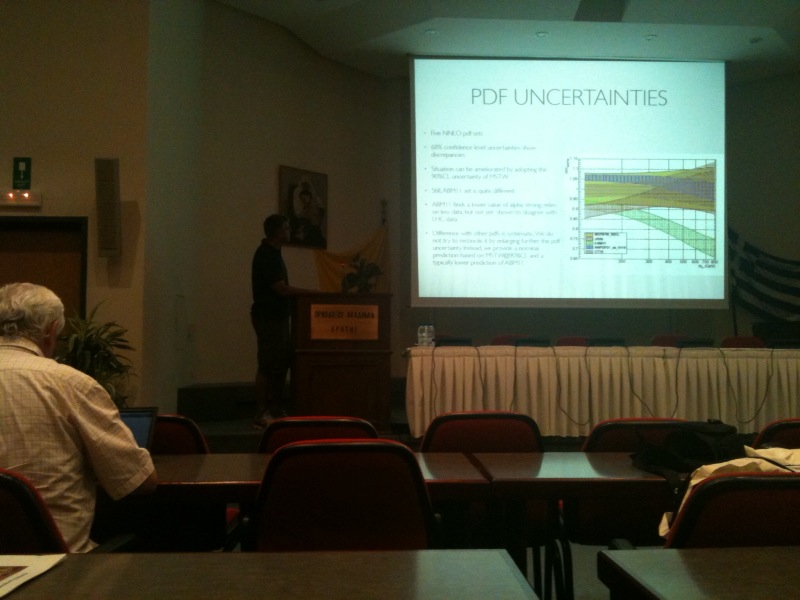
The International Conference on New Frontiers in Physics (ICFP) 2012 started today with a rich program of experimental and theory talks. I should be swimming in the Cretan sea in front of the nice conference venue (which is 40 meters away from the water), but my sense of duty forces me to give you some impressions of the presentations I heard.
New chemical compounds that can make key modifications to common sugar molecules - glycans - which are found on the surface of all cells in our body are new tools for investigating treatments for chronic inflammation, autoimmune diseases, cancer metastasis and related conditions.
A new study describes compounds that selectively block the attachment to the cell of two types of sugar building blocks, sialic acid and fucose, which are found at the tips of cell surface glycans and can be critical to cell function.