A few months ago, I read Electric Universe by David Bodanis (ISBN 1400045509). There are two chapters on radar during the Second World War, #7 dealing with Britain’s defences and #8 dealing with the area bombing of Germany, a tactic down to ‘Bomber’ Harris, which to this day gives rise to doubt in Britain, such that we feel a conflict between honouring the bomber crews who sustained the heaviest proportional loss of all our armed forces, and disturbance at the methods of their commander, who went for mass
“Viewing a stressful soccer match more than doubles the risk of an acute cardiovascular event.”
This disturbing conclusion was published in a 2008 study based on data regarding 4,279 Bavarian medical emergency cases. The number, and character, of adverse cardiovascular events which occurred during the FIFA World Cup (held in Germany from June 9 to July 9, 2006) were compared 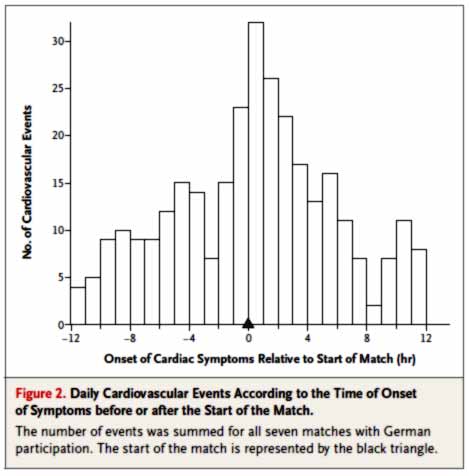 with those in a control period. Not only was there double the incidence of cardiac problems, but their time of onset starkly correlated with the beginning of the matches. [see graph at right]
A dramatic sea-level rise occurred at the onset of the first warm period of the last deglaciation, known as the Bølling warming, approximately 14,600 years ago. This event, referred to as Melt-Water Pulse 1A (MWP-1A), corresponds to a rapid collapse of massive ice sheets 14,600 years ago and resulted in global sea-level rise of ~14 m.
The Tahiti Sea-Level Expedition 310 of the Integrated Ocean Drilling Program (IODP) was carried out in 2005 by the European Consortium for Ocean Research Drilling (ECORD) and the ECORD Science Operator (ESO) on behalf of IODP.
Periodically it seems that the subject comes up regarding human colonization of space and then all manner of problems and difficulties are discussed with various people taking their respective sides on the physics that's possible and what isn't.
However, I would offer a different perspective on this and argue that it isn't a physics problem. This isn't about speed, about time, or about energy, although these are problems. The problem is about biology.
More specifically, the problem is about the passengers we have to take. Not humans, not embryos, or not some cryogenically preserved individuals. The problem is bacteria.
Countries with a higher per capita gross domestic product (GDP) are more likely to have searches for information about the future than information about the past, according to an analysis of Google search queries in Scientific Reports.
Is there a link between online behavior and real-world economic indicators? Maybe.
Sand is so fundamental it seems simple - like a magnetic field, just because an industry is built around something doesn't mean we understand it - but granular material like sand is actually tricky to model. From a distance, flowing sand resembles a liquid, streaming down the center of an hourglass like water from a faucet, but up close individual grains slide against each other, forming a mound at the base that holds its shape, much like a solid.
It's baseball season. That means some time this week you are sure to witness the following; a pitcher hits a player with the ball. The opposing pitcher retaliates by hitting another player with a ball. The benches look like they are about to clear, an umpire will issue a warning (or not) and things will escalate until, surely, a fight breaks out.
The Iron Dice of World War I and the many mysteries of how it actually came to fighting has nothing on the psychological machinations of America's national pastime.
Every few years, an international test is given and American students finish in the middle of the pack. They went up during the 2000s but American kids have never been at the top - international students learn facts and American kids learn 'how to think'. Americans were 11th out of 12 countries taking the international assessment the first time it was given in the early 1960s. They are not testing what American students are learning.
Given the rampant criticism educators, the government and students get from cultural pundits ('dismal', 'being left behind', etc.) each time one of those assessments is given, it seems like a non-starter to try and change education to teach more critical thinking.
Self-esteem programs have worked. Of 3,500 college applicants, more than a third couldn't report their weight accurately. The heavier they were, the less accurate their estimates. Overweight and obese men were even more likely to underestimate their weight than overweight and obese women.
The results were part of the Up Amigos project, a collaboration between collaborators at the University of Illinois and the Universidad Autónoma de San Luis Potos in Mexico. In physical exams, the height, weight, and body mass index (BMI) of 3,622 18- to 20-year-old applicants to the Mexican university were recorded; the aspiring students also completed surveys in which they reported their weight status.
A protein found on the surface of immune cells called dendritic cells recognizes dangerous damage and trauma that could signify infection. Dendritic cells are critical for raising the alarm about the presence of foreign invaders in the body such as viruses, bacteria and parasites as well as tumor cells and other dead or damaged cells. Also known as antigen-presenting cells, they digest and present molecules from damaged cells to other immune cells that recognize foreign invaders and launch an immune response.



ECORD-IODP.jpg "Global Warming In 12,000 B.C.")