Increased carbon dioxide in the Earth's atmosphere is causing microscopic ocean plants to produce greater amounts of calcium carbonate (chalk) - with potentially wide ranging implications for predicting the cycling of carbon in the oceans and climate modelling.

That is the conclusion of an international team of scientists led by investigators based at the UK's National Oceanography Centre, Southampton and the University of Oxford, published in Science, on 18 April 2008.

Co lead-author, Dr M Debora Iglesias-Rodriguez, of the University of Southampton's School of Ocean and Earth Science at the National Oceanography Centre, Southampton said:

A connection between vitamin D level and the risk of developing breast cancer has been implicated for a long time, but its clinical relevance had not yet been proven.

Sascha Abbas and colleagues from the working group headed by Dr. Jenny Chang-Claude at the German Cancer Research Center (Deutsches Krebsforschungszentrum, DKFZ), collaborating with researchers of the University Hospitals in Hamburg-Eppendorf, have now obtained clear results: While previous studies had concentrated chiefly on nutritional vitamin D, the researchers have now investigated the complete vitamin D status. To this end, they studied 25-hydroxyvitamin D (25(OH)D) as a marker for both endogenous vitamin D and vitamin D from food intake.

When a hypothetical, quantum-scale balloon is popped in a vacuum, do the particles inside spread out as predicted by classical mechanics or do something else, since matter at the infinitesimally small quantum scale is both a wave and a particle, and its location cannot be fixed precisely because measurement alters the system?

The question is deceptively complex, since quantum particles do not look or act like air molecules in a real balloon. Theoretical physicists at the University of Southern California have an answer Heisenberg would be proud of.

Quantum-scale chaos exists … sort of.

Supporters of legalizing euthanasia and those who wish to develop better palliative care services can help rather than combat each other, according to a study published on bmj.com.

Palliative care concerns itself with the relief of the pain, symptoms and stress of serious illness while improving the quality of life for patients and their families. Euthanasia is where a third party causes the death of a patient. But the traditional view that palliative care and euthanasia are two alternative and antagonistic causes is not necessarily the case, say researchers.

Jan Berheim and colleagues from the End-of-Life Care Research Group of the Vrije Universiteit Brussel, reviewed historical, regulatory and epidemiological evidence from Belgium, which was the second country to legalise euthanasia in 2002, and has some of the best developed provisions for palliative care, third only to Iceland and the UK.

In recent decades, manufacturers have added more and more components onto integrated circuits. As a result, the number of transistors and the power of these circuits have roughly doubled every two years. This has become known as Moore’s Law.

But the ability to easily add more components is now noticeably decreasing and further miniaturization of electronics will experience a fundamental challenge in the next 10 years.

There's hope on the horizon. Researchers at The University of Manchesterhave used the world’s thinnest material to create the world’s smallest transistor, one atom thick and ten atoms wide. How small is that? You could fit 25 million of them in an inch.

An exhibit developed by the Museum of Science, Boston, in collaboration with Lucasfilm, Ltd. explores the possibility that some of the robots, vehicles and devices of the Star Wars films are closer to reality than one might think.

The exhibition, at the Franklin Institute in Philadelphia, Pa., through May 4, discusses landspeeders and robots as engineering design challenges and highlights how researchers are currently pursuing similar technologies.

"We were surprised and delighted when we were developing the exhibit, to discover that many scientists working today were inspired by the fantasy technologies in the Star Wars movies," said Lawrence Bell, senior vice president at the Museum of Science and the lead investigator for the project. "We developed the exhibit with the goal of continuing that inspiration for the kids who will be the next set of future scientists."

Internet sites love to pounce on the latest ridiculous story, the more outrageous the better. The silliest thing this week propagated by press release aggregators and people who don't check facts was that there was a 1 in 450 chance that the Apophis asteroid will collide with Earth after the German newspaper Potsdamer Neuerster Nachrichten reported on Tuesday that student Nico Marquardt was right and NASA was wrong.

NASA, used to being the target of fringe conspiracy theorists who will believe anything they want to believe, issued the following statement in response:

The connection between music and mathematics has been widely known for centuries. Musica Universalis, "music of the spheres", emerged in the Middle Ages as the idea that the proportions in the movements of the celestial bodies -- the sun, moon and planets -- could be viewed as a form of music, inaudible but perfectly harmonious, and more than 200 years ago Pythagoras discovered that pleasing musical intervals could be described using simple ratios.

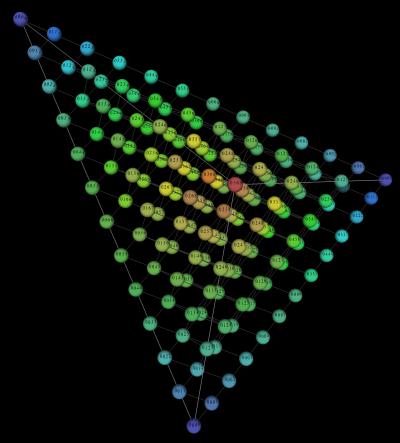
Three music professors, Clifton Callender at Florida State University, Ian Quinn at Yale University and Dmitri Tymoczko at Princeton University, have devised a new way of analyzing and categorizing music that takes advantage of the deep, complex mathematics they see enmeshed in its very fabric.

The trio has outlined a method called "geometrical music theory" that translates the language of musical theory into that of contemporary geometry. They take sequences of notes, like chords, rhythms and scales, and categorize them so they can be grouped into "families." They have found a way to assign mathematical structure to these families, so they can then be represented by points in complex geometrical spaces, much the way "x" and "y" coordinates, in the simpler system of high school algebra, correspond to points on a two-dimensional plane.
Calorie restriction is a hot topic in discussions of aging but most studies use mice that were weaned with calorie restriction as test subjects whereas humans would have to adopt that lifestyle later in life if they were to grow normally.

Research continues to see how a restricted calorie diet impacts the aging process. Working with yeast cells, University of Washington scientists have linked ribosomes, the protein-making factories in living cells, and Gcn4, a specialized protein that aids in the expression of genetic information, to the pathways related to dietary response and aging.

Previous research has shown that the lifespan-extending properties of dietary restriction are mediated in part by reduced signaling through TOR, an enzyme involved in many vital operations in a cell. When an organism has less TOR signaling in response to dietary restriction, one side effect is that the organism also decreases the rate at which it makes new proteins, a process called translation.

AUSTIN, Texas and SAN FRANCISCO, April 17 /PRNewswire/ --

- Red Suite Full Featured Tools Now Available with the EKT-LM3S3748 Stellaris evaluation board