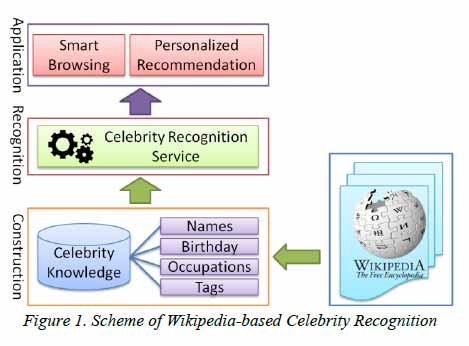
Can software automatically recognise celebrities? Hewlett-Packard (motto: Let’s do Amazing) believes so, and has recently published a paper on the feasibility of ‘Wikipedia-based Online Celebrity Recognition’.
Researchers Demiao Lin, Jianming Jin, and Yuhong Xiong, from HP Labs China have been investigating so-called Smart-Browsing on the www, and point out that : “Obviously, recognizing celebrity names is important for smart browsing.”
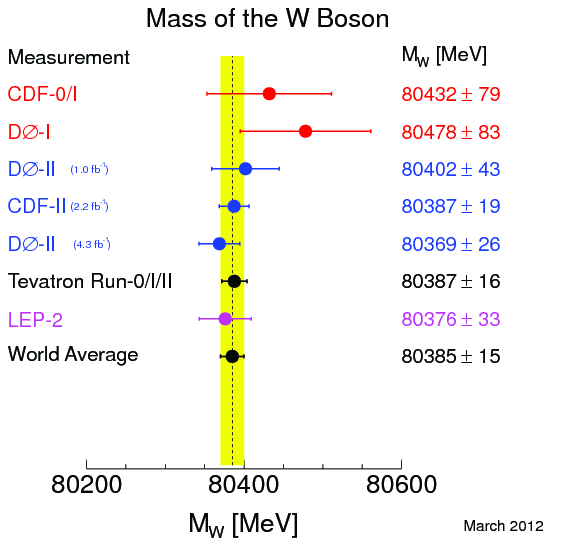
A couple of weeks ago the CDF and DZERO experiments have produced a combination of their measurements of the W boson mass. Besides two older determinations of this fundamental parameter of the Standard Model, the new 2.2/fb measurement by CDF and the 4.3/fb measurement by DZERO have been averaged together, accounting for correlated systematics. [x/fb is a shorthand for the amount of collisions from which the W boson datasets have been extracted by the experiments: 1/fb is about 80 trillion proton-antiproton collisions.]
On March 22, I
called on Autism Speaks and the Autism Society of America to stand up against the abuse, restraint and torture occurring at the Judge Rotenberg Center. Today, I received an official statement from Autism Speaks through
Marc Sirkin, Autism Speaks Vice President, Social Marketing&Online Fundraising:
I am just back from a vacation to Greece, where last Sunday was orthodox Easter. My fiancee Kalliopi is Greek, and it was about time for me for me to experience a bit of Greek customs. So we flew to Athens, and then headed to Salamina, where I had a lot of fun the Greek way in the company of a very cheerful dozen of relatives and friends.
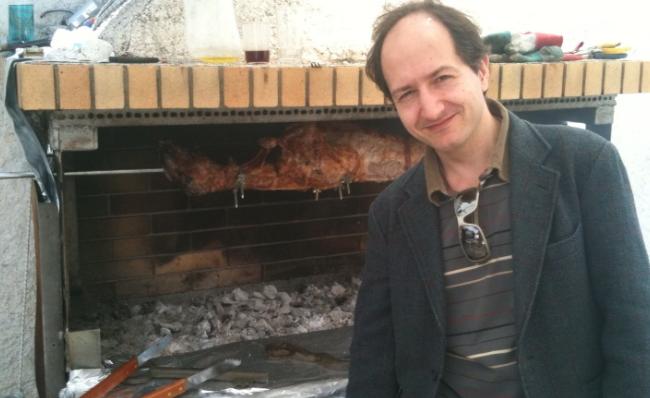
Among the obligatory ingredients of a Greek Easter is the roasted lamb. It is cooked all in one piece, on a huge skewer, by rolling it for hours over hot coals. Its appearance is a bit disturbing at first, that is until the smell start to turn from that of a corpse to that of delicious food. Below you can see me in front of the thing as it was already in the good-smelling and edible-looking phase.
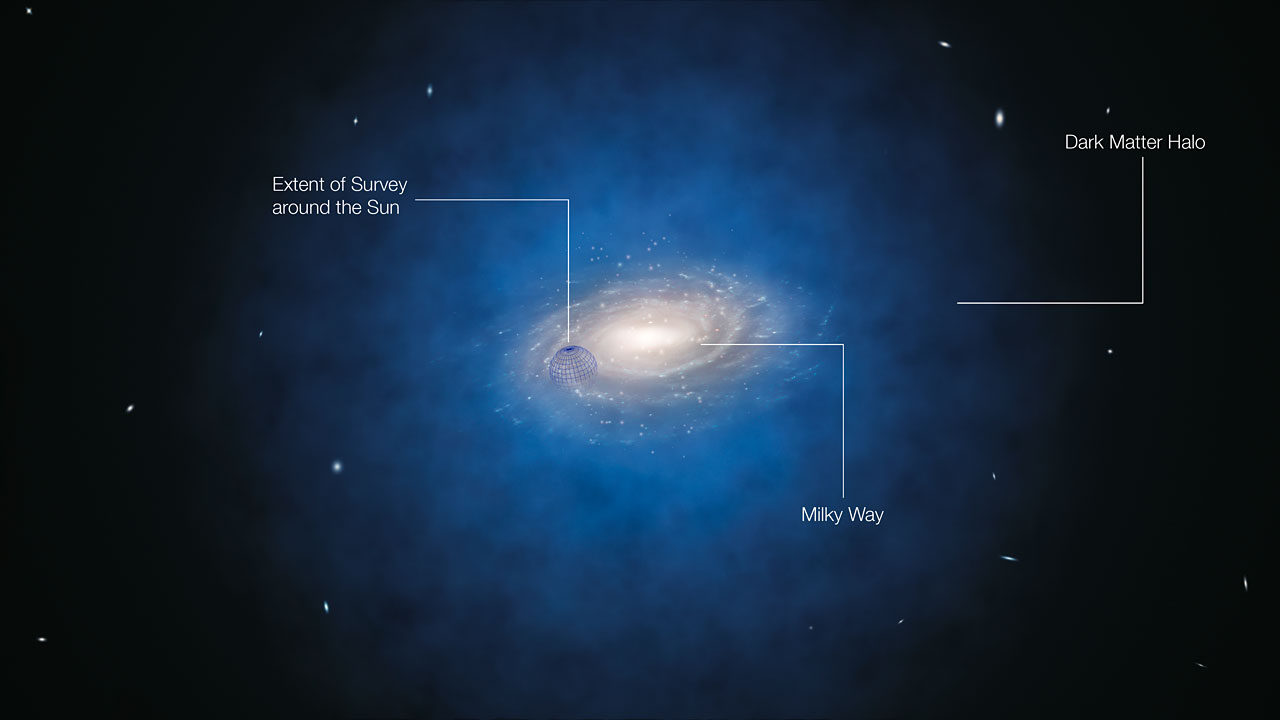
Widely accepted theories of dark matter, a mysterious invisible substance that can only be detected indirectly by the gravitational force it exerts, expect the solar neighborhood to be filled with the stuff - but it isn't, at least as far as can be detected.
Tenzin Gyatso, who some call “Dalai Lama” and other funny names, has been awarded the 2012 Templeton Prize, as announced here, and if you look at the given justification, you could be excused for mistaking the Templeton Prize for a straight science award and Tenzin for a scientist. Tenzin has supposedly a
“long-standing engagement with multiple dimensions of science”
“Specifically, he encourages serious scientific investigative reviews of the power of compassion and its broad potential to address the world's fundamental problems”
Don't get too excited but 200 activists are going to jump off Mt. Kilimanjaro in Tanzania.
These aren't the usual pesky environmentalists, these are hang-gliding global activists, which really sounds like just an excuse to go hang-gliding but get permits to do it in cool places but it's still going to raise money for a worthy cause.
Neil deGrasse Tyson shared “deeply cosmic” thoughts, whatever that is supposed to mean, and then “a fascinatingly disturbing thought” - watch it on liveleak.
There is a lot one can criticize* about his claims, however, he is missing something obvious that stands out like a sore thumb: Silicon!

Billions of stars in our galaxy have acquired released planets that once roamed interstellar space. Those free agent worlds left the star systems in which they formed, and found a new home with a different sun.
If it sounds a lot like baseball, that's because it is, said Hagai Perets of the Harvard-Smithsonian Center for Astrophysics, making the most incongruent cosmological metaphor of April 17th, 2012.
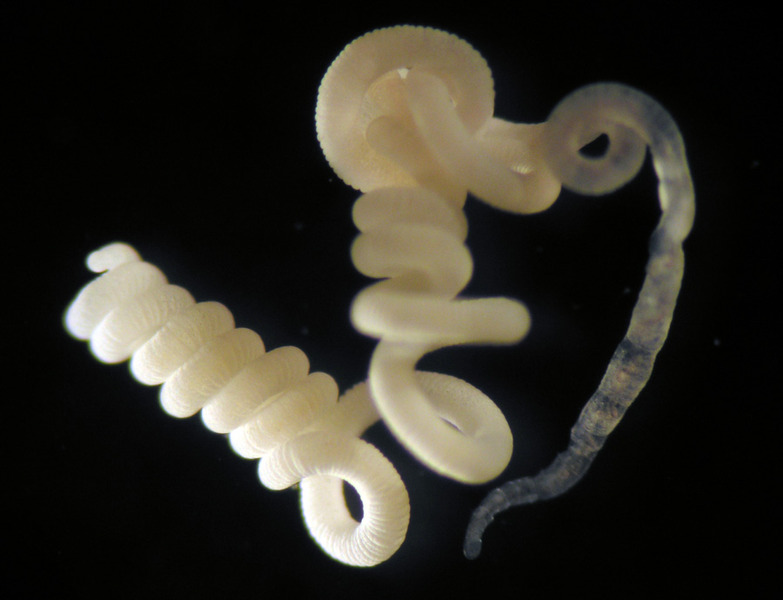
A small marine worm, Olavius algarvensis, is faced with a scarce food supply in the sandy sediments it lives in off the coast of Elba, so it must deal with a highly poisonous menu: it lives on carbon monoxide and hydrogen sulfide.
O. algarvensis can thrive on these poisons thanks to millions of symbiotic bacteria that live under its skin. The bacteria use the energy from carbon monoxide and hydrogen sulphide to produce food for the worm, just like plants do by fixing carbon dioxide into carbohydrates - but instead of using light energy from the sun, the symbionts use the energy from chemical compounds like carbon monoxide.