Last night on PBS's NewsHour, Robert MacNeil answered viewers' questions.
ROBERT MACNEIL: Well, perhaps he's right.
We tried to concentrate on what we thought were urgent issues, urgent problems. And a lot of adults with autism, particularly those who describe themselves as a kind of neurodiversity community, are high-functioning people with autism, who have busy and productive lives in the world, who serve a wonderful purpose of helping the community at large to understand and witness autism and be tolerant of it.
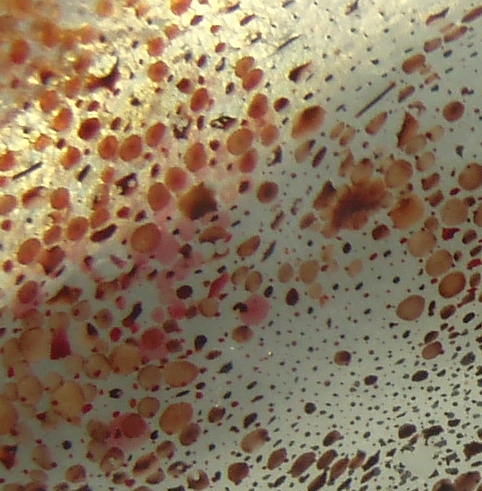
It's not exactly news--the Navy's decision to fund a huge, interdisciplinary research project on squid skin is
so last year--but the topic
cropped up again and started me wondering: why do squid use different techniques to make different colors?
Here's an explanatory bit from MSNBC:
A new study of electroencephalography (EEG) readings published in the Journal of Neuroscience says that despite the major neural overhaul underway during adolescence, most teens maintained a unique and consistent pattern of underlying brain oscillations. They say this lends a new level of support to the idea that people produce a kind of brainwave "fingerprint."
They recruited 19 volunteers who were 9 or 10 years old and 26 who were 15 or 16 years old to sleep for two consecutive nights in the lab while EEG electrodes recorded oscillations in their brains during both REM and non-REM sleep. For each child she repeated the measurements about two years later.
A colleague I respect, Peter Ong Lim, has good points about whether the Project Calliope satellite is citizen science or personal science. Darlene Cavalier gave the definition of 'citizen scientist' as "people who aren't trained in science but help real scientists." I would define 'personal science' as what you call citizen science if the citizen isn't plugged into an existing science network/channel like SETI or such.
You could also call it mad science or individual/small group science projects. I would put amateur astronomy into the 'personal science' more than 'citizen science'. You're not helping an established scientist, but doing bonafide research on your own. I'd also put some of the DIY/Maker efforts in that category.
Spring is my favourite season in Batavia, watching peaks blossom in every distribution... A
comment by Lubos Motl (in the thread of a post of mine on Higgs searches in ZZ decay modes) alerted me of a
new result by the DZERO collaboration, where a significant (2.5 standard deviations) fluctuation of the data in the mass distribution of t-prime quarks makes its ephemeral appearance. Lubos already
covered it in his blog.
In 2003, Rollin McCraty, the Director of Research at the Institute of HeartMath in Boulder Creek, California, published an e-book called The Energetic Heart: Bioelectromagnetic Interactions Within and Between People. In it he explains his research on an electromagnetic field created by the heart that he believes communicates with the brain and the body simultaneously, and affects those around us. In one study, McCraty monitored six longtime married couples’ heartbeats while they slept alongside each other. Both heartbeats fell into harmony, beating in sync. Electrocardiogram printouts of each person were laid on top of one another, revealing practically identical heartbeats and rates converging in nearly perfect synchronization—two hearts, as it were, beating as one.
Queen's University researchers writing in the Journal of Preventative Medicine say there is a strong association between adolescent computer and Internet and multiple-risk behaviors (MRB), including illicit drug use, drunkenness and unprotected sex.
The researchers found that high computer use was associated with approximately 50 percent increased engagement with a cluster of six MRB, including smoking, drunkenness, non-use of seatbelts, cannabis and illicit drug use, and unprotected sex. High television use was also associated with a modestly increased engagement in these MRB.
The Relativistic Heavy Ion Collider at Brookhaven National Laboratory has detected the antimatter partner of the helium nucleus, antihelium-4. This new particle, also known as the anti-alpha, is the heaviest antinucleus ever detected, topping a discovery announced by the same collaboration just last year. The new record will likely stand far longer, the scientists say, because the next weightier antimatter nucleus that does not undergo radioactive decay is predicted to be a million times more rare - and out of reach of today's technology.