




A reader of this blog asked in the comments thread of a recent piece the following interesting question:
The question was triggered by two facts, if I read correctly between the lines. The first is the observation, by the CMS collaboration, of a quite spectacular event with two Z bosons decaying to muon pairs (you can read about the event, and see several event displays, at this link). The second is an interview to the CMS Spokesperson, Guido Tonelli, who was broadcast by the Italian newspaper "Il Corriere della Sera". The accompanying newspaper article could not be restrained into less prosaic claims than "the LHC is seeing the origin of the Universe" and similar overhypings. Oh well, we know how the press works.
The question by our reader, however, is more meaningful: Okay, maybe this is not a Higgs decay (the chance that it is due to simple production of two Z bosons together is way higher, even if the Higgs boson exists). But let's see anyway what comes up for the Tevatron experiments in the same final state. Would CDF and DZERO have seen more such events in case the Higgs was there, at 201 GeV ?"Assuming mH = 201 GeV/c2, how many Higgses shoud have been produced at
the Tevatron by now with an integated luminosity of 10 inverse
femtobarns? And how many H -> ZZ -> µµµµ would one expect to see?"
The question was triggered by two facts, if I read correctly between the lines. The first is the observation, by the CMS collaboration, of a quite spectacular event with two Z bosons decaying to muon pairs (you can read about the event, and see several event displays, at this link). The second is an interview to the CMS Spokesperson, Guido Tonelli, who was broadcast by the Italian newspaper "Il Corriere della Sera". The accompanying newspaper article could not be restrained into less prosaic claims than "the LHC is seeing the origin of the Universe" and similar overhypings. Oh well, we know how the press works.
At the Tevatron, the total cross section for H production is about 247 femtobarns, as you gather from table 1 in this paper, for instance (I apologize for picking an experimental reference to quote a theoretically-computed number; but the link is actually quite informative). This means that in 10/fb one experiment would have got N(H) = 2470 produced Higgs bosons, in total.
At 200 GeV the H-->ZZ branching fraction is B(H->ZZ) = 0.2533 (also in table 1 of the reference above). On the other hand, the Z branching fraction into dimuon pairs is B(Z->mm)=0.03366 (see here). So the production times branching fraction is then N(mmmm) = N(H) x B(H->ZZ) x B(Z->mm)^2 = 0.709 events.
Now, you should be aware that most of these events will not leave a completely reconstructed signal in the detector. Both CDF and DZERO see muons in a central rapidity interval, which means that they do not cover the full solid angle. Let us say that the total coverage amounts
to 80% (an educated guess), and let us also say that in that region the detectors "see" 90%
of the muons from Z decay (another educated guess). These are rough numbers, and of course one cannot make detailed calculations on a piece of paper: one really needs to run a simulation which correctly describes the angular distribution of the decay products, etcetera etcetera. In any case, approximating is the art of the experimental physicist, so let us proceed. You want to see all four muons: this is possible only in a fraction of times equal to 0.8^4 x 0.9^4 = 0.27. This means that CDF, or DZERO, might expect to detect 0.709x0.27= roughly 0.2 events of that kind in 10/fb.
Now please note that the experiments have not yet analyzed such amount of data - they have collected less than 10/fb, due to downtimes etcetera, and they are currently analyzing datasets of about 7/fb each. In such data they expect about 0.15
 events if the Higgs has
that mass.
Now please also note that the standard model production of ZZ pairs has a cross section which is about 1.5 picobarns. This is roughly 23 times larger a number than the production cross section of H->ZZ events (247 fb x 0.2533). So you get two things. First, that in 7/fb our back-of-the-envelope calculation predicts that from SM we expect to see roughly 23x0.15=3 four-muon events. Second, that there is no chance to detect a Higgs boson there in this final state.
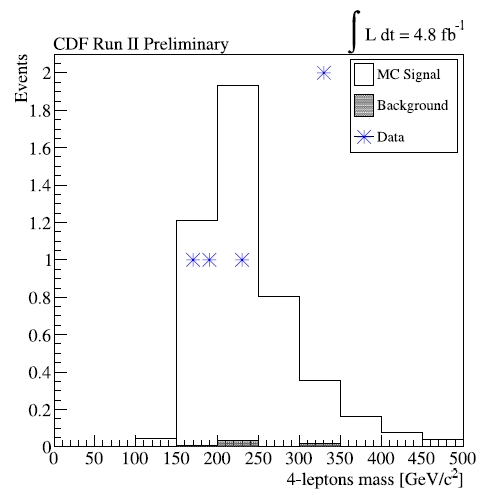 Incidentally, a search for 4-lepton decays of ZZ pairs was performed by CDF in 4.8/fb of data last year -so two-thirds of the 7/fb I was basing my estimate on. They looked for both electron and muon final states, and observed 5 ZZ candidates, as shown in the figure on the right. Our back-of-the-envelope calculation is not too bad! In fact, 4.8 is 2/3 of 7, but considering that they use both eeee, eemm, and mmmm final states (all in all a 4 times larger branching fraction, since the eemm final state has double probability due to the combinatorial factor), our estimate should have been 3 events x 2/3 x 4= 8 events.
 Another note: the figure on the right shows the total invariant mass of the four leptons in the events found by CDF. Backgrounds to the ZZ final state hypothesis total less than a tenth of one event, so these really are clean ZZ candidates. The mass of three of them is close to the threshold, 180 GeV or little more; but two candidates have a mass very close to each other, about 325 GeV (to be precise, one is at 324.8, the other at 325.0 GeV!). You might not notice those two, since they are plotted with blue asterisks, quite unconventional if you ask me... Even more unconventional is the weird choice of having a separate binning for data and MC predictions!! Oh well...
Let me finally tell you how probable it is that at least one H->ZZ->4m event has shown up in either CDF or DZERO or both, in 7/fb of data. We expect 0.15 events in each experiment: this makes the average 0.3 in total. The probability to observe at least one event of that kind, if the expected value is 0.3, is calculated with an integral of the Poisson distribution of mean mu=0.3, from 1 to infinity. This amounts to 1-exp(-mu)=26%.



Comments