






A new fossil cephalopod has turned up in the news! It's funny cuz I was just pondering ammonites recently.
"It is a new species of squid, totally new, that has not been seen in other parts of the world," paleontologist Klaus Honninger told AFP. Honninger, director of the Meyer-Honninger Paleontology Museum in the northern city of Chiclayo, said the fossil was a large cephalopod of the extinct Baculite species, known for their long straight shells.
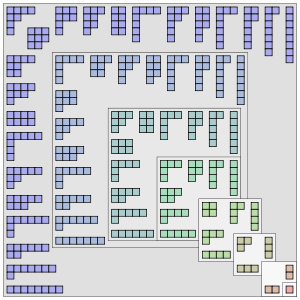
For hundreds of years, mathematicians even as great as Leonhard Euler(1) have tried to make sense of partition numbers, the basis for adding and counting.  Progress has been made but there has never been a full theory to explain partitions.   Answers have always led to more questions.

Basically, partitions are not considered by some to be part of number theory at all but to keep it simple for now, in number theory, a partition of a positive integer (n) is a way of writing n as a sum of positive integers.    

Here is an example from the Classic Encyclopedia:
Over at the Journal of Cosmology, an engaging open journal I've discussed before, there is a controversy over their book, "The Human Mission to Mars: Colonizing the Red Planet".  Namely, Eurekalert refused to accept their press release.  Says the JoC:
EurekAlert has refused to issue a paid-for press release announcing the publication of the book edition of The Human Mission to Mars. Over 120 top scientists, including 4 astronauts who walked on the Moon, co-authored this text.
Lab rats generally don’t live pleasant lives. Some are infected with diseases. Some are exposed to radiation. Some are sucked nearly dry with ticks. But occasionally a rat makes it lucky and is chosen to participate in a study on pleasure and rewards, where the pleasure and rewards are sex.  

You might think, as I once did, that initiating rat sex would be straightforward.  Male rat + female rat = GO! And… mission complete!

Microbiologists have discovered a central metabolic pathway in microorganisms and the microorganisms use this pathway to survive under extremely salty conditions, like the Dead Sea.

The Dead Sea is not dead, in the science sense.  Many microorganisms which inhabit it belong to a group of salt-tolerant archaea (from the Greek archaĩos, from which we also get"archaic“).   Archaea are among the most primordial life forms on earth and have managed to survive in extreme environments. 
For robots to get 'smart', they have to learn to adapt.   University of Vermont roboticist Josh Bongard has created both simulated and actual robots that, like tadpoles becoming frogs, change their body forms while learning how to walk.

Over generations, his simulated robots also 'evolved', spending less time in infant tadpole-like forms and more time in adult four-legged forms.

These evolving populations of robots were able to learn to walk more rapidly than those with fixed body forms and, in their final form, the changing robots had developed a sturdier gait,  better able to withstand being knocked with a stick, than the ones that had learned to walk using upright legs from the beginning.

Was the fall of the Roman Empire or, as often predicted, the coming fall of the American Empire, numerically predictable?

It is, according to research led by Sergey Gavrilets, associate director for scientific activities at the National Institute for Mathematical and Biological Synthesis and a professor at the University of Tennessee-Knoxville published in Cliodynamics: The Journal of Theoretical and Mathematical History.

How can a man who writes an article noting the many positive strides made in eliminating gender discrimination be sexist?    Well, he isn't, but men who go out of their way to help women can be considered sexist, thought it is a more benevolent sexism than the real kind.

New research from the University of Granada warns about the negative effects of "benevolent sexism", a term used for apparently positive ideas and attitudes of men towards women, which are based on the assumption that men must take care of and sacrifice themselves for women.

I am taking part in discussions with Sascha Vongehr about the MIT video - here on this site -
Falling Faster Than Freefall: A Lesson In Didactics And Critical Thinking.

I have played with the problem in a toy simulator  ( see PHUN (download), scroll a bit down) and have fun..

From my post there:
Nanotechnology is my own field of research for 12 years now. It is one of the, if not the most important of the emerging technologies, and it is widely believed to be the vital ingredient to many by transhumanists desired transformations, be it slowing down aging, computer to brain network-neuron interfaces, or the development of ever faster (quantum) computers. Nano is still the big buzz word and I am afraid to have become the uninvited party-pooper.

