




A team of scientists say they have reconstructed the Earth's climate belts of the late Ordovician Period, between 460 and 445 million years ago, and their study says these ancient climate belts were surprisingly like those of the present.

The team of scientists looked at the global distribution of fossils called chitinozoans – probably the egg-cases of extinct planktonic animals – before and during this Ordovician glaciation, and found a pattern that revealed the position of ancient climate belts, including such features as the polar front, which separates cold polar waters from more temperate ones at lower latitudes.
Why are some things funny? Philosophers have asked that for millenia but two marketing people think they've come up with the formula: humor comes from a violation or threat to the way the world ought to be that is, at the same time, benign. 

Most theories of humor are missing something, says A. Peter McGraw, assistant professor of marketing and psychology at the University of Colorado-Boulder, who co-authored the study with Caleb Warren, a Ph.D. candidate in marketing. Freud thought humor came from a release of tension, another theory holds that humor comes from a sense of superiority, and still another from incongruity.

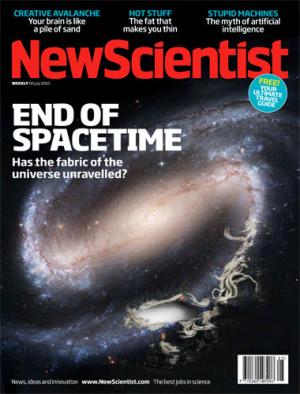
Can neuroscience help a magazine sell more copies?   New Scientist wants to find out, so they teamed up with NeuroFocus, who bill themselves the world's largest neuromarketing company, to make a magazine cover. 

Using high density arrays of electroencephalographic (EEG) sensors to capture test subjects' brainwave activity, NeuroFocus measured and analyzed their responses to three different cover designs for the August 7 edition of New Scientist.

The International Society of Aesthetic Plastic Surgery (ISAPS) has produced the ISAPS Biennial Global Survey(TM) of plastic surgeons and procedures in the top 25 countries and regions - representing 75% of all procedures in 2009.  They say this ISAPS Survey marks the first time reliable international plastic surgery data has been obtained and analyzed by independent statistical specialists. 

Geographic Trends

The ISAPS Global Survey revealed a new hierarchy of countries with the most surgical and non surgical cosmetic procedures. While the United States continues its dominance in the field, countries not always associated with plastic surgery are emerging as major centers.

Barchester Green Investment Limited (Barchester),  which bills itself as the UK's leading ethical and environmental financial adviser, released their list of the current 'Heroes and Villains' amongst the ethical and environmental funds. 

Fabio Casati and his collaborators at LiquidPublication, an EU-financed research project, want to change how you do science.  Namely by allowing you to do more of it, instead of sifting through journals.

“The more papers you produce, the more brownie points you get,” says Casati. “So most of your time is spent writing papers instead of thinking or doing science.”
No one here at Science 2.0 really noticed the Scienceblogs Pepsigate thing, being busy writing about science, but I lurk in a number of other places and, since Scienceblogs is the Big Kahuna in science blogging, it merited some attention, at least from me.

In the It-From-Bit series I have reported extensively on Verlinde's 'entropic gravity' concept. I have also provided you with an illustrative 'mikado universe' picture of entropic gravity. This got topped off with my own intuitive notion that in an entropic universe, not only gravity, but also accelerated cosmic expansion emerges. As a result, in one fell swoop, entropy eliminates the need for a fundamental force of gravity as well as the need for dark energy. 
The Anatomy Of A Discovery

Petermann Glacier Ice Tongue Calving 2010


Science20.com is a science site.


Now, I could blabber and bluster about how I once advised Margaret Thatcher1.  Which I did.  In a private letter which was answered by the Iron Lady herself in her own handwriting.  I had further communication with her via my local M.P. - the politician, not the policeman!  All of which has nothing whatsoever to do with my reputation in the science community.  Nor should it.

Researchers at the RIKEN Center for Developmental Biology say they have unraveled the mystery of why human embryonic stem (ES) cells and induced pluripotent stem (iPS) cells undergo apoptosis (programmed cell death) when cultured in isolation, a discovery that promises new hope to sufferers of debilitating degenerative diseases.


