Researchers from the University of Gothenburg have discovered a brand new species of bacterium found only in the Gullmarsfjord north of Gothenburg in Sweden. The new species has been dubbed Endoxenoturbella lovénii.
The bacterium is an endosymbiotic prokaryote living in the gut of a marine worm called Xenoturbella, a creature also unique to the Gullmarsfjord. Researchers identified two types of endosymbiotic bacteria (Xenoturbellida, Bilateria). They say other scientists should consider the new endosymbionts "when interpreting the poorly understood ecology and evolution of Xenoturbella."
Paleontologists have discovered a plant-eating dinosaur that live 70 to 80 million years ago. The new species, Texacephale langstoni, was about as big as a medium sized dog. The discovery represents a new genus of pachycephalosaur, a group of bipedal, thick-skulled dinosaurs.
Researchers discovered two skull fragments in Big Bend National Park in southwest Texas in 2008 and compared them to dozens of fossils from related species found in Canada and Montana.
The new species is one of about a dozen known to have solid lumps of bone on top of their skulls, which researchers speculate was probably used to ram one another head-on in a manner similar to modern-day musk oxen and cape buffalo.
A new study in the Journal of Geophysical Research suggest that solar wind may charge polar lunar craters to hundreds of volts as it flows over natural obstructions on the moon.
The findings are important for NASA scientists who are investigating the resources, including water ice, which exist in polar lunar craters. Solar wind inflow into craters can erode the surface, which affects recently discovered water molecules. Static discharge could short out sensitive equipment, while the sticky and extremely abrasive lunar dust could wear out spacesuits and may be hazardous if tracked inside spacecraft and inhaled over long periods.
Attempting to eradicate disease is not a good use of public health dollars, say researchers writing in Proceedings of The Royal Society B. Instead, the emphasis should be placed on reducing the prevalence of diseases in areas most affected by them.
What's more, the scientists argue, new research shows that the most at-risk populations can be identified using just three variables.
A great diversity of local mammals and birds in a region, a large human population and ineffective disease control efforts point to a high-prevalence of disease. Climate plays a role in determining how many different kinds of diseases there are, but not how many people will suffer from them.
Possibly some of the more hotly contested fishing grounds in the world occur around the Falkland Islands, just off the Atlantic coast of South America. The islands themselves are a point of international contention, and the ocean comes right along for the ride, since fishing accounts for about half of the Falklands' economy.
If you're not familiar with it, this history of the Falklands/Maldivas makes for a
fascinating read. The short version is that the United Kingdom and Argentina have been fighting over it, and so far the UK has won.
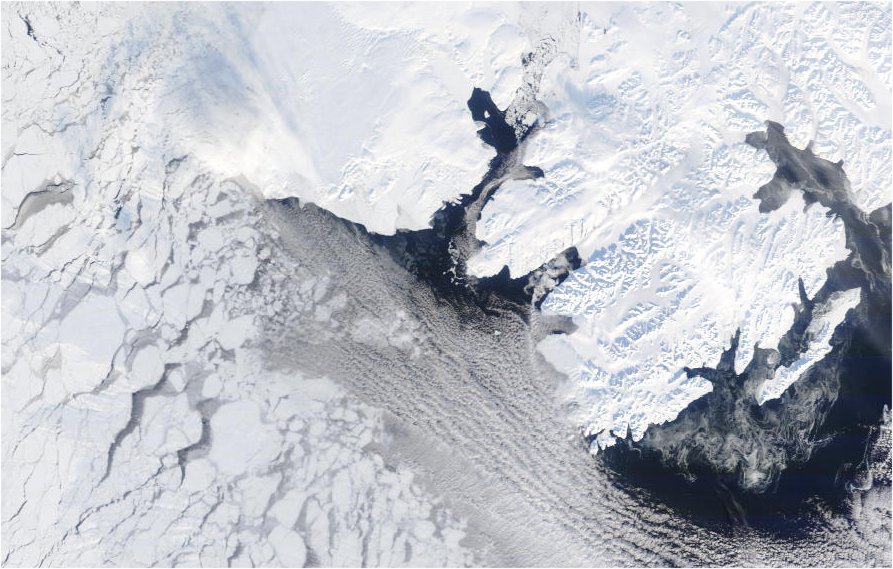
Arctic Tipping Points - #4: The Broken Bridges Of Nares
In
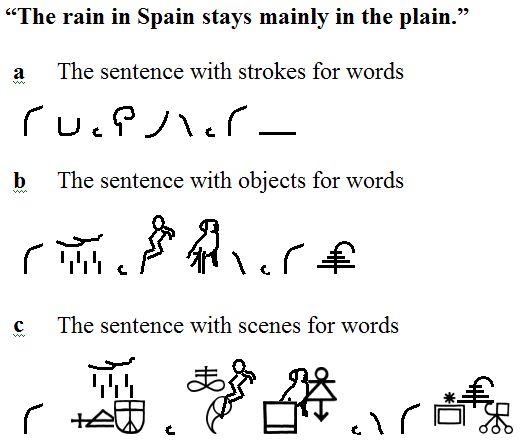
Writing As Superpower I outlined how writing is for the eye, at the expense of the hands, despite the fact that our brains may have evolved to comprehend speech. We still prefer to 'listen' with our eyes, despite our eyes not having been designed for this. In
Harness The Wild Eye I showed how non-linguistic visual signs are a visual system designed to recognize objects and efficiently react to the information.
To begin to grasp why using object-like visual symbols for words is a good strategy, consider two alternative strategies besides the objects-for-words one.
Arctic Tipping Points - #3: More About FeedbackThis series is a follow-on to my 3-part series
Arctic Ice 2010. It begins with
part #1: Background And Recent History. In
Arctic Tipping Points - #2: Some Feedback Mechanisms I wrote:
Analogies are a powerful way to explain complicated scientific concepts. I use them as much as I can whenever I describe particle physics in this blog or when I give a outreach talk in a school. However, good ones are not always easy to find. One usually needs examples from everyday life, which are simple to describe and which do not possess distracting features.
Today I wish to try my luck with you, to see if you come up with an analogy which is better than the one I could find to explain a feature of weak interactions. I must say I am not dissatisfied with my own find, but it is always good to subject oneselves to external judgement.
Eyjafjallajökull, Gígjökull, Jökulhlaup, Gosmökkur
The world is suddenly faced with the need to learn how to pronounce Islenska, the Icelandic language.
With much of European airspace closed due to volcanic ash in the skies, people are most commonly asking how long it will last, and if it may get worse. Also, the media continues to confuse the issue with talk of an eruption under, variously, a glacier, an ice cap, an ice sheet.
There is a world of difference between an ice sheet kilometers thick, and the Gígjökull glacier and the Eyjafjallajökull ice cap.