Engineers from Oregon State University are attempting to develop a robot capable of running effortlessly over rough terrain and they're doing it with assistance from the unlikeliest of creatures--cockroaches. While they maybe unsightly, the insects are also biological and engineering marvels, and are providing the researchers with what they call "bioinspiration" in their efforts to build a running robot.
Their latest findings – just published in the professional journal Bioinspiration and Biomimetics – outline how animals use their legs to manage energy storage and expenditure, and why this is so important for running stability.
From the smallest South American monkeys to the largest African apes, the timing of molar development and eruption is closely attuned to many fundamental aspects of a primate's biology, according to Gary Schwartz, a researcher at the Institute of Human Origins and an associate professor in the School of Human Evolution and Social Change in ASU's College of Liberal Arts and Sciences.
With the first decade of the millennium coming to a close, it is time to
take stock. What have 'The Noughties' brought us in terms of scientific advances?
Scared by the void of Christmas vacations ? Unable to put just a few more feet between your mouth and the candy tray ? Suffocating in the trivialities of the chit-chat with relatives ? I have a solution for you. How about trying to solve a few simple high-energy physics quizzes ?
I offer three questions below, and you are welcome to think any or all of them over today and tomorrow. In two days I will give my answer, explain the underlying physics a bit, and comment your own answers, if you have been capable of typing them despite your skyrocketing glycemic index.
Here's a pleasant Christmas thought-- why are rocket launches like holidays-- infrequent, big productions that tend to always be the same? A New York Times op-ed,
Faster, NASA, Faster, puts forth an idea that, really, resurfaces at least once every few years. It's a good idea. It says, hey, let's do more launches with higher risk.
Sure, Christmas is a religious holiday and science and religion share common people but not often common ground. That doesn't mean we can't all join together and share some Christmas science ... and an awesome electric car (5 MPH!) I assembled for my youngest kids last night (picture to come later). Like Rock'em Sock'em Robots, even adults think miniature cars are cool. If you're the environmental type, I am basically teaching my kids to like a Prius - and it goes about as fast. So thank me by reading some of the terrific science below:
The climate is changing and the natural world has to adapt to it. But how much time do the multitudes of species and their habitats have before it's too late? A team of environmental researchers has set out to answer that very question, and they say that as the world warms through the 21st century, ecosystems will need to shift about 0.42 kilometers per year (about a quarter mile per year) to keep pace with changing temperatures across the globe.
Many illusions are like spherically curved space. Below on the left (fig. 1 ) is a geometrical illusion, and on the right is a ball with some great arcs drawn on it.
Notice the similarities: the distortions in the illusion are qualitatively similar to the non-Euclidean nature of the contours on the ball.
Why? Is there something in perception that’s like curved space?
figure 1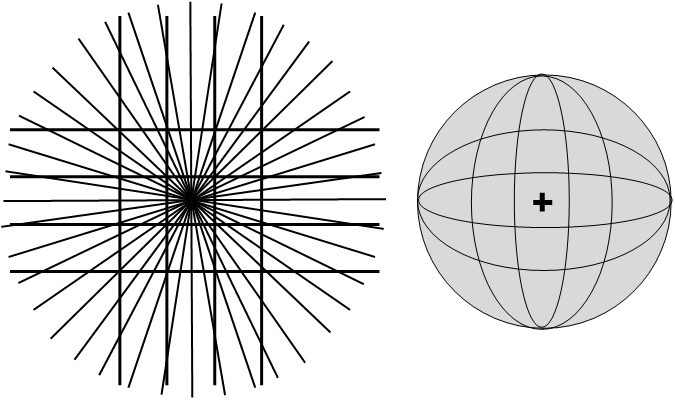
According to a 2007 press release by the Consumer Product Safety Commission, every year 33.1 million people are injured by consumer products in the home. No one is safe and constant vigilance is required to avoid maiming and/or death (paraphrased). Here are the prime offenders:
1. Magnets: If a child eats your wedding ring, it will pass. If the same child eats both your wedding ring and a magnet, the two might attract through intestinal walls, creating a massive kink and making it very difficult to retrieve your ring.
2. Recalled Products: At cspc.gov, you can sign up for e-mail notification of recalled goods. With about 400 recalls a year, you can rest assured that your in-box will be a constant source of terror.
Female ducks can thank evolution for avoiding becoming impregnated by undesirable but aggressive males endowed with large corkscrew-shaped penises: vaginas with clockwise spirals that thwart oppositely spiraled males. That's right, males are literally screwed.
The research on this evolutionary 'battle of the sexes' at the genitalia level were described in the December 23 issue of the journal Proceedings of the Royal Society B.