





Geckos have the uncanny ability to traverse even the trickiest terrain without so much as a slip. Until now, it has been unknown when and how they switch on their they all-foot grip.

Scientists at the University of Calgary and Clemson University in South Carolina have discovered that the geckos' amazing grip is triggered by gravity.

"Geckos use microscopic, hair-like filaments to attach to surfaces. Only at certain angles do they switch on their traction system, however," says Russell, a biological sciences professor at the U of C. "We are trying to understand this process, which will help in mimicking it for application to robotics."

When the ancient Japanese art of origami first came about, it consisted of one piece of paper folded to form cranes, flowers, and other shapes. Now, however origami has been revised and resized a bit. All the way down to the nanometer (1/1000000000 meters).

Scientists at the Technische Universitaet Muenchen (TUM) and Harvard University have have taken a new approach to building nanoscale structures out of DNA with its complex twisting and curving shapes. In the journal Science, they report a series of experiments in which they folded DNA, "origami-style," into three dimensional objects including a beachball-shaped wireframe capsule just 50 nanometers in diameter.

It doesn't take a catastrophe to end entire lineages. (Well, for the dinosaurs it did.) But an analysis of 200 million years of history for marine clams found that vulnerability to extinction runs in evolutionary families, even when the losses result form ongoing, background rates of extinction.

A new process that cleans wastewater, generates electricity, and can remove 90 percent of salt from brackish water or seawater, was reported by an international team of researchers from China and the U.S.

Clean water for drinking, washing, and industrial uses is a scarce resource in some parts of the world. Its availability in the future will be even more problematic. Many locations already desalinate water using either a reverse osmosis process -- one that pushes water under high pressure through membranes that allow water to pass but not salt -- or an electrodialysis process that uses electricity to draw salt ions out of water through a membrane. Both methods require large amounts of energy.

Prospects for building a practical quantum computer are as unpredictable as quantum mechanics itself. However, physicists at the National Institute of Standards and Technology (NIST) have demonstrated sustained, reliable information processing operations on electrically charged atoms (ions). The work, described in Science Express, overcomes hurdles in scaling up ion-trapping technology from small demonstrations to larger quantum processors.

The human papillomavirus (HPV) vaccine is a contentious debate.   A large pharmaceutical company with budget to spend can't usually find a friend in science but even with vague benefit it's difficult to argue against protecting children or opening debate about the value of all vaccines by being critical of one.
The Commonwealth Fund,  a private foundation devoted to health care reform, has issued a report saying that President Obama's proposed health care plan would help more than 13 million uninsured young adults ages 19-29 gain coverage.
Now that people have finally realized ethanol is a government-run, unscientific boondoggle, efforts are under way to make legitimate biofuels efficient enough for mass usage.

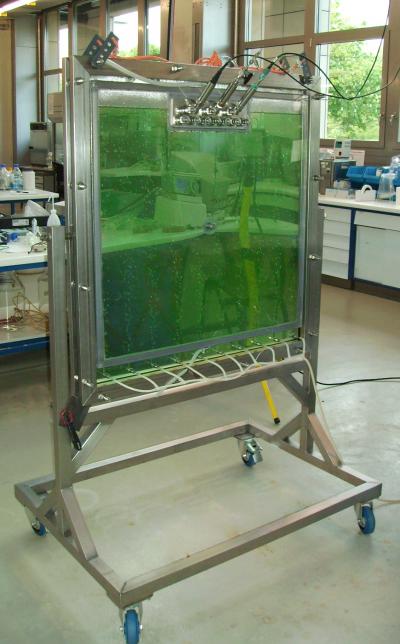
Microalgae are monocellular, plant-like organisms that use photosynthesis and convert carbon dioxide (CO2) into biomass. From this biomass, both potential resources and active substances as well as fuels like biodiesel may be produced. While growing, algae take up the amount of CO2 that is later released again when they are used for energy production. Hence, energy from algae could potentially be produced in a CO2-neutral manner contrary to fossil fuels or current biofuels.
As kids, we all liked to imagine scenes where big dinosaurs squared off against each other for gigantic battles - if you're young, imagination is like a Transformers movie, but without $100 million for special effects.  

Those battles rarely happened, if at all, goes a new hypothesis.    Dinosaurs became chickens in evolution (well, maybe) but they were already chickens at heart, say paleontologists at Ludwig-Maximilians-Universität (LMU) in Munich.
Usain Bolt, sprinter from Jamaica, currently holds the world record in the 100 meter sprint with a time of 9.69 seconds.  Whenever new records are set, people ask 'what is the limit on human performance?'

So how fast can a human run?  

Two econometricians from Tilburg University in the Netherlands, Professor of Statistics John Einmahl and former student Sander Smeets, say have calculated the ultimate records for the 100-meter sprint. The good news; there is still room for improvement in both the men's and women's times in the near future.


