




Recent research says that talking on a cell phone poses a dangerous distraction for drivers and others whose attention should be focused elsewhere and now a new study in the Journal of Environmental Psychology finds that just the ring of a cell phone may be equally distracting, especially when it comes in a classroom setting or includes a familiar song as a ringtone.

Students exposed to a briefly ringing cell phone scored 25 percent worse on a test of material presented before the distraction.
'True muonium' is a long-theorized but never-seen tiny atom that was first proposed more than 50 years ago.  True muonium, which unlike "muonium" (an atom made of an electron and an anti-muon) is made of a muon and an anti-muon.   Both muons and anti-muons are created frequently in nature when energetic particles from space — cosmic rays — strike the Earth's atmosphere yet their existence is fleeting and their combination, 'true muonium,' decays naturally into other particles in a few trillionths of a second. This has made observation impossible.

But it might be observed even in current collider experiments, according to theoretical work published recently by researchers at the SLAC National Accelerator Laboratory and Arizona State University.
This is going to be a rather long piece, so for the lazy and the absent-minded among you I decided to put together an executive summary at the top, and not at the bottom of the article as I usually do. It is a bit of a spoiler, but those of you who can invest some time reading about particle physics will not be deterred by the first few lines of text. Besides, an executive summary is needed because we are discussing real news here: so here it is.
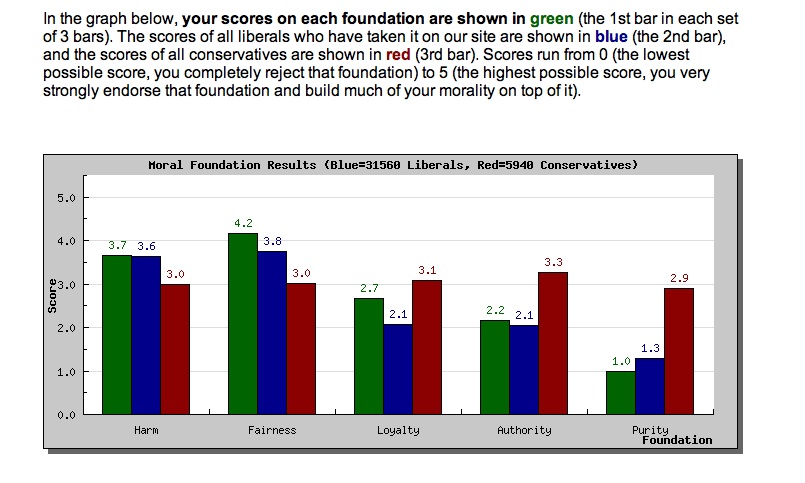
Liberals and conservatives don’t just think differently, they also feel differently. This may even be a result, in part, of divergent neural responses.


I don't know much about the science behind this, but the NY Time's Nicholas Kristof points readers to an online survey set up by some psychologists to study morals and political beliefs:

On the drive home yesterday afternoon I heard a fascinating story on NPR about an ecosystem near and dear to all humans - our skin. Even if bacteria aren't your thing, the story and the findings are really interesting (and actually could be applicable to a wide host of conditions and diseases).

Scientists in Portugal and France managed to follow the patterns of gene expression in food-poisoning bacteria Listeria monocytogenes (L. monocytogenes) live during infection for the first time. The work about to be published in PLoS Pathogens shows how the bacterial genome shifts to better adapt to infection by activating genes involved in virulence and subversion of the host defences, as well as adaptation to the host conditions.
Like ethanol, the darling of activists who refused to know any better until it was actually implemented and shown to be a disaster, there is a certain amount of marketing hype around CFL bulbs and environmental groups have drunk the Kool-Aid.  

All mercury is bad when it comes to kids.   And who knows what those frequencies will do to your pets?   But it may not be an issue for long.   A new laser process says it can double the brightness of incandescent bulbs while using the same amount of energy.    

DHS Begins Test of Biometric Exit Procedures at Two U.S. Airports, the next step toward deploying biometric exit procedures for international travelers.

The U.S. Department of Homeland Security (DHS) today began collecting biometrics - digital fingerprints - from non-U.S. citizens departing the United States as part of a pilot program at Hartsfield-Jackson Atlanta International Airport and Detroit Metropolitan Wayne County Airport. Since 2004, biometrics have helped DHS prevent the use of fraudulent documents, protect visitors from identity theft and stop thousands of criminals and immigration violators from entering the United States.

Collecting biometrics allows us to determine faster and more accurately whether non-U.S.

"The men are getting really angry and the women are a little too gleeful,” wrote New York Times columnist Lisa Belkin commenting on the overwhelming response she got for an article on a new study that found that men, too, may have a “biological clock” ticking when it comes to having what biologists would call “high quality” offspring.
I’m fascinated by the contributions of researchers outside of the mainstream— the monk whose bean garden seeded modern genetics, the bicycle mechanic brothers who built a flying machine in their garage, and all of those amateur stargazers who found supernovae in their favorite corner of the sky.

Modern indie researchers, often called "grassroots scientists" or  “citizen scientists”, make especially good food for thought when grad school is at its most frustrating. It’s comforting to remember that at its heart, science is still open to anyone with a bit of curiousity and good observation skills.


