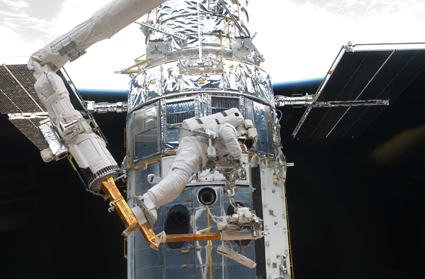




Astronauts John Grunsfeld and Drew Feustel successfully installed the Wide Field Camera 3 (WFC3) Thursday during the first of five scheduled EVAs, or spacewalks, to rejuvenate the Hubble Space Telescope.

Hubble was "full of surprises" for the astronauts, and EVA 1 took an hour longer than planned, but the veteran space and ground crews overcame all obstacles and Servicing Mission 4 (SM4) remains right on schedule.  (See the full scheduled timeline in my previous post.)
Have you ever thought about what's going on in your brain when you look at a painting that you like a lot?  While Neuroscientist Dr. Edward Vessel has and he's done brain imaging experiments to figure it out.

What happens in your brain when you have a pleasurable experience -- for example, when you see at a painting that you like very much.  Scientists describe this as an aesthetically pleasing experience.  They want to know if simply seeing a painting that you enjoy engages an emotional response and triggers the emotion circuits in your brain.
Did Language Invent Humans ?

Writing is a human invention.  We have plenty of evidence of its invention and of its improvement down the ages.  It would make no sense to assume that writing somehow 'just appeared'.  A magical origin of writing would presuppose that our brains are hard wired to read, but we all know that reading and writing are skills that must be taught in a formal manner.  Again, if we were 'hard wired' for written language then we would all use a single writing method, regardless of language.  Writing is most definitely invented.

Following on from the previous post, I wanted to pull out another couple of 'pointers to God' that Francis Collins and BioLogos like to present as part of their argument for belief. I like them because, far from being pointers to god, they are in fact powerful examples of the power of science and the weakness of religion as a tool to help us understand morality. They're great examples of how science is encroaching into what was once regarding as purely religious territory.

First example is this one - "Why is it wrong to torture an individual for the greater good?"

Although the theoretical applications for stem cell research are seemingly endless, the far-off possibilities are not as awe-inspiring as some scientists would like. Setbacks, ethical concerns and funding are all part of the hurdles that face all new scientific research, stem cell research especially. However, drastic results and benefits may be closer than previously thought.

    Last week I described how John Oro discovered that five hydrogen cyanide molecules (HCN) could react to produce adenine (H5C5N5) one of the primary components of nucleic acids. 

A first observation of the Omega_b baryon -a quite exotic particle composed of a bottom quark and two strange quarks- has been recently published by the DZERO collaboration. Their paper claims to observe the so-far-unseen particle in 1.3 inverse femtobarns of Run II data (about a hundred trillion proton-antiproton collisions, that is).

The claim is based on the signal they find, 17.8 fitted events making a peak in the reconstructed mass distribution, a signal whose significance is computed to exceed five standard deviations: 5.4 of them, to be precise.
The American Civil Liberties Union action in filing a lawsuit yesterday against Myriad Genetics is going to lead to one of the most important legal battles in the history of biotechnology, asserts Genetic Engineering&Biotechnology News(GEN).   The ACLU charged that the patenting of two human genes linked to breast and ovarian cancer will inhibit medical research.   The organization also claims that the patents are invalid and unconstitutional, though the ACLU didn't disclose which clause of the Constitution it violates.
Should You Share  A Higher Genetic Risk?

If you learned that you were at high risk of cancer because you carry the hereditary BRCA1/2 gene mutation, would you tell your children? A recent study at Fox Chase Cancer Center not only considered that question, but also took it to the next level and studied the parent perceptions of the impact of such a decision on children.   BRCA1/2 are hereditary gene mutations that indicate an increased risk of developing breast cancer.
The potential contribution to sea level rise from a collapse of the West Antarctic Ice Sheet (WAIS) have been greatly overestimated, according to a new study in Science.   These scientists estimate global sea level would rise 3.3 metres, not five or six, which were some previous estimates.


