6 out of every 10 university students, regardless their field of study, get anxious when it comes to mathematics, according to a research work carried out at the University of Granada. There are significant differences between men and women in this sense, as men suffer less anxiety when it comes to deal with mathematical tasks (47% of men against 62% of women).
Is today's academic and corporate culture stifling science's risk-takers and stopping disruptive, revolutionary science from coming to the fore? Writing in Physics World, Mark Buchanan looks at those who have shifted scientific paradigms and asks what we can do to make sure that those who have the potential to change our outlook on the world also have the opportunity to do so.
A groundbreaking new loudspeaker, less than 0.25mm thick, has been developed by University of Warwick engineers, it's flat, flexible, could be hung on a wall like a picture, and its particular method of sound generation could make public announcements in places like passenger terminals clearer, crisper, and easier to hear.
All speakers work by converting an electric signal into sound. Usually, the signal is used to generate a varying magnetic field, which in turn vibrates a mechanical cone, so producing the sound. Lightweight and inexpensive to manufacture, the new 'Flat, Flexible Loudspeaker' (FFL) speakers are slim and flexible: they could be concealed inside ceiling tiles or car interiors, or printed with a design and hung on the wall like a picture.
Sure, things are tough all over. Heck, Linda Evangelista recently stated she now would get out of bed for less than $10,000 a day(1).
Can't wait for the next Star Trek movie? Okay, this doesn't have Zoe Saldana but it's still pretty terrific - the first movie ever of carbon atoms moving along the edge of a graphene crystal. Given that graphene, single-layered sheets of carbon atoms arranged like chicken wire, may hold the key to the future of the electronics industry, the audience for this new science movie might also reach blockbuster proportions.
Okay, I am going to do something that will cost me my Republican voter card - I am going to recommend we reopen a government agency, the Office of Technology Assessment (OTA).
It's not just American cars that are hurting the environment, researchers in California and Colorado have set their sights on ... rocket launches?
Future ozone losses from unregulated rocket launches will eventually exceed ozone losses due to chlorofluorocarbons, or CFCs, which stimulated the 1987 Montreal Protocol banning ozone-depleting chemicals, said Martin Ross, chief study author from The Aerospace Corporation in Los Angeles. The study, which includes the University of Colorado at Boulder and Embry-Riddle Aeronautical University, provides a market analysis for estimating future ozone layer depletion based on the expected growth of the space industry and known impacts of rocket launches.
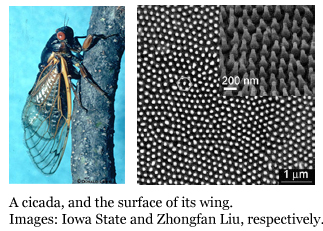
Cicadas might have used their wily
prime number scheme to dodge 2 and 4 year predators, but what about a predator with continual exponential growth?
The microcircuitry industry has reliably doubled the density of transistors on a chip every 2 years, as observed by Gordon E. Moore in 1965. This exponential density growth trend is known as
Moore’s law, and satisfying it requires that nanofabrication techniques are constantly embraced, devoured, then cast aside.
... Not that the Texas school board creationists were coherent before, but what else do they have left? After
the defeat of language in the state standards to teach the "strengths and weaknesses" of evolution in Texas public schools, the creationist school board members have rallied under the motto "Somebody's got to stand up to experts!" Thus, in defiance of the logical thinking and coherent grammar embraced so fondly by those nefarious experts, the Texas school board on Friday passed a number of incoherent amendments to their state science standards.
Here's another reason to hate leftovers. A research study in the Journal of Leukocyte Biology sheds light on one cause of arthritis: bacteria. In the study, scientists from the United States and The Netherlands show that a specific gene called NOD2 triggers arthritis or makes it worse when leftover remnants of bacteria cell walls, called muramyl dipeptide or MDP, are present. This discovery offers an important first step toward new treatments to prevent or lessen the symptoms of inflammatory arthritis.