The run up to Valentine's Day is peak period for the lonely hearts business, says an advocacy group for the lonely hearts business. Many singles decide not to leave it to chance at this time of year, they say, and join dating agencies rather than leave their love-lives to fate. The dating industries watchdog Association of British Introduction Agencies say the dating industry is thriving even amongst the doom and gloom of the economic crisis.
January 2009 registrations among member agencies were up 20% over the same period last year. That means you'd better hurry and do it too, before all the people are taken!
Another reason not to eat pate de foie gras is discussed by Michael Greger of The Humane Society of the United States, Washington DC in a forthcoming issue of the International Journal of Food Safety, Nutrition and Public Health.
Harmful proteins fragments known as amyloid fibrils associated with damage to brain cells in Alzheimer's disease and to pancreatic cells in Type II diabetes can be present in the meat of poultry and mammals. These amyloids are not destroyed even with high-temperature cooking process.
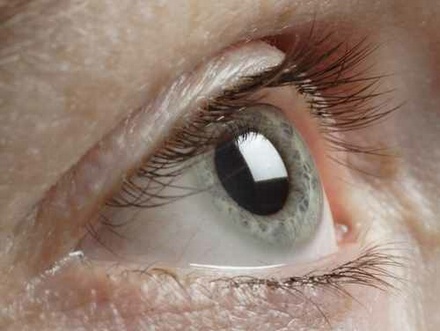
There's another reason to dust off those running shoes. Vigorous exercise may help prevent vision loss, according to a pair of studies from the U.S. Department of Energy's Lawrence Berkeley National Laboratory. The studies tracked approximately 31,000 runners for more than seven years, and found that running reduced the risk of both cataracts and age-related macular degeneration.
The research, which is among the first to suggest that vigorous exercise may help prevent vision loss, offers hope for people seeking to fend off the onset of eye disease.
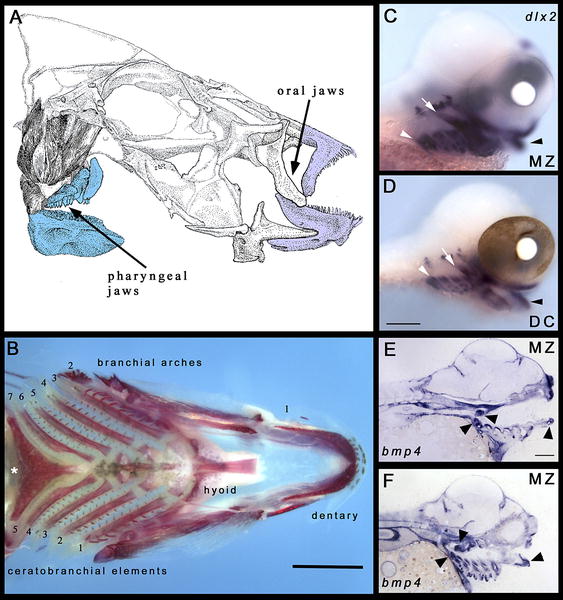
A common gene regulatory circuit controls the development of all dentitions, from the first teeth in the throats of jawless fishes that lived half a billion years ago to the incisors and molars of modern vertebrates (that includes you and me), say researchers from Georgia Institute of Technology and the University of Georgia.
The jaguar, Panthera onca, has become an animal in danger of extinction over recent decades, due to the fragmentation and deterioration of its habitat, as well as hunting and illegal animal smuggling. As a result of this vulnerability, no individuals have been seen in the centre of Mexico since the start of the 20th Century. However, Mexican and Spanish scientists have now managed to photograph a male jaguar in this region.
Could a hereditary illness ever spread by contamination? Researchers at the CNRS Laboratoire d’enzymologie et biochimie structurales, studying Huntington’s disease in collaboration with Professor Ron Kopito’s team at Stanford University, have shown that the normal form of
huntingtin protein can acquire an abnormal form without any modification of its genetic code. These researchers observed that clumps of abnormal huntingtin protein, characteristic of Huntington’s disease, could induce clumping in the normal form of the protein.
Think there's not enough time to do everything you need to do? You may just need to change your perception, says Michael DeDonno, a doctoral student in psychology at Case Western Reserve University.
If you don't think you have enough time, you've already given up.
DeDonno recently studied 163 subjects performing the Iowa Gambling Task (IGT), a popular psychological assessment tool, to investigate the effect of perceived time pressure on a learning-based task. His study, the first to look at the relationship between perceived time pressure and IGT performance, was published in the December issue of Judgment and Decision Making.
Scientists have used a computer simulation to predict what the very early Universe would have appeared like 500 million years after the Big Bang. The images, produced by scientists at Durham University's Institute for Computational Cosmology, show the "Cosmic Dawn" - the formation of the first big galaxies in the Universe.
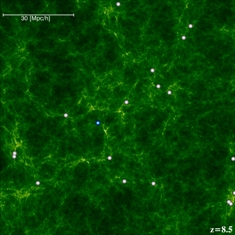 Universe 590 million years after the Big Bang. Credit:Alvaro Orsi, Institute for Computational Cosmology
Demands on telescope technology are rapidly increasing as astronomers look at fainter and fainter objects in the night sky. The large amount of light collection area required to view very dim objects poses a number of significant engineering problems to future telescope designers. To collect short-wavelength radio waves, for instance, an antenna miles across would be required. This has led engineers to construct multiple small telescopes whose signals can be integrated, providing the necessary level of detail.
Physicians have known for years that there exists a link between cardiac surgery and a subsequent decline in cognitive function of patients.
According to recent research, “previous studies have reported an 11% to 75% incidence of postoperative cognitive decline among cardiac surgery patients” (Slater et. al). However, until recently, the cause for this link was largely unknown.
Coronary Artery Bypass Grafting (CABG) surgery, continues to produce clinical results demonstrating cognitive decline in some patients despite improved surgery practices.