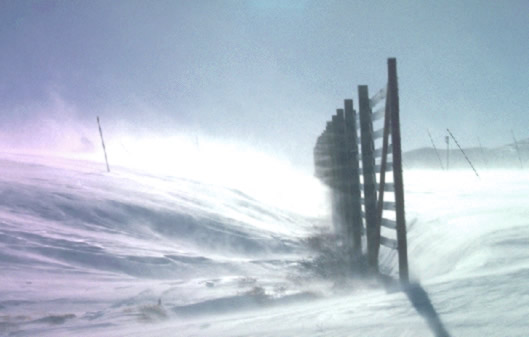
If you've ever been to a windy beach or a snow-blown landscape, you may have noticed a useless-looking fence with a pile of snow or sand on one side. The fence looks useless because it's full of holes - they're usually about 50% porous - and you might wonder what on earth they could be meant to control. It turns out that in windy conditions such a fence can cause a buildup of snow (or sand) on the downwind side, and that these fences are commonly used to prevent snowdrift across roadways as well as provide a measure of control over where snow or sand might build up.
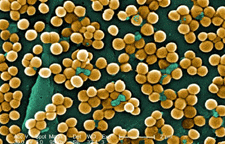
Mold is icky. However, it has yielded one of the most important advances in medicine: antibiotics. There was a time when penicillin was the cure-all antibiotic, capable of quelling almost any one-celled invader.
However, today this is not the case. Today’s bacteria are getting faster, stronger and more resistant to even our most aggressive antibiotics. This has prompted scientists to look in other nooks and crannies of our world to find the next solution to our growing resistant population of angry bacteria.
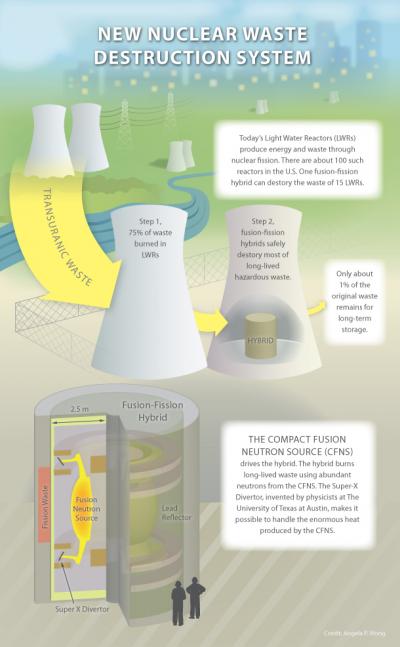
It's been nearly thirty years since the last application for construction of a nuclear power plant was filed in the United States. Despite the age of the reactors already operating, however, the amount of our power generated using nuclear sources is second only to coal. The energy generated by nuclear plants is also increasing steadily, as delays in refueling shorten and reactors operate for longer periods of time. However, there are still numerous environmental concerns regarding the waste products generated by American nuclear reactors - by 2010, the total amount of dangerous waste will exceed 77,000 tons. Now, researchers have found a way to reprocess that waste using new technology while still generating power.
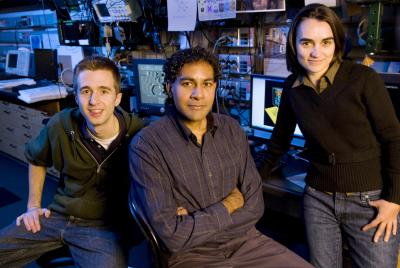
How many Cardinals can fit on the head of a pin? Still unknown, but Stanford physicists can at least tell us how many letters formed by quantum electron waves can fit on the surface of a sliver of copper - two; as in "S" and "U." That's for 'Stanford' and 'University' if you haven't caught on and Cardinals are their ... oh, never mind, if you didn't already get it you stopped reading by now.
So how small is that? The letters in the words are assembled from subatomic sized bits as small as 0.3 nanometers, or roughly one third of a billionth of a meter. Bonus: the wave patterns even project a tiny hologram of the data, which can be viewed with a powerful microscope.
Show Me The Science Day 3
Reproduction involves some tricky trade-offs for all species, and anyone who has watched a David Attenborough film knows that you can find a wide range of reproductive strategies in nature. Some animals spend their energy producing hundreds or thousands of offspring and leave them to fend for themselves. Others, like whales and humans, produce only a few offspring but expend an enormous amount of resources trying to give those offspring the best chance in life possible.
Plants face a similar trade-off. They can choose to produce many energetically cheap small seeds, or fewer, more expensive large seeds. A
recent paper in PLoS Genetics takes a look at one of the genes involved in seed size evolution. They study naturally-occurring genetic variation in found in this gene, and the relationship of that genetic variation to seed size in the domesticated tomato and its wild relatives.
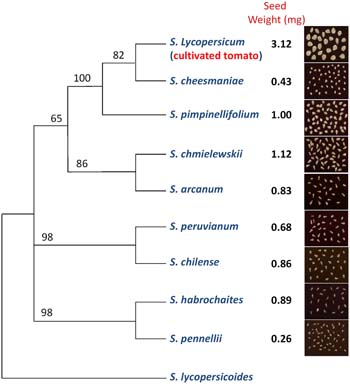
Variation in Seed Size, Figure 1 from Orsi and Tanksley
Biology exists in a physical world and cancer researchers are increasingly looking to include concepts of physics and mathematics in their efforts to understand how cancer develops -- and how to stop it.
Traditional cancer biology involves taking a sample of cells and holding them in time so they can be studied. Then the researchers look at that slice of cells to understand what signals and pathways are involved. But that doesn't capture the full picture, says Sofia Merajver, M.D., Ph.D., co-director of the Breast Oncology Program at the University of Michigan Health System Comprehensive Cancer Center.
When it comes to assessing the romantic playing field -- who might be interested in whom -- men and women were shown to be equally good at gauging men's interest during an Indiana University study involving speed dating -- and equally bad at judging women's interest.
Researchers expected women to have a leg up in judging romantic interest, because theoretically they have more to lose from a bad relationship, but no such edge was found.
In almost every diet book you read, they tell you to never get hungry. You will binge if you do, they all say, because of temptation and that gnawing in your stomach. Yet all those snacks and meals have corresponded to a ballooning obesity problem which gets instead blamed on trans fats, high fructose corn syrup, salt - you name it.
It may be that all those self-help books and catering to mental weakness has caused a drop in self-control, says psychological theory. If you want to lose weight, keep a house full of chocolate.
Variations in the brightness of the Q0957+561 quasar, also known as the “twin quasar” due to its duplicated image on Earth, are intrinsic to the entity itself and not caused by the gravitational effects of possible planets or stars from a far away galaxy.
This is the conclusion of a study carried out by Spanish researchers resolving a mystery that has intrigued astronomers for the past 30 years.
The origin of species may be almost as random as a throw of the dice, says Iosif Pinelis, a professor of mathematical sciences at Michigan Technological University, who claims to have worked out a mathematical solution to a biological puzzle: Why is the typical evolutionary tree so lopsided?
In other words, the reason some descendants of a parent species evolve into hundreds of different species while others produce so few goes beyond natural selection and into math; simple probability yields a surprisingly elegant solution, Pinelis says.