






Squids are weird, and then some are weirder. This Bobtail squid was imaged by the Deep Discover ROV in Atlantis Canyon, is less than one foot in length.
This Bobtail squid was imaged by the Deep Discover ROV in Atlantis Canyon, is less than one foot in length.This bobtail squid is very surprised at the absence of squid gynaecologists! Image credit: NOAA OKEANOS Explorer Program

A paper in The Journal of Clinical Investigation helps explain why brain tumors occur more often in males and frequently are more harmful than similar tumors in females.

Glioblastomas, the most common malignant brain tumors, are diagnosed twice as often in males, who suffer greater cognitive impairments than females and do not survive as long. The researchers found that retinoblastoma protein (RB), a protein known to reduce cancer risk, is significantly less active in male brain cells than in female brain cells.

New research has revealed psychogenic seizures which could be mistaken for epilepsy are linked to feelings of anxiety. The team of researchers devised a set of tests to determine whether there was a link between how people interpret and respond to anxiety, and incidences of psychogenic nonepileptic seizures (PNESs) – seizures that can be brought on by threatening situations, sensations, emotions, thoughts, or memories.

Understanding eye diseases is tricky enough but knowing what causes them at the molecular level will help.

University of Iowa researchers have created the most detailed map to date of a region of the human eye long associated with blinding diseases, such as age-related macular degeneration. The high-resolution molecular map catalogs thousands of proteins in the choroid, which supplies blood and oxygen to the outer retina, itself critical in vision.

By seeing differences in the abundance of proteins in different areas of the choroid, the researchers can begin to figure out which proteins may be the critical actors in vision loss and eye disease.

Researchers have been able to experimentally reproduce morphological changes in mice which have taken millions of years to occur. Through small and gradual modifications in the embryonic development of mice teeth, induced in the laboratory, they obtained teeth which morphologically are very similar to those observed in the fossil registry of rodent species which separated from mice millions of years ago.

To modify the development of their teeth, the team from the University of Helsinki and the Universitat Autònoma de Barcelona worked with embryonic teeth cultures from mice not coded by the ectodysplasin A (EDA) protein, which regulates the formation of structures and differentiation of organs in the embryo throughout its development.

Scholars at University Hospitals Rainbow Babies  &  Children's Hospital analyzed pediatric medical emergencies on flights worldwide between January 2010 - June 2013 and found 90 that percent of deaths occurred in children under the age of 2 - lap infants may be at greater risk for death on a commercial airline flight, they suggest.

The history of World War I - since there was no II then, it was simply The Great War - is well-known. Volumes have been written about why European monarchs, related to each other, nonetheless rolled "the iron dice" and sent millions of young men to their deaths. The technological and medical advances, and America's emergence as the decision-maker in geopolitics, have also been exhaustively examined.

Yet the role of women, not so much. World War II was another matter; from Rosie the Riveter to WACs, empowered female imagery was common. World War I, on the other hand, caused  progress on universal suffrage to go backward, and the role of women challenged the concept of femininity that existed.  

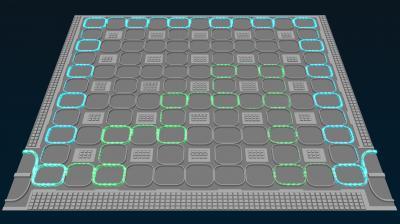
Topological transport of light is the photonic analog of topological electron flow in certain semiconductors.

In the electron case, the current flows around the edge of the material but not through the bulk. It is "topological" in that even if electrons encounter impurities in the material the electrons will continue to flow without losing energy.

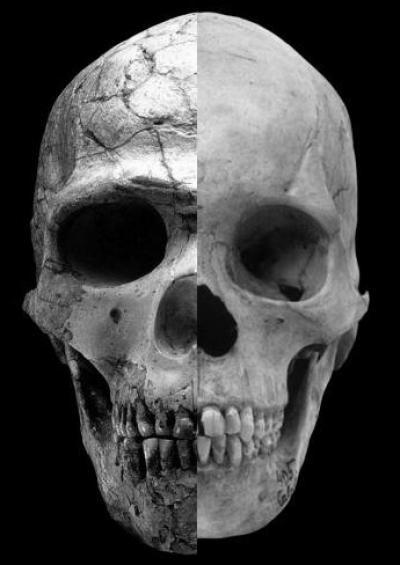
Modern humans began the first steps to what we might call culture some 50,000 years ago, 150,000 years after appearing in the fossil record. What changed?

A new paper in Current Anthropology argues that more feminine faces and gentler personalities were the result of less testosterone. People got nicer. The evidence is in the shape of more than 1,400 ancient and modern skulls and the conclusion is that human society advanced when people started being nicer to each other, which entails having a little less testosterone in action. 

Heavy brows were so 100,000 B.C., rounder heads were in, and those changes could be linked to testosterone levels acting on the skeleton, according to Duke University anthropologist Steven Churchill.


If you read politics on Twitter, you would have recently seen that Republicans in the U.S. Congress are going to impeach President Obama if they get enough seats in November, so it is vital that Democrats win elections.

