


NEW YORK, N.Y. (April 24, 2014) – A new study from investigators with the Autism Genome Project, the world's largest research project on identifying genes associated with risk for autism, has found that the comprehensive use of copy number variant (CNV) genetic testing offers an important tool in individualized diagnosis and treatment of autism.

Learning Lessons From Yesterday

It is well said that people who do not learn from their mistakes are doomed to repeat them.  History can teach many valuable lessons if only we are willing to learn.  Never forget, though, that history started a femtosecond ago.  More realistically we can say that yesterday is now history.

Ellen's (not her real name) adoptive parents weren't surprised when the school counselor suggested that she might have attention deficit hyperactivity disorder (ADHD). Several professionals had made this suggestion over the years. Given that homework led to one explosion after another, and that at school Ellen, who is eleven, spent her days jiggling up and down in her seat, unable to concentrate for more than ten minutes, it seemed a reasonable assumption. Yet her parents always felt that ADHD didn't quite capture the extent of Ellen's issues over the years. Fortunately the school counsellor was familiar with fetal alcohol spectrum disorder (FASD).

During the 2012 US Presidential election, both political parties were tripping over themselves to claim they cared about small business, either by sabotaging them with more costs in the way of health care on one side or by constantly giving breaks to giant multinational corporations that small businesses could not get on the other.

Nothing is more antithetical to baseball culture than apple slices and kale chips - fans want crackerjack and beer and hot dogs.

For events, that's okay, but it is also a recurring part of youth sports, according to researchers at Wake Forest Baptist Medical Center. An observational study (naturally) published in Childhood Obesity found that high-calorie snacks and sugar-sweetened drinks dominate the youth baseball scene. 

A new version of SPASER (surface plasmon amplification by stimulated emission of radiation) technology being investigated could mean that mobile phones become so small, efficient, and flexible they could be printed on clothing. 'Hey, is that your t-shirt ringing or mine?'

Researchers have modeled the world's first SPASER to be made completely of carbon.

As you guessed by the definition, because the SP replaces the L in LASER, a
SPASER
is effectively a nanoscale laser or nanolaser. It emits a beam of light through the vibration of free electrons, rather than the space-consuming electromagnetic wave emission process of a traditional laser.

There's a hidden battle happening planet-wide at the microbe level. 

Researchers have discovered that Arabidopsis thaliana, a small flowering plant widely used as a model organism in plant biology, puts out a welcome mat to bacteria seeking to invade, and a new study reveals new targets during the battle between microbe and host that researchers can exploit to protect plants.
Basically, if the winter annual is putting out a welcome met, scientists have discovered that mat's molecular mix.

The study reveals new targets during the battle between microbe and host that researchers can exploit to protect plants.

Just a few grams of the new substance are enough to tag the entire olive oil production of Italy. If counterfeiting were suspected, the particles added at the place of origin could be extracted from the oil and analysed, enabling a definitive identification of the producer. "The method is equivalent to a label that cannot be removed," says Robert Grass, lecturer in the Department of Chemistry and Applied Biosciences at ETH Zurich.

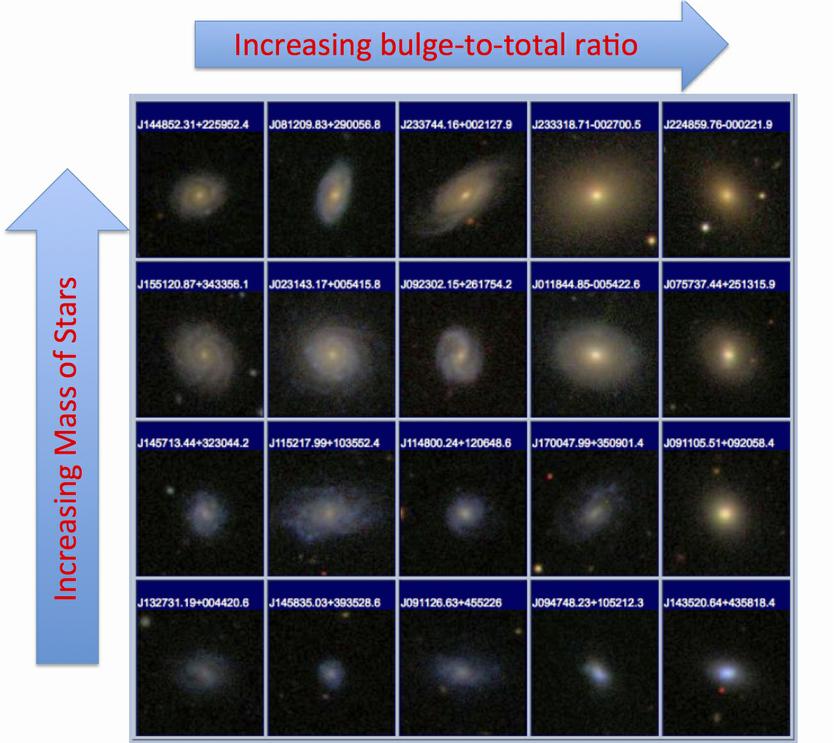
The universe we can see is made up of billions of galaxies, each containing anywhere from hundreds of thousands to hundreds of billions of stars.

Large numbers of galaxies are elliptical in shape, red and mostly made up of old stars. Another (more familiar) type is the spiral, where arms wind out in a blue thin disk from a central red bulge.

On average stars in spiral galaxies tend to be much younger than those in ellipticals.

Now a group of astronomers led by Asa Bluck of the University of Victoria in Canada have found a (relatively) simple relationship between the color of a galaxy and the size of its bulge – the more massive the bulge the redder the galaxy.

I have seen creeping into recent discussions of the TV show ‘Cosmos’ the idea that we scientists, because of our greater knowledge and understanding of how the natural world works, will somehow be intrinsically better when it comes to dealing with matters of ethics, politics or religion.  I beg to differ.

