







The ocean is a noisy place and although we don't hear much when we stick our heads underwater, the right instruments can reveal a symphony of sound.

The noisemakers range from the low-frequency bass tones of a fish mating ritual to the roar of a motorboat. The study of how underwater animals hear is a growing topic in marine science, especially with regards to naval sonar and whales.

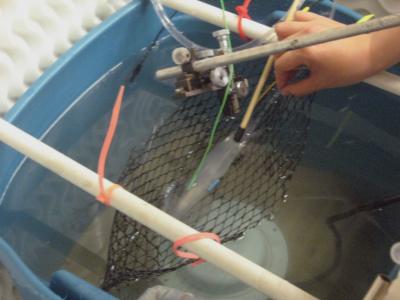
This summer at the Marine Biological Laboratory (MBL), zoologist T. Aran Mooney will be the first scientist to look at cephalopod hearing, using the squid, Loligo pealeii, as a model. To learn how sensitive the translucent animals are to noise, he is monitoring squid brain waves as they respond to various sounds, specifically the echolocation clicks of its main predators: the sperm whale, beaked whale, and dolphin. In addition to the brain wave experiments, he also plans to condition squid to avoid certain sounds.

Oxytocin was originally studied as the "milk let-down factor," i.e., a hormone that was necessary for breast-feeding. However, there is increasing evidence that this hormone also plays an important role in social bonding and maternal behaviors.

A new study in Biological Psychiatry shows that one way oxytocin promotes social affiliation in humans is by enhancing the encoding of positive social memories.

BRAY, Ireland, July 28 /PRNewswire/ --

Advanced Surgical Concepts is pleased to announce that surgeons have used its TriPort device to complete a kidney transplant through only a small incision in the donor's bellybutton. The donor was able to leave the hospital less than 48 hours after the surgery with his surgical scar hidden by the natural contour of the bellybutton, rather than the 12" abdominal scar that is common following kidney removal surgery.

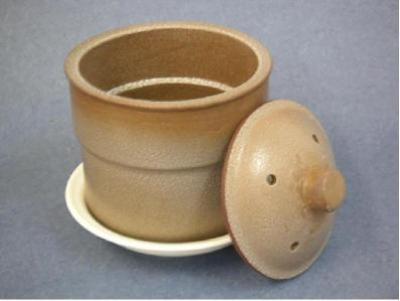
Is even microwave cooking not fast enough for you? Researchers from Saga Ceramic Research Laboratory in Japan and the Department of Crop and Soil Sciences and Materials Research Institute at Pennsylvania State University report in Chemistry of Materials that their new ceramic materials heat up faster and retain heat longer than conventional microwave cookware, all while using less energy.

In the new study, Sridhar Komarneni, Hiroaki Katsuki, and Nobuaki Kamochi note that researchers long have sought a commercially feasible method for using microwaves in the production of new genres of sturdy-heat-resistant ceramic materials. However, no optimal process had been developed.

Cut off one finger from a salamander and one will grow back. Cut off two and two will grow back. It sounds logical, but how the salamander always regenerates the right number of fingers is a biological mystery.

The salamander isn't the only animal with this regenerative ability. Take the sea squirt, Ciona intestinalis, a cylindrical marine creature about the size of a small cucumber that regularly loses its siphons, or feeding tubes, to hungry predators.

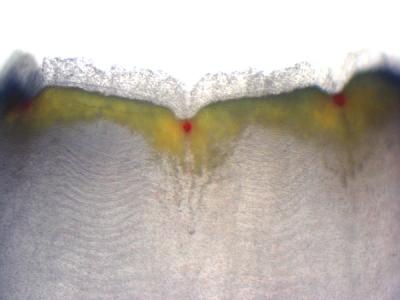
At the base of each siphon are eight photoreceptors, cells used to detect light. Whenever the sea squirt experiences a violent loss at the siphon base, the number of photoreceptors that grow back is always eight.


Two of the sea squirt's eight photoreceptors, dyed red, which are found at the base of its siphons. Credit: Dr. William Jeffery

Cells are intrinsically artistic. When the right signals tell a cell to divide, it usually splits down the middle, resulting in two identical daughter cells, though stem cells are the exception to the rule. This natural symmetry is visible on the macroscopic scale as well. All living creatures, be they mushrooms or humans, are visibly symmetric, a product of our cells' preference for equilibrium.

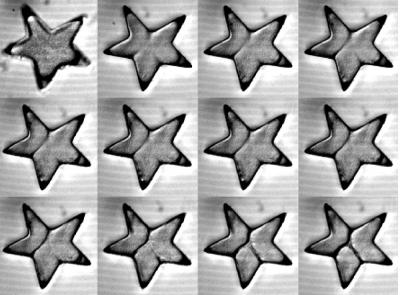
Scientists at the Marine Biological Laboratory (MBL) Whitman Center for Visiting Research are curious to know what cues tell a cell to divide at the center. Fred Chang, professor of microbiology at Columbia University, his postdoctoral student Nicolas Minc, and David Burgess, professor of biology at Boston College, are placing sea urchin eggs in snug, microscopic chambers shaped like triangles, squares, rectangles, stars, and ice cream cones to see whether the cell will still split 50-50.

The International AIDS Vaccine Initiative (IAVI) and Key Thought Leaders Explore Critical Next Steps for AIDS Vaccine Research at the 17th International AIDS Conference in Mexico City.

Today, they write, AIDS vaccine research is at a pivotal moment. Just ten months ago, the second AIDS vaccine candidate to reach late-stage testing failed. In the wake of this disappointment, some skeptics have argued that an AIDS vaccine may not be possible and that resources dedicated to its development should be directed instead towards treating HIV-infected individuals.

Almost every metropolitan area in America has a "dead man's curve", a road notorious for fatalities. If you've moved to a new location, you may not know of it. Using the interactive maps on www.saferoadmaps.org developed by University of Minnesota researchers, you can learn which roads near your home or work are considered dangerous simply typing in your address.

Researchers in the Center for Excellence in Rural Safety (CERS) have mapped out every fatality in the nation with details on each death.

A scientist at the University of Liverpool has found that hypnosis can slow down the impacts of dementia and improve quality of life for those living with the condition.

Forensic psychologist, Dr Simon Duff, investigated the effects of hypnosis on people living with dementia and compared the treatment to mainstream health-care methods. He also looked at how hypnosis compared to a type of group therapy in which participants were encouraged to discuss news and current affairs.

Scientists hope a vaccine is on the horizon for tularemia, a fatal disease caused by the pathogen Francisella tularensis, an organism of concern as a potential biological warfare agent. Until recently we knew very little about this bacterium. However, according to the August issue of the Journal of Medical Microbiology, research on the bacterium has been reinvigorated and rapid progress has been made in understanding how it causes disease.

Infection with F. tularensis can result in a variety of symptoms, depending on the route of infection. For example, infection via an insect bite can lead to a swollen ulcer or fever, chills, malaise, headaches and a sore throat. When infection occurs by eating
contaminated food, symptoms can range from mild diarrhoea to an acute fatal disease.

