




In Sweden the welfare system allows for generous maternity leave, long spells of sickness absence with almost full compensation and opportunities to work part time.

The result: women on long term sick leave outnumber men two to one, reveals research published in the online open access journal BMC Public Health. Factors associated with taking long term sick leave among women in study were a self-reported lack of competence for work tasks, high physical and mental demands at work and not enough flexibility or influence over their working lives.

93% of women on sick leave wished to return to work. Although the number of sick leave days claimed ranged from 90 to 381, almost three quarters believed they would return to work within two years.

The majority of non-medical anabolic-androgenic steroid (AAS) users are not cheating athletes or risk-taking teenagers, according to a recent survey published in the Journal of the International Society of Sports Nutrition.

Instead, the typical male user is about 30 years old, well-educated, and earning an above-average income in a white-collar occupation. The majority did not use steroids during adolescence and were not motivated by athletic competition or sports performance.

The study, containing the largest sample to date, was coordinated by Jason Cohen, Psy.D. candidate, using a web-based survey of nearly 2,000 US males.

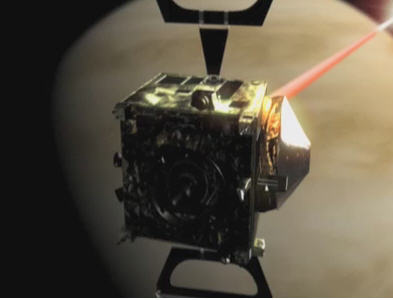
Planetary scientists on both sides of the Atlantic have tracked down a rare molecule in the atmospheres of both Mars and Venus. The molecule, an exotic form of carbon dioxide, could affect the way the greenhouse mechanism works on Venus.

The discovery is being announced today at the annual meeting of the American Astronomical Society’s Division of Planetary Sciences in Orlando, Florida. Its presence could affect the way the greenhouse mechanism works on Venus. The mystery began back in April 2006, soon after ESA’s Venus Express arrived at the second planet in the Solar System.

The ability to tactually recognize fine spatial details, such as the raised dots used in braille, is especially important to those who are blind. With that in mind, a team of researchers has identified the neural circuitry that facilitates spatial discrimination through touch. Understanding this circuitry may lead to the creation of sensory-substitution devices, such as tactile maps for the visually impaired.

The research team, led by Krish Sathian, MD, PhD, professor of neurology in Emory University School of Medicine, included first author Randall Stilla, research MRI technologist at Emory, and Gopikrishna Deshpande, Stephen Laconte and Xiaoping Hu of the Coulter Department of Biomedical Engineering at Georgia Tech and Emory.

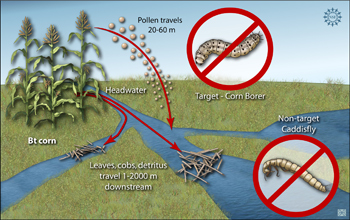
A new study indicates that a popular type of genetically engineered corn--called Bt corn--may damage the ecology of streams draining Bt corn fields in ways that have not been previously considered by regulators. The study appears in the Oct. 8 edition of The Proceedings of the National Academy of Sciences.

This study provides the first evidence that toxins from Bt corn may travel long distances in streams and may harm stream insects that serve as food for fish.

A collaboration of University of Pennsylvania chemists and engineers has performed multi-scale modeling of ferroelectric domain walls and provided a new theory of behavior for domain-wall motion, the "sliding wall" that separates ferroelectric domains and makes high-density ferroelectric RAM (FeRAM) possible.

The new theory, supported by a novel modeling study developed specifically for this research, confirms experimental data long at odds with existing theories of domain-wall behavior. Most notable is that, Penn's simulations reproduced experimental domain growth rates and revealed small, square critical nuclei with a diffuse interface. Researchers also found that small dipoles play a key role in smoothing the transition between up and down regions as the wall moves.

Expensive trainers are not worth the money, finds a study in the British Journal of Sports Medicine.

Cheap and moderately priced running shoes are just as good, if not better, in terms of cushioning impact and overall comfort, it concludes. The research findings are based on a comparison of nine pairs of trainers, bought from three different manufacturers, in three different price ranges. The cheapest pairs were priced at £40 to £45, with the moderate range costing £60 to £65. The three most expensive pairs cost £70 to £75.

The 43 participants were not told how much any of the shoes cost.

Embryologists at University College London have helped solve an evolutionary riddle that has been puzzling scientists for over a century. They have identified a key mechanism in the initial stages of an embryo's development that helps differentiate more highly evolved species, including humans, from less evolved species, such as fish.

Early on in development, the mass of undifferentiated cells that make up the embryo must take the first steps in deciding how to arrange themselves into component parts to eventually go on to form a fully developed body. This is a process known as 'gastrulation'.

During this stage, the cells group into three layers, the first is the 'ectoderm' which then in turn generates the 'mesoderm' and 'endoderm' layers.

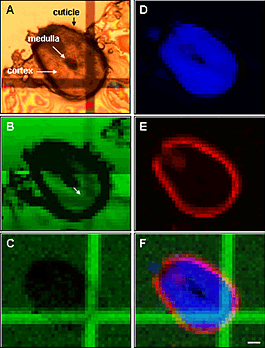
Scientists at the U.S. Department of Energy's Brookhaven National Laboratory have developed a method for correlating the results of microscopic imaging techniques in a way that could lead to improved understanding, diagnosis, and possibly treatment of a variety of disease conditions, including Alzheimer's disease. The Laboratory has filed a U.S. provisional patent application for the invention.

The invention is essentially a micron-scale metallic marking grid upon which scientists place their samples - biological tissues or inorganic samples such as minerals - prior to imaging with different methods.

Dental x-rays could be a thing of the past thanks to a new knowledge transfer partnership between the University of Abertay Dundee and pioneering research firm IDMoS.

A team of scientists from the university’s SIMBIOS (Scottish Informatics and Mathematics Biology and Statistics) Centre will use sophisticated CAT (Computerised Axial Tomography) scanning equipment to verify that the company’s newly developed equipment for detecting dental cavities works.

Chair of the Environmental Sciences School, Professor Iain Young said: “IDMoS have developed a non-invasive method of checking teeth for cavities.

