
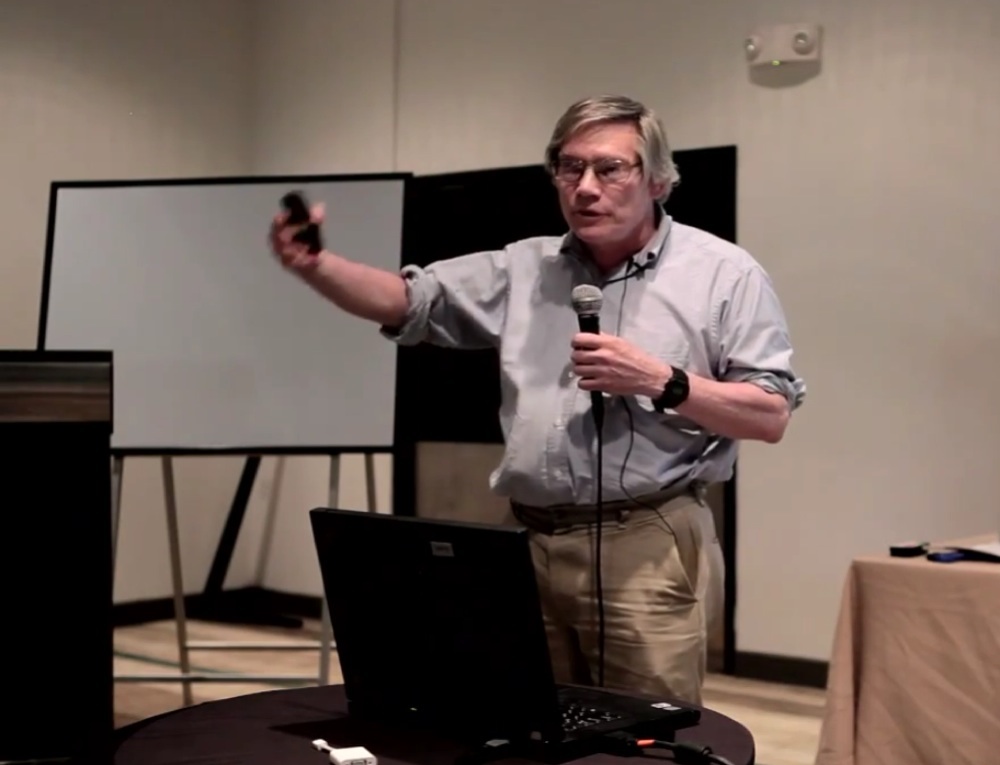




Apparently the EPA has not yet discovered how to do a video conference.

The U.S. Environmental Protection Agency has announced that Administrator Gina McCarthy will promote President Obama’s Climate Action Plan to cut carbon pollution, slow the effects of climate change and leave a cleaner environment for future generations by doing an Earth Week Tour, flying around to talk about how we should cut emissions.

She likes to fly. When she is not flying around to save all of us from emissions, she is commuting to Washington, D.C. weekly from her home in Boston.
Our universe is eternal, expanding indefinitely, and not threatened by any form of 'heath death'. All evidence points into this direction. In fact, at the end of the nineteenth century Ludwig Boltzmann had collected all the evidence to draw such conclusions. His consistent reasoning on how to render the reversible laws of physics compatible with the second law of thermodynamics brought him close, but he failed to make the final decisive steps.

Ok, I realize that at Boltzmann's time our knowledge of the universe didn't stretch beyond the Milky Way, the island of stars that we inhabit. And yes, I admit reasoning here with the benefit of a heap of hindsight. But even now, in the twenty-first century, this hindsight is apparently not distributed uniformly.

Researchers report that they have discovered a new genus and species of electric knifefish in several tributaries of the Negro River in the Amazonia State of Brazil.

Professor Cristina Cox Fernandes at UMass Amherst, with Adília Nogueira and José Antônio Alves-Gomes of INPA, describe the new bluntnose knifefish in the current issue of the journal Proceedings of the Natural Sciences of Philadelphia and detail the new genus and species' anatomy, range, relationship to other fish, salient features of its skeleton, coloration, electric organs and patterns of electric organ discharge (EOD).

True to their name, these fish produce electric discharges in distinct pulses that can be detected by some other fish. 

Anywhere from 40 to 60 percent of women who undergo routine screening mammography during a ten-year period will experience a false-positive mammogram.

They then suffer anxiety while they undergo additional testing, sometimes involving a biopsy, to confirm that cancer is not present.

Researchers have suspected that increased anxiety, pain, and the bother of additional tests might adversely affect the quality of life for women who experience false-positive screening mammograms. In a new paper, Dartmouth scholars used data collected by the Digital Mammographic Imaging Screening Trial (DMIST), which was conducted by the American College of Radiology Imaging Network (ACRIN), to study the impact a false-positive mammogram has on women's lives.

Are you on the go a lot? Is your time so limited even moving your eyeballs is putting you behind?

If so, there is an app for that. If not, app developers are looking to create a market for that kind of personalized optimization, so they have devised speed-reading software that eliminates the time we supposedly waste by moving our eyes as we read.

Are eyes just passive conduits getting in the way of the modern world with their ancient biological mechanism? 

A paper in Psychological Science argues that eye movements we make during reading actually play a critical role in our ability to understand what we've just read.

The term "tween" is a marketing colloquialism for a child who is between the ages of 8 and 12 -not quite a little kid but not yet a teenager. A pre-adolescent.

This demographic watches more television than any other age group and is thus considered a lucrative market for advertisers. Tween television programming often consists of the following: "teen scene" and "action-adventure" , which a pair of academics say is shaping stereotypes in tweens rather than reflecting what kids want to watch.

77% of Americans prefer summer over winter and while we know what temperatures actually were this past winter, what people think they were in a recent Harris Poll is something else.

When it came to the temperature, 88 percent of Midwesterners and 84 percent of Easterners say it was colder than normal. 71 percent believe it was while only 18 percent felt it was colder than normal. 45% in the West believe it was warmer than normal.

When it came to precipitation, 77 percent of those in the Midwest, 73 percent in the East and 49 percent say there was more rain or snow in their area. In the West, 62% say they had less rain or snow this winter.

Was the snow due to climate change?
Dr. Bruna Bezerra from the University of Bristol and colleagues have captured video of a wild male marmoset embracing and caring for his dying partner after she accidentally fell from a tree in the Atlantic Forest in the Northeast of Brazil, the first time that compassionate care-taking behavior towards a dying adult group member has been observed in monkeys.

Previously, such behavior was believed to be unique to humans and chimpanzees.

Manure from dairy cows, which is commonly used as a farm soil fertilizer, contains a surprising number of newly identified antibiotic resistance genes from the cows' gut bacteria. The findings, reported in mBio® the online open-access journal of the American Society for Microbiology, hints that cow manure is a potential source of new types of antibiotic resistance genes that transfer to bacteria in the soils where food is grown.

Thousands of antibiotic resistance (AR) genes have already been identified, but the vast majority of them don't pose a problem when found in harmless bacteria. The real worry is when these genes appear in the types of pathogenic bacteria that cause food-borne illnesses or hospital infections.

2,234 adults surveyed online between March 12 and 17, 2014 by The Harris Poll reveal that people are concerned about the environment - but may not be doing much about it.

And over 80 percent avoid labels like “green”, “conservationist” and “environmentalist”, which shows that environmental corporations have lost a lot of credibility among the public. 

However, parents with younger kids are more concerned than childless people, though they are only slightly more likely to tell others to be more environmentally responsible. Women are more likely to indicate encouraging others to be more environmentally-friendly. 25% more women than men claim they are making more effort to be environmentally-conscious than they did a year ago.


