



A study led by Manchester scientists has shown promising results for a new treatment approach in follicular lymphoma.

Follicular lymphoma is a type of non-Hodgkin's lymphoma, a blood cancer, that usually develops slowly but the majority of patients are diagnosed when their disease is already at an advanced stage.

Recent improvements in treatment have included the use of antibodies to specifically target the tumour cells and to stimulate the patient's own immune system to attack their tumor. The use of such antibodies has improved treatment response, but unfortunately most patients still relapse. Radioimmunotherapy – where a radioactive substance is attached to the antibody – has been shown to be successful in treating patients who had previously relapsed. 

Do you think pharmaceutical companies are creating problems that don't exist in order to keep selling drugs to an increasingly over-medicated population? Do you think scientists are unethical if they work at a corporation like DuPont or in nuclear science, rather than being funded by the government?

Such beliefs have become so increasingly mainstream among a particular political and cultural demographic that we can quite easily make lots of accurate determinations about them, the same way we can infer things about someone if they don't buy into global warming.

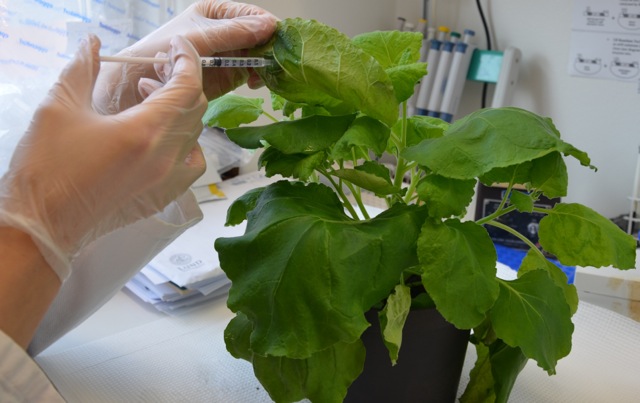
Genetic engineering of tobacco plants so that they produce moth pheromones demonstrates the potential of genetically modified plants to act as factories for the synthesis of insect pheromones, write the authors of a Nature Communications paper.

Pheromones are widely used as an environmentally friendly alternative to traditional pesticides for trapping insects and the new work presents an opportunity for the cost-effective production of an environmentally safe alternative to insecticides. The demographic most likely to ban GMOs and tobacco aren't going to be happy, but they aren't happy with most science. Maybe if the work were done with marijuana it would be more acceptable.

If you ask aging environmental activists, the worst thing that can happen to nature is to have people step onto it.

This is the completely wrong approach, but one adopted by their corporate leaders in the last two generations when they found their donor base becoming increasingly urban. While it was once recognized that hunters, hikers and other sportsmen were obviously the most in love with nature, gradually they became treated like the enemy of environmentalists.

Is depression as dangerous as smoking?

A 12-person panel has published a paper in the journal Circulation saying that their review of literature indicates that depression should be listed with smoking, obesity, diabetes and high blood pressure as risk factors for heart disease.

A new research effort in Ethiopia seeks to improve the productivity of chickpea varieties by harnessing the genetic diversity of wild species.

The federal Feed the Future Initiative is the latest rebranding of the U.S. government’s global hunger and food security initiative.

Chickpea is the third most widely grown legume crop in the world, following soybean and bean, and it has the ability to capture and use atmospheric nitrogen, thus contributing to soil fertility.  This five-year, $4 million research program could be important in the developing world, where the chickpea provides a crucial source of income, food security and nutrition to poor farmers.

You may not know it but on our biosphere - Earth - there is also a relatively unknown world hiding in plain sight. It is composed of microbes that live on floating pieces of plastic floating on the ocean. 

This "Plastisphere" of microbial organisms living on ocean plastic that was first discovered last year and it is now getting studied.

The Fermi National Accelerator Laboratory is still getting important particle work done, years after the closure of the Tevatron was announced.

Scientists on the CDF and DZero
experiments have announced that they have found the final predicted way of creating a top quark, completing a picture of this particle that has been nearly 20 years in the making.

Methane has 23X the impact of carbon dioxide on warming and livestock produces methane - burping cows burp.

A new study has found that several types of aquatic algae can detect orange, green and blue light.

Land plants have receptors to detect the common visual optical wavelengths in the air, light on the red and far red of the spectrum. That allows them to sense the light and move and grow as their environment changes, such as when another plant shades them from the sun.

But the ocean is a different environment. Water absorbs red wavelengths and reflects colors such as blue and green. As part of the study, and the team sequenced about 20 different marine algae and found they were capable of detecting not only red light, but also many other colors.

