

When it comes to what's for dinner – or breakfast and lunch for that matter - too many people suffer from chemophobia, an irrational fear of chemicals that pose no risk to our health.

Chemistry Professor Gordon Gribble argues that low doses of chemicals in modern food are inherent, typically harmless and often highly beneficial. He says most people don't know they are routinely exposed to a host of compounds in non-toxic concentrations in what they eat and drink each day.

Even the air we breathe, whether in big cities or the countryside, is full of naturally occurring and synthetic chemicals, including wine "aroma," flower "bouquet," perfume "fragrance," bakery "smell" and "garbage "stench."

Physicists have successfully teleported information in a solid state system for the first time - they moved information from A to B for the first time in an electronic circuit, similar to a computer chip.

The essential difference between their method and the usual computer chip is that the information is not stored and processed based on the laws of classical physics, but on those of quantum physics. The researchers were able to teleport information across a distance of about six millimeters, from one corner of a chip to the opposite one. This was shown to be possible without transporting the physical object carrying the information itself from the sender's to the receiver's corner.

The Earth has periodic ice ages - every 100,000 years, give or take, and the ice ages last far longer than the warm periods.

In the last century, scientists determined that Earth's ice ages were determined by the wobbling of the planet's orbit, which changes its orientation to the sun and affects the amount of sunlight reaching higher latitudes, particularly the polar regions. The Northern Hemisphere's last ice age ended about 20,000 years ago and then the ice age in the Southern Hemisphere ended about 2,000 years later, suggesting that the south was responding to warming in the north.

 But new research says that Antarctic warming began at least two, and perhaps four, millennia earlier than previously thought.

Which strategies give players an edge at winning in multi-player real-time strategy games like Warcraft III/ Defense of the Ancients or Starcraft II?

An analysis technique by North Carolina State University computer scientists offers extremely precise information about how a player's actions affect a team's chances of winning, and could be used to develop technology for use by players and developers to improve gameplay experiences.

Their technique various existing analytical tools to evaluate logs of player actions from thousands of real-time strategy games. They then used that information to develop a set of rules governing team gameplay strategies, in order to identify which approaches give teams the best chance of winning.

Cleaner drinking water with fewer chemicals may be made possible using ... bacteria.

A research team studied four bacteria, Sphingobium, Xenophilus, Methylobacterium and Rhodococcus, found in a city's drinking water to see which combinations were more likely to produce a 'biofilm'. Biofilms are layers of bacteria which form on the inner surfaces of water pipes. Like in many instances, bacteria can be harmful or not.

For as much as the War of the Roses has been over-analyzed and documented, you'd think researchers would know where the Battle of Bosworth, which brought the Plantagenet King of England Richard III to a grisly end at the hands of the Tudors, was fought.

Not really.  it was thought that the Battle of Bosworth took place at a site in Leicestershire called Ambion Hill. There is a battlefield heritage center there.  Like Glastonbury being the burial place of King Arthur, sometimes the English just pick a spot.
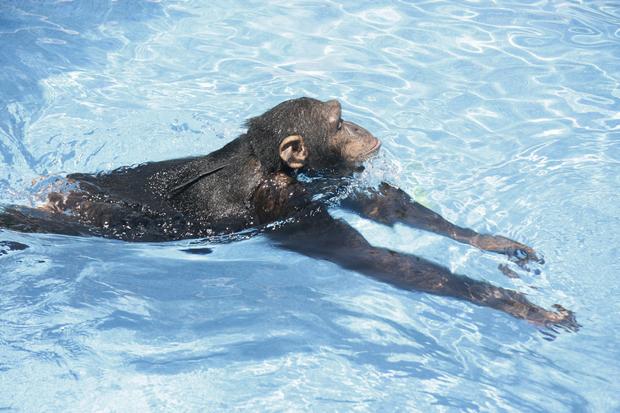
Zoos have used water moats to confine chimpanzees, gorillas or orangutans. When apes ventured into deep water, they often drowned, which indicated that apes could not learn to swim and so prefer to stay on dry land.

But it turns out that they can.

Two researchers have video-based observation of swimming and diving apes. Instead of the usual dog-paddle stroke used by most terrestrial mammals, these animals use a kind of breaststroke. This swimming strokes peculiar to humans (and apes) might be the result of an earlier adaptation to an arboreal life.

Light traveling in a vacuum is the ultimate speed demon, moving at about 700 million miles per hour.

Matter cannot exceed the speed of light - unless, perhaps, there is a speed bump in light's path. Researchers from  France's Université de Nice-Sophia Antipolis and China's Xiamen University have embedded dye molecules in a liquid crystal matrix to throttle the group velocity of light back to less than one billionth of its top speed. The team says the ability to slow light in this manner may one day lead to new technologies in remote sensing and measurement science. 

It's not right for cobia not to be carnivorous but researchers in Baltimore have scientifically modified these fish so that they no longer occupy their usual place in nature's circle of life: they are now unnatural vegetarians.

During four years of experimentation, these "scientists" created a synthetic mixture using taurine, a chemical found in human energy drinks, plant-based (not fish) proteins and fatty acids and fed it to these unsuspecting creatures and it ruined their diets; they became addicted to this new Frankenfood and changed their feeding patterns.
Readers of this blog are familiar with my criticism of some scientists or scientific practices, from evolutionary psychology to claims concerning the supernatural. But, especially given my dual background in science and philosophy, I pride myself in being an equal opportunity offender.


