



An international team has found evidence of substantial overlap for genetic risk factors shared between bipolar disorder, major depressive disorder and schizophrenia and less overlap between those conditions and autism and attention deficit-hyperactivity disorder (ADHD).

The root causes of psychiatric illnesses are not known. Instead, for the past 125 years, clinicians have based diagnosis on a collection of symptoms observed in patients, something medical science has long left behind - and so the race has been on to find biological links.

A pre-emptive warning to the reader: the article below is too long to publish as a single post. I have broken it out in four installments. After reading the text below you should continue with part II, part III, and part IV (which includes a summary).

Here's a development that could have significant implications for electrochemistry, biochemistry, electrical engineering and many other fields: a Nature Materials paper is about computer simulations which find that the electrical conductivity of many materials increases with a strong electrical field in a universal way. 

Electrical conductivity is a measure of how strongly a given material conducts the flow of electric current and is generally understood in terms of Ohm's law, which states that the conductivity is independent of the magnitude of an applied electric field, i.e. the voltage per meter. This law is widely obeyed in weak applied fields, which means that most material samples can be ascribed a definite electrical resistance, measured in Ohms.

You have decided to start a graduate study in physics. Where should you apply? And how to decide which offer to take?

A diarrhea of lists attempt to rank "the world’s best universities". Mostly these lists are based on some aggregate of different metrics. Yet, for a postgraduate degree your focus should be on one and only one metric: you want to surround yourself with the best brains. If you're good, the place to hone your skills is there where you get the opportunity to learn from the best. There where you can join those that are making impact in their field of research.

What are the high-impact universities in physics?
What group has above average interest in systems and scores below average in empathy?

If you answered autistic people, you are correct. If you answered girls with anorexia, also correct.

Girls with anorexia nervosa show a mild echo of the characteristics of autism, suggests new research. At first glance, anorexia and autism seem very different, but they both share certain features, such as rigid attitudes and behaviours, a tendency to be very self-focussed, and a fascination with detail. Both conditions also share similar alterations in structure and function of brain regions involved in social perception.

I wrote before about the controversy involving the release earlier this year of a genome sequence of the HeLa cell line, which was taken without consent from Henrietta Lacks as she lay dying of ovarian cancer in 1950s Baltimore.

Now, the NIH has announced an agreement with Lacks’ descendants to obtain their consent for access to and use of the HeLa genome (the agreement applies only to NIH funded research, but the hope is that others will agree to it as well).

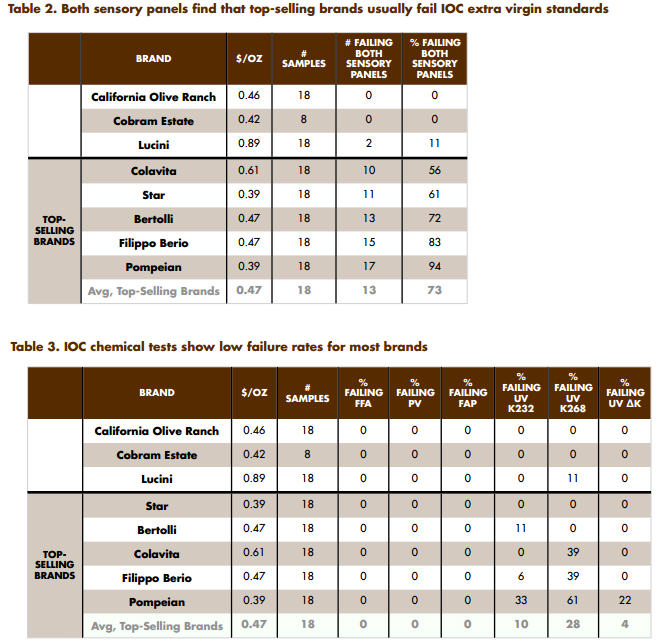
When I think of cheap knock-offs I think of things like a Rolex watch or a Gucci handbag, but apparently knock-off food is a $10-15 billion industry.

I don't even mean the faux organic stuff sold as such because some shell company in China claims it is organic and no one bothers to test it, actual food in real supermarkets is sometimes fake, or at least misleading, according to Shaun Kennedy, associate professor of veterinary population medicine at the University of Minnesota Director of the National Center for Food Protection and Defense.

A young child buried in the medieval town of Ribe in Denmark 800 years ago had an unpleasant life even before that - because the child had been given a large dose of mercury in an attempt to cure a severe, ongoing illness. 

A new methodology developed by chemist Kaare Lund Rasmussen from University of Southern Denmark and colleagues can reveal an unprecedented amount of details about the time even shortly before a person's death. Mercury is of particular interest for the archaeologists as many cultures in different part of the world have been in contact with the rare (and toxic) element.

There is a phenomenon in speech called coarticulation, in which certain sounds are produced differently depending on the sounds that come before or after them.

For example, though the letter n is usually pronounced with the tongue pressed near the middle of the mouth's roof (as in the word "ten") but it's pronounced with the tongue forward when it's followed by a –th, as in tenth).

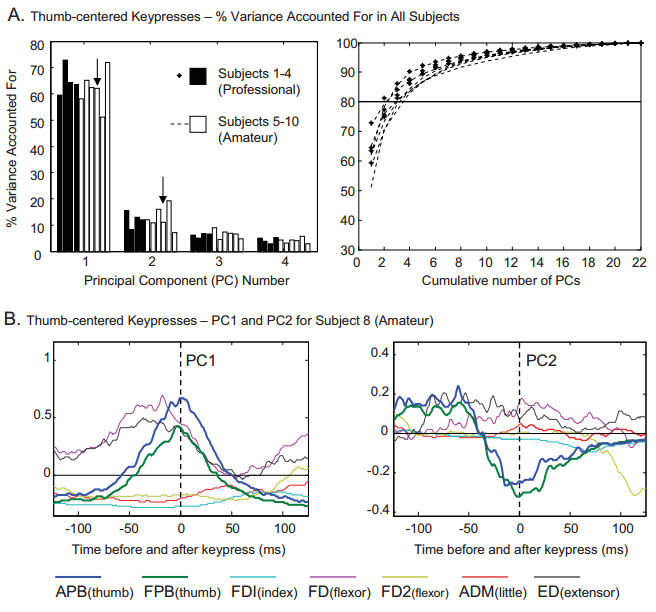
A decade ago, researchers discovered that coarticulation extends to a different kind of communication - American Sign Language. Knowing that hand movements could be affected according to where they fit in during sign language, researchers wondered if there was a similar effect on hands when they were used to produce sound, such as playing the piano. 

Surveys show that people have less empathy for battered human adults than they do dogs, according to a paper at the American Sociological Association.

Jack Levin  and Arnold Arluke, sociology professors at Northeastern University, used the opinions of 240 men and women, most of whom were white and between the ages of 18-25 (college students), at a large northeastern university (guess which one) who randomly received one of four fictional news articles about; the beating of a one-year-old child, an adult in his thirties, a puppy, or a 6-year-old dog. The stories were identical except for the victim's identify. After reading their story, respondents were asked to rate their feelings of empathy towards the victim.


