

New research just out in the journal Science Translational Medicine opens the door for treatments capable of stopping Alzheimer’s disease (AD) before its first symptoms, that is to say before crucial damage occurs. In fact, while AD is a devastating disorder, it is also an extremely slow one; it takes more than 10 years for the first symptoms to appear making this preclinical period (pre-symptoms) the ideal time to intervene. 

Excavations of tools at two neighboring Paleolithic sites in southwest France have made the blurred lines between modern humans and Neanderthals more blurry. 

Two research teams from the Max Planck Institute for Evolutionary Anthropology in Leipzig, Germany, and the University of Leiden in the Netherlands have jointly reported the discovery of Neandertal bone tools unlike any others previously found in Neandertal sites - but similar to a tool from later modern human sites and still and still used even today. 

Near-death experiences may have found a new grounding in science.

Whether and how the dying brain is capable of generating conscious activity has been vigorously debated but the near-death experiences reported by cardiac arrest survivors worldwide may be verifiable, according to a new paper.

Approximately 20 percent of cardiac arrest survivors report having had a near-death experience during clinical death. These visions and perceptions have been called "realer than real" but it remains unclear whether the brain is capable of such activity after cardiac arrest.

A new paper found that shortly after clinical death, in which the heart stops beating and blood stops flowing to the brain, rats display brain activity patterns characteristic of conscious perception.

Researchers have measured light emitted by photoluminescence from a nanodiamond levitating in free space. 

Their paper describes how they used a laser to trap nanodiamonds in space, and – using another laser – caused the diamonds to emit light at given frequencies.

The experiment, led by Nick Vamivakas, an assistant professor of optics at the University of Rochester, demonstrates that it is possible to levitate diamonds as small as 100 nanometers (approximately one-thousandth the diameter of a human hair) in free space, by using a technique known as laser trapping.  Specifically, nitrogen vacancy (NV) photoluminescence (PL) from a nanodiamond suspended in a free-space optical dipole trap.

Ice ages and warm periods have alternated fairly regularly in the Earth's history: 90,000 of every 100,000 years in the past had vast areas of North America, Europe and Asia being buried under thick ice sheets.

Eventually, the pendulum swings back, it gets warmer and the ice masses melt. 

There's solid evidence of this 100,000-year cycle in glacial moraines, marine sediments and arctic ice, but a plausible explanation for it is harder to find.  

Researchers have described
Megaconus mammaliaformis, an unusual mammal that lived about 165 million years ago.

Previously, all that was known about this long-extinct mammal was a few little teeth with striking cusps on their occlusal surfaces. "Paleontologists have been wondering for over a hundred years what the animal that went with these teeth might have looked like," said Prof. Dr. Thomas Martin from the Steinmann-Institut of the University of Bonn. But locals then found a completely preserved skeleton of the enigmatic mammal in Northeast China, which was then acquired by the Paleontological Museum of Liaoning in Shenyang.

A plastic material already used in absorbable surgical sutures could also administer antibiotics to patients with brain infections, scientists report in a new study. Use of the material, placed directly on the brain's surface, could reduce the need for weeks of costly hospital stays now required for such treatment, they say in the journal ACS Chemical Neuroscience.

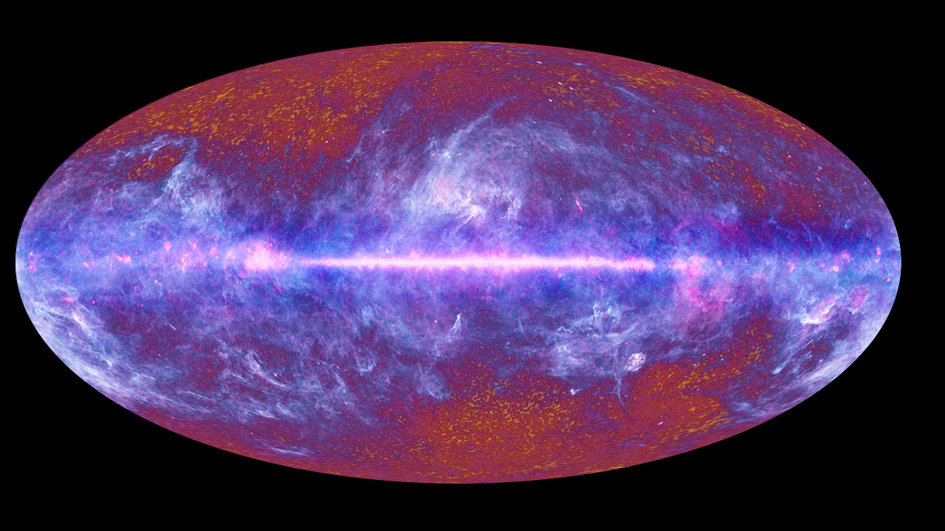
Detectives of both the amateur and occupational variety know that the best way to solve a mystery is to visit the scene where it began and look for clues.

Cosmological detectives do that too, by trying to peer as far back to the Big Bang as possible. A new analysis of cosmic microwave background (CMB) radiation data has taken the furthest look back through time yet – 100 years to 300,000 years after the Big Bang - and provided tantalizing new hints of clues as to what might have happened.

Steven Pinker has written a long essay in The New Republic embracing scientism. That's really too bad, because this way Pinker joins a disturbingly long list of scientists (and a few philosophers) who confuse a defense of good science with a knee-jerk reaction against sound criticism of science. [For a good, if partial, response to Pinker from the Left look here; for a far less convincing one, from the Right, look here.]
We're in a hyper-regulated society. Everyone wants to regulate other people while they claim to care about freedom and choice. If you claim to care about freedom and then want to ban marriage or IVF or food or medicine, I know how you vote.

As a hallmark of its presidency, the White House advocated and got passed the Affordable Care Act, which friend and foe alike call Obamacare.


