



Fuel cells can be as efficient (or more) than internal combustion engines, silent, and at least one type produces zero greenhouse emissions at the tail pipe. Car and bus manufacturers as well as makers of residential and small-business-sized generators have been testing and developing different forms of fuel cells for more than a decade but the high cost and insufficiencies of platinum catalysts have been the Achilles heel. 

An inexpensive and easily produced catalyst that performs better than platinum in oxygen-reduction reactions could be a step toward eliminating what industry regards as the largest obstacle to large-scale commercialization of fuel cell technology. 

While the Orion Nebula is one of the closest stellar nurseries to Earth and that makes for great viewing in backyard telescopes, it is not the most prolific star-forming region in our galaxy. That distinction may go to the Cat's Paw Nebula, otherwise known as NGC 6334, formally known as  NGC 6334, which is experiencing a "baby boom."

The drug aflibercept, under the trade name Eylea, has been approved in Germany since November 2012 for the treatment of wet age-related macular degeneration (AMD). 

In an early benefit assessment pursuant to the Act on the Reform of the Market for Medicinal Products (AMNOG), the German Institute for Quality and Efficiency in Health Care (IQWiG) examined whether this new drug offers an added benefit over the current standard therapy. Such an added benefit cannot be derived from the dossier, since the manufacturer did not submit data for the comparison, says the advocacy group in Germany.

A new species of tiny blenniiform fish has been discovered in the southern Caribbean. Haptoclinus dropi is only around 2cm in length with a color pattern that includes iridescence on the fins.

The proposed common name of the species is four-fin blenny, due to the division of the dorsal fin into four sections, which is a distinguishing feature of the genus and unique among blenniiform fishes. 

A few years ago, I wrote a piece for Communicating Astronomy with the Public outlining how to more effectively reach the public.(1)

I have some credibility. Science 2.0 has become a well-known movement despite not having media conglomerate backing, a marketing department, a sales force or any government funding, Not many can do that - or they probably would.
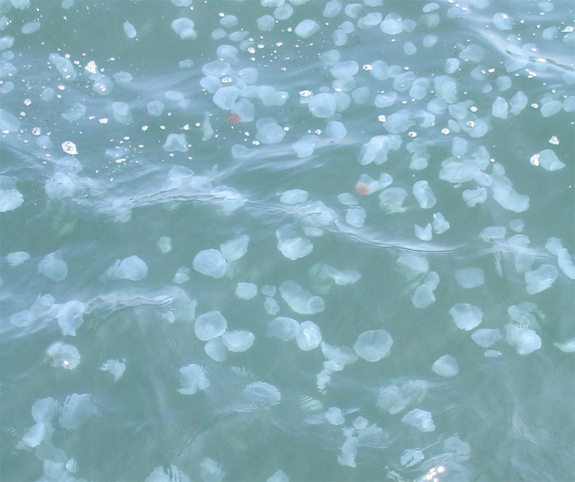
Jellyfish Blooms

Newspapers are currently reporting a surge in jellyfish numbers in the Mediterranean. 

Along with the surge in jellyfish numbers, or bloom, is a surge in bad reporting about global warming.  This is one occasion when I am on the side of the 'natural cycles' folks: jellyfish have a 20 year boom and bust natural cycle.
Female mosquitoes are predators of mammalian blood, relying on blood proteins to lay their eggs. While certain mosquito species are attracted to mammals by their emission of body heat and carbon dioxide, other species, such as Anopheles gambiae and Aedes aegypti, have evolved a strong lust for the smell of humans. Such mosquitoes are also deadly vectors that contribute to the efficient spread of human diseases such as malaria, Dengue hemorrhagic fever, West Nile fever, and chikungunya, with the latter two commonly known as urban epidemics.  
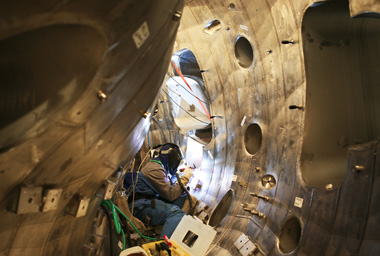
The last open seam on the steel outer cover of the Wendelstein 7-X fusion device was closed last week, which means the core of fusion device and the installation stage has been completed and it can go into operation at the Greifswald branch institute of Max Planck Institute of Plasma Physics (IPP) in 2014.

A new paper suggests women can remember faces better than men, in part because they spend more time studying features - without even knowing it.

Some Paleo Diet believers think neither food nor humanity has evolved but anthropologists disagree. They have found that diets were a 'game changer' in ancient African hominid evolution, even 3.5 million years ago.

Tests on tooth enamel indicate that prior to about 4 million years ago, Africa's hominids were eating essentially chimpanzee style, likely dining on fruits and some leaves, said University of Colorado Boulder anthropology Professor Matt Sponheimer, lead author of the study. Though grasses and sedges were readily available back then, the hominids seem to have ignored them for an extended period.


