The last posts in this series will discuss some of the practical issues of performing research on complex themes.
Whether you agree or not, the funding machine for solar and wind energy is in motion and it is hard to stop - look at the debate over ending ethanol subsidies.
One way to make an informed policy decision is to truly know just how much solar energy will be provided in a 'smart' grid scenario, beyond optimistic projections by lobbyists. U.C. San Diego Professor Jan Kleissl and Matthew Lave, a Ph.D. student in the Department of Mechanical and Aerospace Engineering at the Jacobs School, say they can do it. They developed a software program that allows power grid managers to predict fluctuations in the solar grid caused by changes in the cloud cover - and even discovered a solar variability 'law'.
Researchers say that a protein expressed in the human retina, human cryptochrome 2 protein (hCRY2), can sense magnetic fields when implanted into Drosophila, leading to an interesting topic in sensory biology; perhaps humans have an innate magnetic sense.
Migratory birds and sea turtles do, and that ability to sense the Earth's magnetic field is how they navigate long-distance voyages during migration.
A study in Canada says Canadian pre-schoolers prefer to play with kids more like them.
Are Canadian parents ingraining bias in their kids? Or French-Canadians? Hard to know. Participants were recruited from six daycares located in Montreal and its suburbs: 30 mostly second-generation Asian-Canadians and 30 French-Canadians. Children were paired with peers they had known for at least three months. According to the research team, social mores likely prompted a lack of interaction between cultures.
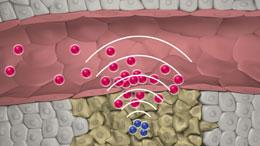
By using two types of nanoparticles, drug delivery to tumors could be increased significantly. At the moment, several drug-delivering nanoparticles are already being used in clinical trials to combat tumors. A team at MIT decided to use two distinct particles, each with its own job, one to locate the tumor, and another one to deliver the drugs, all the while making use of the body’s own blood clotting system.
A paper describing the first evidence of top pair production in association with a energetic photon has just
appeared on the Cornell Arxiv. This search has been performed by the CDF collaboration in a sample of 6 inverse femtobarns of proton-antiproton collisions.
There is nothing strange or particular about the fact that any hard production process at a hadron collider can produce, in addition with a massive state such as a top pair, additional energetic photons. That is because any charged particle involved in the process will have a small but finite chance of radiating electromagnetic energy, with a strength governed by our good-old fine-structure constant.
A great title is key to getting lots of views. For my blogs, ones with the fewest views include “Snarky Puzzle Answers”, and “Snarky Puzzle Answers 2”. Do I have high expectations for SPA 3, Revenge of the Nerds? Nope, I expect the community to be consistent. This is an observation, not a complaint, honest.
What is exciting to me is that I am asking questions and developing answers. I want to emphasize the plural. This is not a one trick pony (quaternions can do 3D rotations and nothing else of interest). Many different topics are being raised and looked at from odd angles. I didn’t have a plan to write these puzzles, but am glad they emerged from the blog writing process. Now back to the questions and their answers.
The Quantum Randi Challenge (QRC), first introduced here, exists in order to stop the spread of pseudo-science by simply teaching quantum mechanics. Here is the official version of the challenge (also published here and partially in Annals of Physics 339: 81-88). [We are still looking for people who can help to turn it into a multiplayer internet app.*]
What is a “Randi-type” challenge?
According to Feynman, the 2-slit experiment with electrons "has in it the heart of quantum mechanics" and "is impossible, absolutely impossible, to explain in any classical way". To begin with, it may not be amiss to inform the never-ending discussion of this experiment with a knowledge of the rules that go into calculating the predicted and observed interference pattern.
The mathematical formalism of quantum mechanics can be built up on the basis of the following rules. Suppose that you want to calculate the probability of a particular outcome of a measurement M2, given the outcome of am earlier measurement M1. Here is what you have to do:
A new study shows that the rate of sea-level rise along the U.S. Atlantic coast is greater now than at any time in the past 2,000 years - and a consistent link between changes in global mean surface temperature and sea level.