History, Science and the TMT BoundaryTo the extent that written records show political, religious or other personal bias, it may be truly said that history is bunk. Or we may say with
Henry Ford that history - as a list of dates of political events - is bunk. But if we take the term 'history' as inclusive of everything known about the past that has a bearing on our current collective human knowledge, then history is a most valuable asset.
A group of biologists have discovered seven previously unknown species of mammals on Luzon Island in the Philippines.
All of the species are forest mice, and each species lives only in a small part of Luzon. Two of the new species live only in the Zambales Mountains (on Mt. Tapulao), two live only on Mt. Banahaw (south of Manila), two only in the Mingan Mountains of Aurora Province, and one lives only in the Sierra Madre of northeastern Luzon.
Scientists at Karolinska Institutet
and Helsinki University
are reporting that DCDC2, a gene linked to dyslexia, has a surprising biological function: it controls cilia, the antenna-like projections that cells use to communicate.
Sexting, where people send photographs and sexually explicit text messages to titillate them and perhaps increase the likelihood of a sexual relationship, is a fairly new phenomenon.
The Internet has made the act of infidelity much easier and though sex and infidelity are now only a keyboard away, the goal for many seems to remain physical, face-to-face contact, at least in sexual relationships. Obviously plenty of people lie or try to initiate cyber-relationships with no interest in actual human contact.
You've heard or read the scenarios - rapidly escalating levels of CO2 could cause rapidly escalating temperatures, even as much as 18 degrees Fahrenheit. The problem is that they are just scenarios based on a growing, yet incomplete, understanding of how climate works.
During some periods in the past, there has been 10 times the CO2 present today with little change in temperature. At other times, temperatures have spiked rapidly but it had little to do with CO2.
Climate change is very complex, and, consequentially, models predicting it need to take into account many different aspects, from wind patterns to plant and algal growth. One of the expected consequences of the changing climate is that some regions will be drier, while others will be subjected to higher rates of precipitation, which, up in the north, means more snow.
If you're anything more than an infrequent stumbler to Science 2.0, then you will probably have noticed - if not, read -
Helen's article on geomagnetic polarity reversals, which until recently has been floating in the top articles list.
Whilst it's a gallant attempt to understand the ins and outs of an incredibly complex and poorly understood process, there are a number of misconceptions that I thought would be a good idea to clear up. It's clearly a topic of great interest, because there are over 400 comments on the article.
Before going into these misconceptions, though, let's start with...
BeautifulPeople.com, a dating and networking community which claims to be exclusively for good-looking people, apparently has programming and security that was done by beautiful people rather than smart ones.
30,000 ugly people recently invaded the site, bypassing the "strict rating stage" where currently designated beautiful members decide the fate of new applicants. The rating module was brought down last month, allowing anyone - regardless of looks(gasp!) - to be accepted.
According to
Karl Popper, there are two contexts at work when trying to understand science. One is called 'the context of discovery', the other 'context of justification'. In many ways all human cognitive activities share similar divisions; art for instance also tends to fall apart in discussions on the intrinsic qualities, the skills, and mastery of the craft on one side, and discussions on the meaning, the purpose, and the place of art in society on the other. Philosophy (of science) itself knows many discussions on the issues related to discovery (e.g.
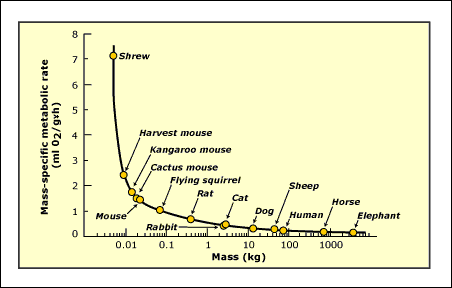
Recently, research has been conducted to see if certain life-history traits could be correlated with DNA mutation rates. By using whole-genome sequence data for 32 species of mammal, the researchers tested the hypothesis that DNA mutation rates are influenced by species-specific life-history traits. These mutation rates were estimated by looking at the rate of substitutions of neutrally evolving DNA segments.
This type of research could make it possible to infer life-history information of extinct species, providing that genomic data is present.
The research focused on three life-history traits.
1) Generation time