I went to a conference this morning at the Hope Street Group, a DC-based think tank. They had a panel of doctors, PhDs, a lawyer, consultants, John Podesta (Clinton's healthcare czar) and an economist discussing Using Open Innovation to Reinvent Primary Care.
Panel moderator was former Washington Post healthcare policy reporter Ceci Conelley who jumped ship to McKinsey probably for gobs more money.
While no one mentioned the P-word (price) a great deal of the discussion centered around reducing costs.
Some points were really interesting. Among them:
The three problems of humanity were outlined in a talk by Nick Bostrom (of Oxford University, UK) at
TED in April 2009.
In this piece I will continue to examine the "big" problems identified in the TEDTalk.
Problem #2: Existential Risk is a BIG problem.
Paleontologists recently unearthed bones, likely in Montana or Wyoming, of a new dinosaur species dubbed Stochastisaurus. "Based on surrounding species and the fossils themselves, there's an approximately 88% chance that Stochastisaurus was an herbivore," says the lead researcher.
Anyone can be skeptical about a scientific result. It's good to state your skepticism, to make your view known. But are you done once you speak your view? Is that all it takes, a quick skeptical wrench and we shut off the flow of science? Guest writer Dan Krimm neatly captures the useful role of skepticism in the scientific process, below.
Alex
Tuesdays at
The Satellite Diaries and Friday at
The Daytime Astronomer (twitter
@skyday)
The title, “The 2010s will be to the 2060s what the 1960s are to us today” is in a sense the most uplifting quote I have heard in a long while (yeah, I know about all the bad things, too, whatever). Since the 60s also stand for quite some influence of psychoactive substances onto later influential, if not revolutionary science and technology that made especially the "2.0" of Science2.0 possible at all, and since indeed the 2.0 part is taking off right now (as is a new wave of psychoactive activity above and underground), I found these quite fitting to add to the topic of Science2.0.
We've all done it: we've blurted out something we wish we'd bitten back. We've made a face or indicated our displeasure or contempt when it would have been better to maintain the appearance of neutrality. We've all, I'm sure, written something we wish we could take back.
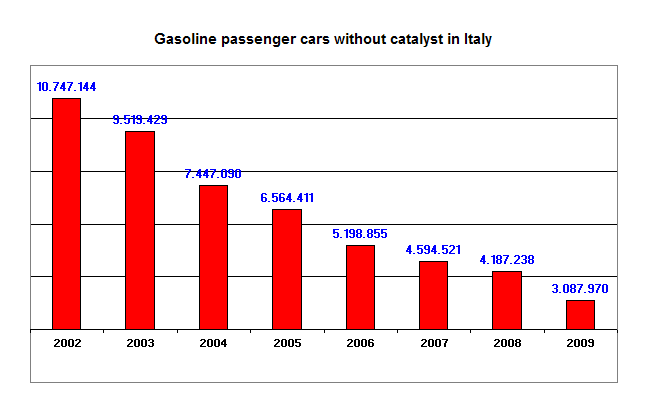
In Europe and worldwide the public attention to environmental protection is growing, together with research of new technologies and new solutions to reduce pollution sources, also in the field of energy and mobility.
However governments and public authorities often establish laws to improve the environment conditions, promising great results, without taking the trouble to provide and manage their actual effects, which in some cases even become the opposite of those expected.
Everyone has heard of "Fahrenheit 451", the classic novel where big government gets its agenda by increasingly taking away rights in order to mandate fairness.
This article has nothing to do with that. Instead, it is about measurement of the viscosity of a gas at a few billionths of a degree Kelvin, or -459 degrees Fahrenheit. Researchers have used lasers to contain ultra-chilled atoms and measured the viscosity or stickiness of a gas often considered to be the sixth state of matter. The measurements verify that this gas can be used as a "scale model" of exotic matter, such as super-high temperature superconductors, the nuclear matter of neutron stars, and even the state of matter created microseconds after the Big Bang.
"My two dads" is no longer
just a lousy TV show. Using induced pluripotent stem cell technology (controversy-free!) scientists have produced male and female mice from two fathers.
It isn't part of any cultural agenda, the intent was to preserve endangered species, but obviously it opens up the possibility of same-sex couples having their own genetic children. The authors
caution that the "generation of human iPS cells still requires significant refinements prior to their use for therapeutic purposes."
The race is on to replace lithium-ion batteries and Rice University research may put nickel-tin nanowires in the hunt.
The vertical arrays of nickel-tin nanowires are encased in PMMA, the polymer best known as Plexiglas. The Rice laboratory of Pulickel Ajayan found a way to reliably coat single nanowires with a smooth layer of a PMMA-based gel electrolyte that insulates the wires from the counter electrode while allowing ions to pass through.
"In a battery, you have two electrodes separated by a thick barrier," said Ajayan, professor in mechanical engineering and materials science and of chemistry. "The challenge is to bring everything into close proximity so this electrochemistry becomes much more efficient."