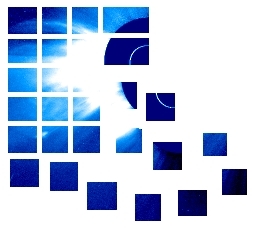




What does the ionosphere sound like?  Well, our Project Calliope sonification will map the ionosphere's properties to a musical range.  What you'll hear is the volume and changes of activity within it.

In some ways, sound is the best method for getting a 'big picture' of an item.  Think of a large body of water.  With your eyes close, you can tell the gentle lapping of a lake from the burble of a brook, the flow of a river, or the periodic crashing waves of an ocean.
deconstructing a solar event

Werner Heisenberg's 'Uncertainty Principle'(1927) is a fundamental concept in quantum physics, basically saying you can be increasingly accurate in position or momentum (mass X velocity), but not both(1).  

This can be an important feature rather than a defect in something like quantum cryptography, where information is transmitted in the form of quantum states such as the polarization of particles of light.

A group of scientists from LMU and the ETH in Zurich say they have shown that position and momentum can be predicted more precisely than Heisenberg's Uncertainty Principle states - if the recipient makes use of a quantum memory that employs ions or atoms.

Optics normally treats the behaviour of packages of light waves (photons). However, when passing through appropriately shaped fields, particles may behave similar as photons. A beam of electrons that is not too dense will under such conditions behave similar to light beams that pass comparable lenses. In a dense beam the electrons will influence each others path via their own Coulomb field.

The OTF

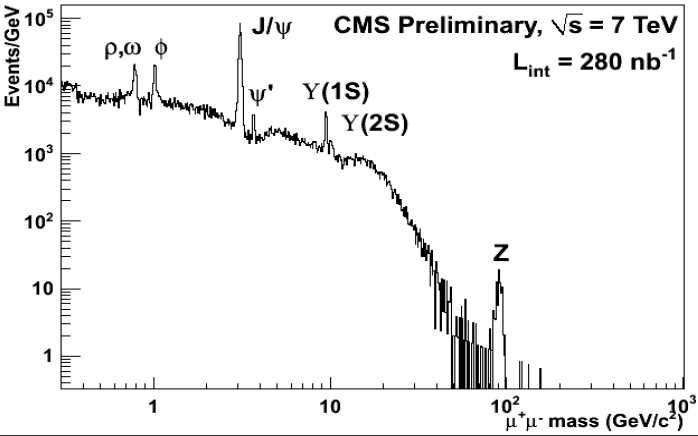
While everybody is busy discussing the latest Tevatron results on the Higgs boson searches -is that the light-mass excess the internet was abuzz, is it consistent with a signal as we expected it, how long will it take to confirm it is not a fluke, etcetera, etcetera, etcetera- I think I have a different plot with which to enthuse you.

If you do not like the figure below, courtesy CMS Collaboration 2010, you are kindly requested to leave this blog and spend your time reading something else than fundamental physics. I do not know what will ever make you believe particle physics is beautiful, if not what is shown here.


Early last month, Michael White’s Adaptive Complexity on Science 2.0 had a useful critique of the citizen scientist.
Here's how I roll: my wife loves three-dollar bagels from the Sunday farmers' market. And so she says, "let's get a loaf of bread, some flowers, and a flat of strawberries!" When we roll home with only bagels, I feel I've won.

No more. I've armed myself with the tools of illogic, thus guaranteeing I win every marital argument from this point forward. You can too.

Use the following brain-deflating fallacies to ensure dominance in debate club and/or with unsuspecting significant other.

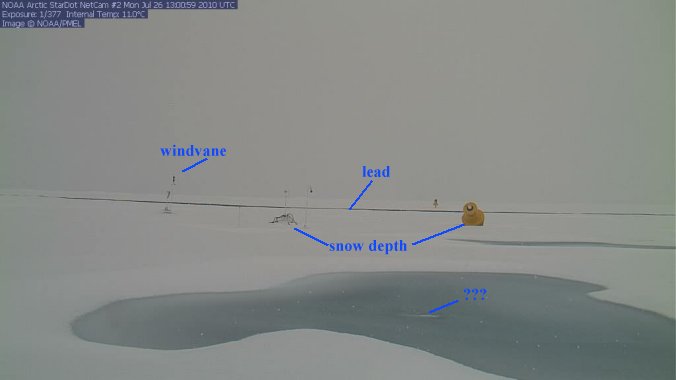
Arctic Ice July - Update #5

The sharp decline in ice extent slowed somewhat during July.  Some people are claiming this as a sign of recovery.

If you are going downhill at full throttle and you take your foot off the gas you will slow down.  A bit.  But if the brakes aren't working you are in for an exciting time.

Loss of ice extent has slowed down.  A bit.  In plain language: loss of ice continues to be a lot more rapid than has been considered normal historically.

Almost the entirety of the main Arctic Ocean ice cover shows substantial amounts of open water.  The ice is freely mobile in most areas.  Both the North West Passage and the Northern Sea Route, aka North East Passage seem to be easily navigable by icebreakers.
Plastiki  is made out of – you guessed it – plastic. Plastiki, the plastic bottle version of Thor Heyerdahl's Kon-Tiki  , was carried from San Francisco to Sydney on a conveyor belt....and wind

I remember when water bottles were introduced on the Norwegian market. It was the most stupid idea I had ever heard of and could not imagine how anybody would be willing to loose their money on this bound to fail business project. Obviously I was wrong. Even in a clean country like Norway where fresh water is abundant everywhere there was a market for bottled water. Go figure.
The concept of "primitive" is one that is very often misunderstood.

Properly defined, "primitive" means "more like a particular ancestor", refers only to individual characteristics (not whole species or lineages), and is contrasted with "derived" (not "advanced" or "more evolved").

I have covered this and other misunderstandings of evolutionary concepts in various articles and I try to clarify these in my courses. But the intuitive interpretation in which one species is deemed more primitive than another is very hard to shake, including in the scientific literature.

An example:
As I have explained in various blog posts and in this paper, it is a fallacy to assume that any one character found in a so-called "primitive" species alive today was also found in the ancestral species. All living species are modern species, and "primitive" vs. "derived" refers to characters, not whole species.

Anyway, New Scientist seems to have fallen for this in their interpretation of a recent paper.
Bellyflopping frogs shed light on evolution


