Ever want to be interviewed by big time media? I'll tell you the two secrets to getting your message out. I'll be talking about the
Project Calliope extreme DIY satellite project on NPR's "All Things Considered" this Saturday (July 24), sometime after 5pm. And while I honestly have no idea what the final edit will sound like, I'm insanely pleased to have been invited.
How did I get on NPR? How can you? I will tell you the 2 secrets I've learned to getting noticed by the media.
The basal ganglia is a series of highly connected brain areas localised deep in the cerebral cortex that recently has attracted interest of neuroscientists when it was linked to learning, and discovered to be affected in a number of disorders of the addictive and obsessive spectrum, but also in Parkinson’s disease (PD). And now researchers think they have understood why as they found that neurons in this area signal the beginning and the end of voluntary actions.
The CMS collaboration at the LHC collider has just produced its very first results on the production of Upsilon particles, with 280 inverse nanobarns of proton-proton collisions at 7 TeV center-of-mass energy. I wish to discuss these results here, to explain what is interesting in these very early measurements, and what we can expect to learn in the future from them.
The production of resonances decaying to muon pairs is one of the first things one wants to study when a hadron collider starts operation. This is because these particles are extremely well known, so one immediately figures out whether the detector is working properly, what is the resolution on the momenta of the reconstructed particles, etcetera.
Arctic Ice July - Update #4
Once again my focus is on Nares Strait. This time I want to show how glaciers can be affected indirectly by sea ice.
There are two major glaciers in the Nares Strait - Petermann and Humboldt. Both are primed for calving.
It has been known for quite some time that exercise promotes neurogenesis, but now a
study by Leuner, Glasper, and Gould, published by PLoS ONE this month, claims that the most intimate form of exercise - sexual activity - can produce the same effects. And better yet- having multiple, repeated sexual experiences results in a greater positive effect than a single experience alone. Added bonus: it reduces anxiety as well. I love that kind of data!
On my way home last night, motoring the red Jeep down Ohio Rt 53, out in the middle of nowhere, only a bunch of farm fields, oncoming traffic and darkness, I saw a bright flash of light in my left eye. I realized, with a familiar guilty pleasure that a death, and an opportunity to observe bizarre evidence of an incredible natural phenomenon had occurred.
A Firefly had crashed into the proverbial windshield on the freeway. My proverbial windshield.
I am not a religious person, and I'm most certainly not spiritual either. Both of these statements get me into trouble in polite society, especially when they are coupled.
Apparently I'm not the only one, as anybody who has used an online dating service will readily testify. Typically, these web sites allow you to specify your religious beliefs (and to express a preference for the religious beliefs of your prospective dates). Try simply checking the "atheist" box (if there actually is one), and you'll be waiting a long time for your matches. But if you describe yourself as "spiritual but not religious" your chances are markedly improved (though the problem now is that you'll see a lot of new agey types showing up in your inbox). Why?
Biotransport and ocean mixingBefore I get into the 'bio' aspect of this article I want to put it in context by pointing to a means of ocean mixing that is not as well known as it deserves to be. And to put that, in turn, in context: a new report from NSIDC confirms that there is a lot of open water in the central pack near the North Pole. That open water was noted by one of my readers,
Lord Soth in
a comment.
Here is an abstract from the NSIDC report for July 20 2010:
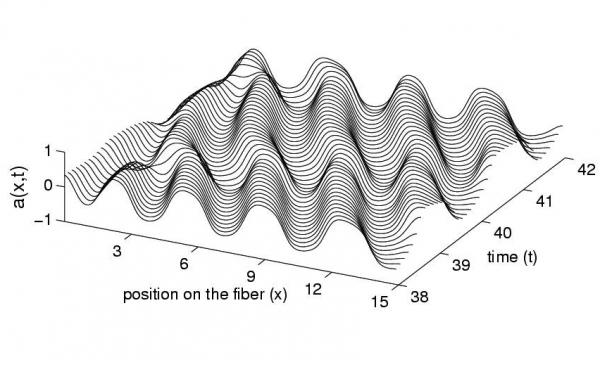
Chaos is the disorder of a dynamical system but it is not completely unpredictable. Researchers are convinced that locating the origin of chaos and watching it develop might allow science to predict, and perhaps counteract, outcomes.
Like having a heart attack.
Writing in in the journal CHAOS, researchers say chaos models may someday help model cardiac arrhythmias (abnormal electrical rhythms of the heart) and help to understand the behavior of ventricular fibrillation, a severely abnormal heart rhythm that is often life-threatening, in order to mitigate it.
The Atlas collaboration made public, just in time for the 2010 ICHEP conference in Paris, the projected reach of their searches for standard model Higgs bosons. This is a whole set of interesting new results which, although necessarily still based on simulations, tell us a lot about what we might see toward the end of next year at the LHC.
Here I will just flash a couple of the results, because the plentiful online documentation that ATLAS provided makes it a worthless exercise on my part to just echo it here. However, maybe I can comment the most relevant plots for those of you too lazy to browse the information-thick ATLAS pages.