Science 2.0 And Deepwater Horizon
In this age of rapid communication via the internet we have a golden opportunity to engage in synergy on a global scale to solve problems in science and engineering.
Synergy, as I use the term here, is an emergent property of a cooperative human system. A forum is established in which all legitimate participants have an equal opportunity to submit ideas relating to the solution of a problem.
Rules for writing can vary from basic grammar principles to austere proverbs like Hemingway's "Write what you know!" In my
previous article, I listed the first 12 rules of prose as delineated by freelance journalist (and science writer) Tim Radford. Here are the remaining 13. Enjoy!
13. Words like shallow, facile, glib and slick are not insults to a journalist. The whole point of paying for a newspaper is that you want information that slides down easily and quickly, without footnotes, serial caveats, obscure references and footnotes to footnotes.
1
In vitro fertilization (IVF) resulted in the first 'test tube baby' in 1978 and now an estimated 1% of all American babies born each year has happened thanks to in vitro fertilization - wonderful for parents with reproductive issues but IVF and other assisted fertility treatments may be creating one problem by solving another, according to new research from Tel Aviv University.
Our 1950 pick is L. Sprague de Camp and P. Schuyler Miller's Genus Homo, a pulp adventure that takes place a million years in the future after after the genus Homo has destroyed itself, leaving the field wide open for other ape species to evolve higher intelligence, science, and technological war. Although Genus Homo was first published in book form in 1950, it was written for the pulp magazine Super Science Stories in 1941, and thus it really counts as a pre-Hiroshima novel. Nevertheless the book makes a clear reference to the possibility of humanity’s destruction by nuclear bombs, putting it firmly in the post-apocalyptic genre.
Little nuggets of (k)nowledge can often be the most simple and common sense ideas, but it takes someone else to put them into a coherent sentence.
Tim Radford is a freelance journalist who has written for the Guardian, The Lancet, New Scientist and others, and even won the Association of British Science Writers award for science writer of the year four times. Awards do not a great writer make, but they're an indication that he does a decent job communicating, no?
With the press of a button, yesterday Queen Beatrix of the Netherlands activated LOFAR and started the recording of its first official image.
LOFAR (LOw Frequency ARray) is by all standards a big radio telescope. Centered in the North East of the Netherlands, it stretches far over the Dutch borders into Northwest Europe.
 LOFAR location spread across Europe
Polar science will continue to have a global impact, whether you believe in man-made climate change or not, says an expert.
Global warming was always an unfortunate use of 'framing' by policy-oriented scientists who were out of their league and political groups looking to mobilize their base. Climate change was always the issue and change can mean warming ... which leads to cooling.
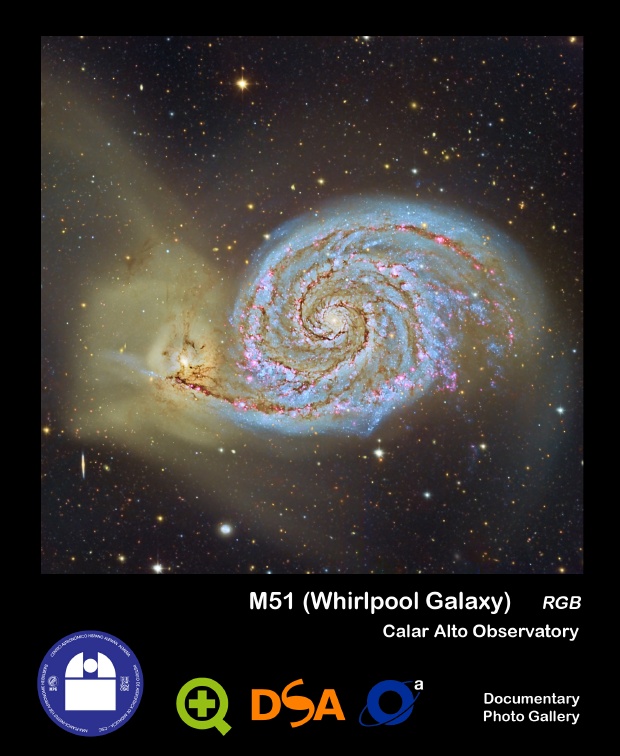
Galaxy M51, now called the Whirlpool Galaxy, was discovered by Charles Messier in 1773 but its spiral structure was first found by William Parsons in 1845, using his huge (and wonderfully named) reflecting telescope called the Leviathan of Parsonstown. Today even small amateur telescopes can see that this galaxy is not isolated, but has a small companion, a dwarf irregular galaxy NGC 5195.
These two stellar systems are colliding and the spiral shape of M51 is due to the tidal forces unleashed during this process. At a distance of 23 millions of light-years, the apparent dimensions of M51 mean that that galaxy has to be quite similar to our own, yet somewhat smaller.
Each day the humans are confronted with a variety of pathogens. Most of them are fended off by our immune system.
For a successful infection, bacteria must deliver so-called virulence factors through a transport channel located in the bacterial membrane. Scientists from the Max Planck Society and the Federal Institute for Materials Research and Testing have shown how in some bacteria this transport channel is formed like a syringe, enabling them to inject virulence factors directly into the host cell - an important starting point for the development of new drugs that might interfere considerably earlier than antibiotics in the course of infection.