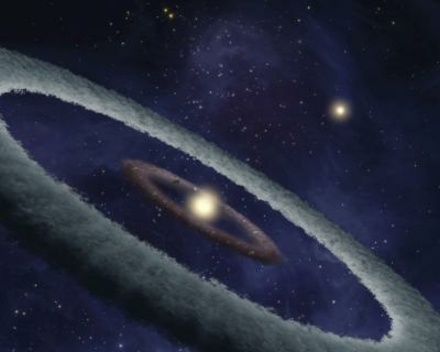
Astronomers have glimpsed what could be the youngest known star at the very moment it is being born -so young it can hardly be considered a true star because it is in the earliest stages of star formation and has just begun pulling in matter from a surrounding envelope of gas and dust.
The Astrophysical Journal study authors found the object using the Submillimeter Array in Hawaii and the Spitzer Space Telescope. The new star, known as L1448-IRS2E, is located in the Perseus star-forming region about 800 light years away yet within our Milky Way galaxy.
Lithium has been used for more than 50 years in the treatment manic depression, clinically termed bipolar disorder, though no one is sure why it has been beneficial.
Don't be concerned. We don't know why aspirin works either, but we still use it.
Still, science mysteries are going to be pursued and new research from Cardiff University suggests a possible mechanism for why Lithium works, opening the door for better understanding of the illness and potentially more effective treatments.
If we can't get rid of CO2, the greenhouse gas that gets the most press, perhaps we can store it, say researchers. Maybe even in rock form. Carbon dioxide when mixed with water forms carbonic acid (also known as carbonated water or soda water), which can percolate through rocks, dissolving some minerals and forming solid carbonates with them, thereby storing the carbon dioxide in rock form.
Sigurdur Gislason of the University of Iceland has been studying the possibility of sequestration of carbon dioxide (CO2) in basalt and presented his findings today to several thousand geochemists from around the world at the Goldschmidt Conference hosted by the University of Tennessee, Knoxville, and Oak Ridge National Laboratory.
People who have been around a long time know the somewhat convoluted history of Science 2.0 in general and Scientific Blogging in specific but the top question I get after people say, "Oh, you're that guy!" is "Why did you call it Scientific Blogging?"
Why not Science 2.0? Well, there's a practical reason and a philosophical one. The practical reason is that the way domain names work it isn't really possible. In order to make Science2.0.com I would have to make Science2 a subdomain of 0.com and that has been in existence since 1985. Yes, 1985, well before Tim Berners-Lee blessed us with an elegant way to make a World Wide Web.
VeriSign owns it and they are unlikely to give it to me.
MODIS Rapidfire For Citizen Scientists - #1
A brief explanation of the NASA/GSFC MODIS Rapid Response System -
Rapidfire - together with a Howto for citizen scientists.
National Aeronautics and Space Administration / Goddard Space Flight Center Moderate Resolution Imaging Spectroradiometer is a bit of a mouthful, so I'll just refer to it as Rapidfire from here on, if you don't mind.
The MODIS Rapid Response System was developed to provide daily satellite images of the Earth's landmasses in near real time. True-color, photo-like imagery and false-color imagery are available within a few hours of being collected, making the system a valuable resource ...
...
"What is the meaning of our existence, what is the meaning of existence for all living beings in general? Knowing how to answer such a question means to have religious feelings. You will say, but then sense asking this question. I will respond: anyone who believes his own life and that of his fellows is meaningless is not only unfortunate, but hardly capable of living. "
Albert Einstein (1879-1955), Religion and Science (1930) (From the collection of lectures and essays, "The World as I See It").
Extinction is nothing new; more than 99% of all species that have ever lived we will never know about. Extinction is entirely natural and, if you've ever watched someone's car weaving on the highway while they talk on the phone and drink a coffee, you have probably hoped it will remain a fundamental process of evolution.
But survival of the fitter(1) can be a fickle mistress. Why, after 800,000 years of successful survival did the Hundsheim rhino (Stephanorhinus hundsheimensis) suddenly and irrecoverably disappear?
Some estimates claim that within the first week after giving birth, up to 70 percent of women experience symptoms of the 'baby blues' - obviously a different thing than clinical postpartum depression, which perhaps 13 percent of new mothers show symptoms of having and is defined as a major depressive episode starting within 4 weeks after delivery.
Milder postpartum blues are obviously a major risk factor for developing postpartum depression and severe postpartum blues symptoms can be viewed as a prodromal stage for postpartum depression, say researchers, and in a new paper they reveal an increase of the enzyme MAO-A throughout the female brain in the immediate postpartum period and propose a neurobiological model for postpartum blues.
Hydrogen is the fuel-cell future but currently it has a number of issues, primarily related to storage(1) and cost. Cost because getting hydrogen out of a molecule requires a catalyst and efficient catalysts, like platinum, dissolve during the stop-and-go driving of a fuel-cell-powered electric car - as much as 45 percent of the catalyst can be lost during five days.
You know when gold looks cheap by comparison your energy technology is not ready for the mass market.
Light beams travel in straight lines and don't go around corners, they instead spread through a process known as diffraction.
Researchers at Tel Aviv University have discovered that small beams of light can indeed be bent in a laboratory setting, diffracting much less than a "regular" beam. These rays are called "Airy beams" after English astronomer Sir George Biddell Airy, who studied the parabolic trajectories of light in rainbows.