Giant freak waves - seriously, that is what oceanographers and physicists call them - are called that because they can appear on the open sea out of nowhere.
Researchers from the Ruhr- Universität Bochum and the University of Umeå, Sweden say they have developed a new statistical model for non-linear, interacting waves in computer simulations which will allow them to be theoretically calculated and modeled.
Scientists from the Institute of Biochemistry and Molecular Biology and Collaborative Research Center 746 of the University of Freiburg say they have discovered a new mechanism which plays an essential role in the assembly and growth of mitochondria, the 'power plants' of the cell.
These organelles make energy stored in food ready for use by the cell. The generators in the cellular power plants are biological membranes located inside the mitochondria. Even minute errors in the composition of the inner mitochondrial membrane can lead to severe metabolic derangements, which can have an especially negative impact on the energy-hungry muscle and nerve cells.
For our 1951 pick, we have the work of one of the great British writers of sci-fi’s Golden Age. In The Day of the Triffids, John Wyndham presents a horror story of giant, ambulatory, flesh-eating plants that topple humans from their dominance of a world they thought they had tamed. The theme is common to other post-apocalyptic stories of the 1950’s: we may tame nature with our technological wizardry, but our undoing is our inability to tame ourselves. We take our dominance of the planet for granted - and it wouldn’t take much to find ourselves in a relentlessly hostile world where we have compete as a species with a new top dog.
When Art Meets War
If you want to make a good historical movie you should find yourself a good historian.
If one of the characters is a singer, make sure they sing in a contemporary style.
Now add in a stirring contemporary theme tune and you may well have a blockbuster.
A war movie which misses an opportunity to show the realities of war is just so much blood and guts. The realities of war are not just the horrors of bloodshed. There are realities of psychology, physics and philosophy: of human interactions, of weaponry and of theories of war.
If you've watched any World Cup matches at all (and statistically, if you have not, you are not reading this article) you have been aware of an omnipresent drone in the background - and you might believe it is the biggest swarm of mutant bees you ever imagined or perhaps South Africa's revenge for Apartheid-based boycotts in the 1980s.
Instead, it is a horn South African fans like to use. They call it a vuvuzela - I call it a B flat plastic trumpet from hell. And
I am not alone.
MODIS Rapidfire For Citizen Scientists - #2
This is part #2 of a brief explanation of the NASA/GSFC MODIS Rapid Response System -
Rapidfire - together with a Howto for citizen scientists. The first part was -
MODIS Rapidfire For Citizen Scientists - #1A note on bookmarks
Since I do educational outreach programs with living Arthropods (referred to below as BUGS!), I have to actually have bugs. Some people think that’s weird. I’m okay with that. I don’t imagine many would find it surprising that I have always had bugs – or something. I mean Bluegills in the basement bathtub, countless beetles and caterpillars and butterflies in nets and other random containers, tons of rolly-pollies and fireflies… you get the idea. I mean, I drove my Mom nuts!
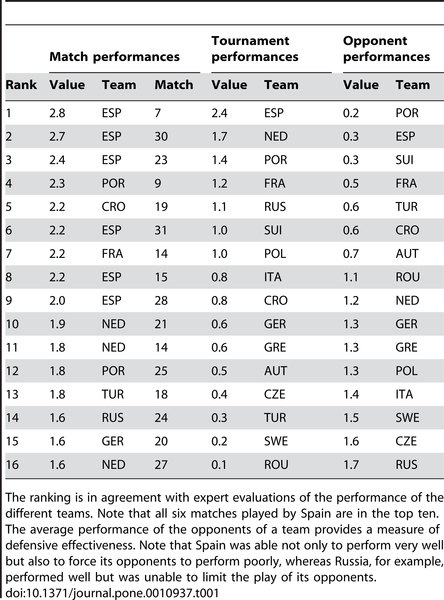
In team sports it is often difficult to determine the value of an individual. Some sports can do it easily enough, like baseball(1) or basketball, but during the World Cup, casual fans who hear commentators talk about the quality 'form' of a player are lost when the game is 0-0.
Jordi Duch, Joshua S. Waitzman and Luís A. Nunes Amaral of Northwestern University say they may have an answer.
Clausewitz On ScienceClausewitz
On War - yes. But Clausewitz
On Science?
Carl Philipp Gottfried von Clausewitz is famous for his book
Vom Kriege - On War. In that book he is very specific in stating that there is no 'science of war'.
In order for someone to state quite categorically that an area of study is not a science they must first know enough about science to be able to determine the matter
scientifically.
During pregnancy, many women experience remission of autoimmune diseases like multiple sclerosis and uveitis and scientists have described a biological mechanism they say is responsible for changes in the immune system that helps explain that remission.
The expression of an enzyme known as pyruvate kinase is reduced in immune cells in pregnant women compared to non-pregnant women, says biophysicist Howard R. Petty from the University of Michigan Kellogg Eye Center, and Roberto Romero, M.D., of the National Institutes for Health. Their study coming in the August issue of the American Journal of Reproductive Immunology also reports that expression of the enzyme is lower in pregnant women compared to those with pre-eclampsia, a condition with inflammatory components.