When asked to justify the research I do, I always struggle a little to explain my dissatisfaction with the traditional descriptive, non-quantitative explanations of molecular biological systems. As a glance at a
classic molecular cell biology textbook will easily demonstrate, molecular biologists have been tremendously successful with verbal or semi-quantitative explanations of what goes on inside the cell. And in any case, the complexity of the cell is extremely daunting for the would-be theoretical biologist.
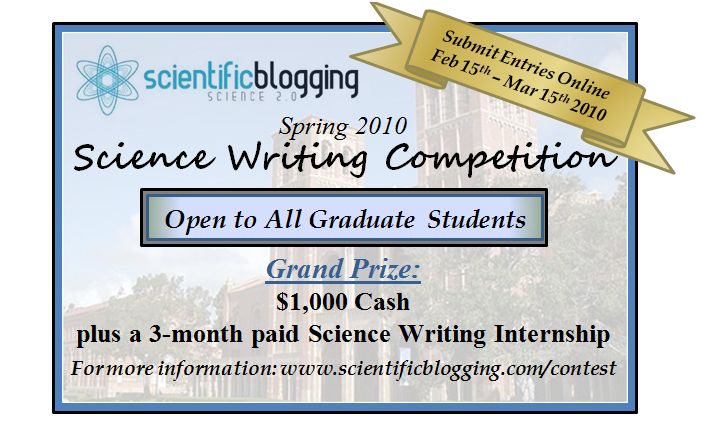
Last fall, ScientificBlogging introduced our first ever University Writing Competition. We were blown away by the quality of science articles we received, and are excited to announce that we’re doing it again this spring. This time the contest is open to ALL graduate students. The official rules are below, but the big idea is that we are inviting graduate students to write about science – on any scientific topic of their choosing. It is our hope to discover those exceptional students that not only know their science, but can also effectively communicate it to the scientific community as well as to the general public.
This morning, upon leaving Brussels to go back home after my seminar in Louvain-la-Neuve, my attention was caught by a big green banner hanging from a tall building at Place Schuman. It said "Safe Internet Day" and below, in smaller fonts, "think before you blog". I found it inspiring.
A blog, if used correctly, is a very nice tool which enhances one's possibility to express one's ideas, or to do scientific outreach, as in my case. It may also be used for self-promotion at times (and
the opportunity does not escape me, although I try to self-contain these outbursts). But a blog, if it attracts traffic, may become also a dangerous instrument, which must be handled with care.
Scientific Evidence Of Your Own AwesomenessDo you like to share awe-inspiring articles with your friends, like the many [New York] Times readers whose habits are analyzed in a new study? Or do you have other motives?
Jonah Berger and Katherine A. Milkman, researchers at the Wharton University of Pennsylvania, have been analysing the New York Times most e-mailed articles list. They have been trying to determine what factors contribute to making an article 'most emailed'.
It appears that NYT readers like to share news about positive, long and intellectually challenging topics. Most of all, the study indicates that people most like to share topics that inspire awe.
The protein ToxT controls the virulent nature of Vibrio cholerae, the bacteria that causes cholera. And buried within ToxT is a fatty acid that appears to inhibit the protein, preventing V. cholerae from causing cholera. The findings appeared recently in PNAS and the authors say the research may enable the development of a new treatment for the potentially fatal illness.
New research published in Stroke has linked the risk of suffering a stroke to the presence of a certain type of antibody in the immune system. According to the study, researchers may now be able to develop a vaccine that can mobilize the body's own defence against arteriosclerosis and stroke.
The study compared 227 individuals who had suffered stroke over a 13-year period with 445 sex and age-matched controls. After controlling for other risk factors (age, sex, smoking habits, cholesterol levels, diabetes, BMI and blood pressure), they were able to show that low levels (below 30 per cent of average) of PC antibodies correlated with a higher risk of stroke, which in women meant an almost three-fold increase.
It appears that the act of voluntarily sharing something with another is not entirely exclusive to the human experience. Researchers writing in Current Biology observe that bonobos—a sister species of chimpanzees--consistently chose to share their food with others.
In the study, bonobos had to choose whether to eat some food by themselves or to give another bonobo access to it. The test subjects had the opportunity to immediately eat the food or to use a "key" to open a door to an adjacent empty room or a room that had another bonobo in it. The test subjects could easily see into the adjacent rooms, so they know which one was empty and which was occupied.
Should there be restrictions on the amount of sodium in processed and restaurant foods? Many public health advocates think so. They argue that people consume excessive amounts of sodium without even knowing it and mandatory restrictions would reduce the number of heart attacks, strokes, and even deaths that result from all that salty food.
But does the available research justify a population-wide restriction on sodium in food? Not quite, says Michael H. Alderman from the Department of Epidemiology and Population Health at Albert Einstein College of Medicine.
Drilling firm Lapindo Brantas has denied that one of its gas exploration well was the trigger for the Lusi mud volcano, which killed 13 people and displaced thirty thousand in East Java, Indonesia on May 29, 2006. The firm instead blamed an earthquake that occurred 280 kilometers (174 miles) away and backed up their claims in an article published in Marine and Petroleum Geology.
In response, a group of scientists from the United Kingdom, United States, Australia and Indonesia have written a discussion paper in which they claim to refute the main arguments made by Lapindo Brantas and document new data that provides the strongest evidence to date of a link between the well and the volcano. That paper will be published in the same journal.
Dairy Farmer Makes BS ClaimThe Utah House has passed a resolution questioning the science behind global warming.
Rep. Mike Noel, the Legislature's chief climate-change skeptic, declared Thursday that global warming is a conspiracy to control world population.
The House Natural Resources Committee then approved a resolution that expresses the Utah Legislature's belief that "climate alarmists' carbon dioxide-related global warming hypothesis is unable to account for the current downturn in global temperatures."