We've all had it happen; you're sitting in class, hopelessly unprepared because you've been writing a D&D campaign or plotting ways to take over the world when, out of nowhere, the teacher calls upon you to come to the front the room and solve a math problem. In front of everyone.
How you respond to that says a lot about you, and 'math anxiety' may be a real phenomenon, according to a new report in Current Directions in Psychological Science. University of Chicago psychologist Sian L. Beilock examines some recent research looking at why being stressed about math can result in poor performance in solving problems.
Imagine tiny cracks in your patio table healing by themselves, or the first small scratch on your new car disappearing by itself. This and more may be possible with self-healing coatings being developed at the University of Illinois.
The new coatings are designed to better protect materials from the effects of environmental exposure. Applications range from automotive paints and marine varnishes to the thick, rubbery coatings on patio furniture and park benches.
We all know how infants can act up during their terrible twos, but when these behaviors are accompanied by developmental setbacks, they could point to something more serious.
Researchers are currently learning more about regressive autistic spectrum disorder (RASD), which describes children who have been diagnosed with
autism who demonstrate a history of a regression. The regression refers to a marked loss of previously acquired developmental skills such as language or social ability.
In 2006, astronomer Alice Quillen of the University of Rochester predicted that a planet of a particular size and orbit must lie within the dust of a nearby star. That planet has now been photographed by the Hubble Space Telescope, making it only the second planet ever imaged after an accurate prediction. The only other planet seen after an accurate prediction was Neptune, discovered more than 160 years ago.
"It's remarkable," says Eugene Chiang, associate professor of astronomy at the University of California at Berkeley, and part of the team that imaged the new planet. "Alice saw the way the inner edge of the dust ring cut off sharply and recognized that a planet likely orbited just inside. The orbit we found was amazingly close to Alice's prediction."
It may seem, at least to those of us who have been alive long enough to witness any of the advances in semiconductor technology, that computer power has been improving at breakneck speed. A
quantum computer, however - a theoretical type of computer that utilizes the states of atoms to store information instead of magnetic fields - may make our current conception of computing power completely obsolete. And now, new research into the storage and retrieval of quantum information has brought quantum computing one step closer to reality.
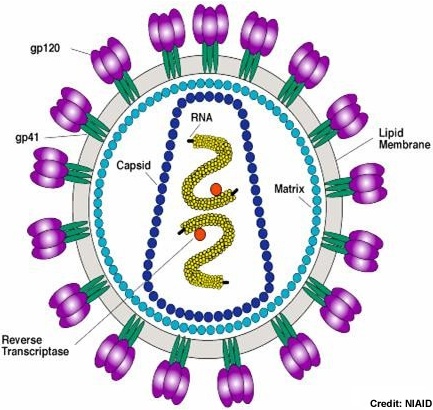
Since the 80’s, as the awareness of HIV has increased exponentially, scientists have struggled for a vaccine to quell the rising number of AIDS-related deaths occurring each year. According to an
AIDS epidemic update released in December of 2006 by the Joint United Nations Program on HIV/AIDS (UNIADS) and the World Health Organization (WHO), there were 39.5 million people worldwide living with HIV. That includes the 4.3 million newly infected individuals that year alone, and not including the 2.9 million deaths from AIDS in 2006.
University of Oregon sociologist Aliya Saperstein and sociologist Andrew M. Penner of the University of California, Irvine have a new twist on race - it isn't just appearance but socioeconomic status, they say. Their new study says that Americans who are unemployed, incarcerated or impoverished today are more likely to be classified and identified as black, by themselves or by others, regardless of how they were seen -- or self identified -- in the past.
With the aid of a straightforward experiment, researchers have provided some clues to one of biology's most complex questions: how ancient organic molecules came together to form the basis of life.
Specifically, this study, appearing online this week in JBC, demonstrated how ancient RNA joined together to reach a biologically relevant length.
Have you ever wondered why it seems like the littlest things make people angry? University of Minnesota marketing professor Vladas Griskevicius says he can explain in three words why people may be inclined to make a mountain out of molehill: aggression, status and sex. He makes an unfortunate correlation-causation jump to the colloquial term 'evolution' too, but let's forget that for a moment, because we'd never get any articles written if we stopped every time a non-biologist calls something Evolution.
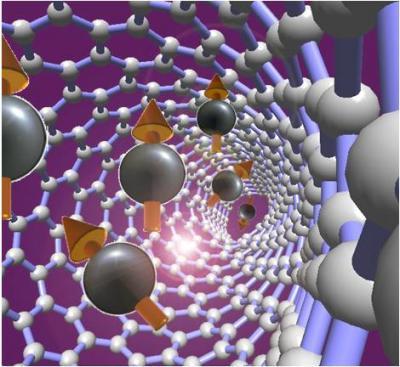
A key challenge of nanotechnology research is investigating how different materials behave at lengths of merely one-billionth of a meter. When shrunk to such tiny sizes, many everyday materials exhibit interesting and potentially beneficial new properties.
Magnetic behavior is one such phenomenon that can change significantly depending on the size of the material. However, the sheer challenge of observing the magnetic properties of nanoscale material has impeded further study of the topic.