For years, pear-shaped people who carry weight in the thighs and backside have been told they are at lower risk for high blood pressure and heart disease than apple-shaped people who carry fat in the abdomen. But new findings from nutrition researchers at Washington University School of Medicine in St. Louis suggest body-shape comparisons don't completely explain risk.
In two studies, they report excess liver fat appears to be the real key to insulin resistance, cholesterol abnormalities and other problems that contribute to diabetes and cardiovascular disease. Having too much fat stored in the liver is known as nonalcoholic fatty liver disease.
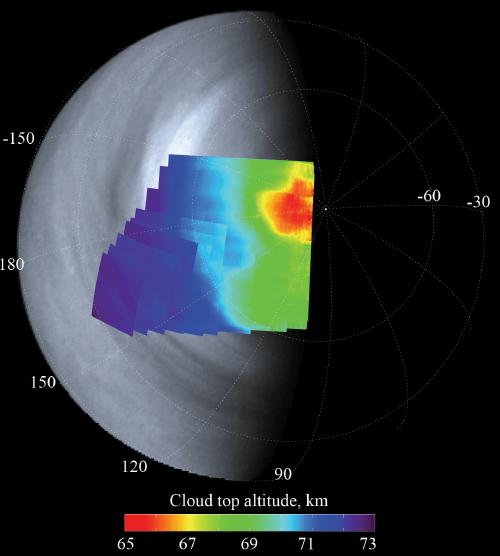
New images taken by instruments on board ESA's Venus Express provide a unique insight into the windy atmosphere of our neighbouring planet and reveal that global patterns at the Venus cloud tops are the result of variable temperatures and cloud heights.
Using the spacecraft's ultraviolet and infrared cameras, the Venus Express team, including UK scientists, have been able to compare what the planet looks like at different wavelengths, allowing them to study the physical conditions and dynamics of the planet's atmosphere. These results appear today (4th December) in the journal Nature.
Can radiation from cell phones affect memory?
The debate continues but in rat experiments done at the Division of Neurosurgery, Lund University, in Sweden, Henrietta Nittby studied rats that were exposed to mobile phone radiation for two hours a week for more than a year and says these rats had poorer results on a memory test than rats that had not been exposed to radiation.
The memory test consisted of releasing the rats in a box with four objects mounted in it. These objects were different on the two occasions, and the placement of the objects was different from one time to the other.
No one really feels left out if they don't have an iPod. An MP3 player is nice to have but not essential to the human condition. But Spanish researchers who have carried out a study looking into the potential future impact of robots on society say that the enormous automation capacity of robots and their ability to interact with humans will cause a technological imbalance over the next 12 years - between those who have them and those who do not.
If there is a bailout of the Big Three, it should include alternative energy metrics against which the three companies compete for better loan repayment terms. The company that most rapidly converts its’ entire fleet to an average of 45 mpg, starts mass production of electric plug in and electric hybrid cars should have significantly better terms – including forgiveness of most of the loans – than the company that comes in second. There has been much discussion about whether America can afford to allow its’ auto industry to go down the tubes. This implies that the Big Three represent the totality of America’s automotive production.
All of us have experienced being in a new place and feeling certain that we have been there before. This mysterious feeling, commonly known as déjà vu, occurs when we feel that a new situation is familiar, even if there is evidence that the situation could not have occurred previously. For a long time, this eerie sensation has been attributed to everything from paranormal disturbances to neurological disorders. However, in recent years, as more scientists began studying this phenomenon, a number of theories about déjà vu have emerged, suggesting that it is not merely a glitch in our brain's memory system.
The Center for International Forestry Research (CIFOR) today released a comprehensive analysis clarifying major challenges and offering an assortment of options that could help negotiators reach a global agreement on reducing carbon emissions tied to forest destruction and degradation.
The report, Moving ahead with REDD: Issues, options and implications, is set to be released as officials from around the world have gathered here under the auspices of the UN Framework Convention on Climate Change (UNFCCC). Negotiators are seeking to outline a new global agreement for reducing greenhouse gases, which will set the stage for final decisions scheduled for 2009 in Copenhagen.
If you're happy and you know it, thank your friends—and their friends. And while you're at it, their friends' friends. But if you're sad, hold the blame. Researchers from Harvard Medical School and the University of California, San Diego have found that "happiness" is not the result solely of a cloistered journey filled with individually tailored self-help techniques. Happiness is also a collective phenomenon that spreads through social networks like an emotional contagion.
The decline of the Roman and Byzantine Empires in the Eastern Mediterranean more than 1,400 years ago may have been driven by unfavorable climate changes.
Based on chemical signatures in a piece of calcite from a cave near Jerusalem, a team of American and Israeli geologists pieced together a detailed record of the area's climate from roughly 200 B.C. to 1100 A.D. Their analysis, to be reported in an upcoming issue of the journal Quaternary Research, reveals increasingly dry weather from 100 A.D. to 700 A.D. that coincided with the fall of both Roman and Byzantine rule in the region.
As our knowledge of biology has increased exponentially, so has our potential to find new treatments and technologies to battle ailments previously incurable. However, many of these expansions of knowledge have faced stalling challenges and hurdles, halting practical applications. Gene therapy has been one of these dreams, touted as having endless potential, yet viable medical treatments were always yet to be developed. This is all about to change, as new laboratory research has seen unprecedented developments in gene therapy.