Illustrating the power of submillimetre-wavelength astronomy, an APEX image reveals how an expanding bubble of ionised gas about ten light-years across is causing the surrounding material to collapse into dense clumps that are the birthplaces of new stars. Submillimetre light is the key to revealing some of the coldest material in the Universe, such as these cold, dense clouds.
A study in rats shows that exposure to a high-fat diet during pregnancy produces permanent changes in the offspring's brain that lead to overeating and obesity early in life, according to new research by Rockefeller University scientists. This surprising finding, reported in the Nov. 12 issue of the
Journal of Neuroscience, provides a key step toward understanding mechanisms of fetal programming involving the production of new brain cells that may help explain the increased prevalence of
childhood obesity during the last 30 years.
A reaction essential for the biosynthesis of hemoglobin and chlorophyll, when catalyzed by the enzyme uroporphyrinogen decarboxylase, causes production in cells to be "increased by a staggering factor, one that's equivalent to the difference between the diameter of a bacterial cell and the distance from the Earth to the sun."
Without the enzyme? 2.3 billion years.
All biological reactions within human cells depend on enzymes. Their power as catalysts enables biological reactions to occur usually in milliseconds. But how slowly would these reactions proceed spontaneously, in the absence of enzymes – minutes, hours, days? And why even pose the question?
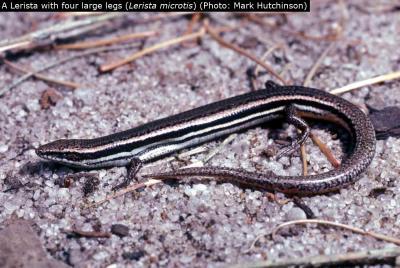
Small skink lizards, Lerista, demonstrate extensive changes in body shape over geologically brief periods. Research published in the open access journal BMC Evolutionary Biology shows that several species of these skinks have rapidly evolved an elongate, limbless body form.
Skinks are a common sight in Australia and many species have limbs that are either reduced or missing entirely. According to the lead author of this study, Adam Skinner of The University of Adelaide, "It is believed that skinks are losing their limbs because they spend most of their lives swimming through sand or soil; limbs are not only unnecessary for this, but may actually be a hindrance".
A team of researchers led by North Carolina State University has made a breakthrough that could lead to new dialysis devices and a host of other revolutionary medical implants. The researchers have found that the unique properties of a new material can be used to create new devices that can be implanted into the human body – including blood glucose sensors for diabetics and artificial hemo-dialysis membranes that can scrub impurities from the blood.
Working out on a stationary bicycle or walking on a treadmill just 25 to 30 minutes most days of the week is enough to modestly lower risk of hospitalization or death for patients with heart failure, say researchers from Duke Clinical Research Institute (DCRI).
I gets weary, and sick of trying … the words almost taken from Ol' Man River. But weary of what? Trying to persuade the physics world from harping too much on about celebrity physicists. This they do (at least in my reading) to an extent grossly exceeding that of mathematicians and chemists. “How will we discover the African Einstein?” they ask, to which I reply that a wilderness of Einsteins would do Africa no good at all, whereas a widespread knowledge of basic physics might help the continent somewhat. Even if Mariah Carey’s new album E=MC² inspires some to take up physics, most will fall exhausted before reaching such high levels.
The seasons are shifting. For most places, colder weather and less daylight means the steady approach of winter. In my home in Northern California, summer lasts through October. The sun shines steadily, temperature drops to a tolerable high 60’s and not a drop of rain is seen. Suddenly, it’s dark by 5:00pm and the cuffs of your pants are constantly wet from trudging through the rain puddles, you know that the dreaded winter is here.
In California, we definitely have seasons.
For those that suffer from Huntington’s Disease or worry about its development, a new hope for a treatment may be on the horizon. Raptor Pharmaceuticals Corp. has announced that it will collaborate with researchers from French university Centre Hospitalier Universitaire d’Angers (CHU d’Angers) on the development of its proprietary drug delayed-release cysteamine bitartrate (DR Cysteamine) in a Phase II clinical trial for treatment for patients with Huntington’s Disease.
Petroleum is the feedstock for many products in the chemical industry but it is becoming increasingly expensive. Renewable raw materials are an alternative but we quickly learned that, despite the beliefs of activists in the 1980s and 1990s, fuel from food was not a good idea.
Thanks to white industrial biotechnology, chemical substances can also be derived from waste products generated by the food industry, leftover biomass from agriculture and forestry, and residual materials. Researchers of the Fraunhofer Institute for Interfacial Engineering and Biotechnology IGB in Stuttgart are demonstrating how this biotechnical recycling works, using colza, whey and crab shells as examples.