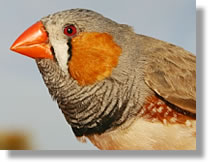








Feeling down? Wondering how to cheer up? Well perhaps all you have to do is sing a song. Hey, it works for birds.


Researchers at the RIKEN Brain Science Institute in Japan have recently uncovered a breakthrough in animal behavior. In their recent study, they concluded that singing by male birds to attract females stimulates reward centers in their brains, reinforcing their behavior. In essence, singing for mates makes male birds really happy.

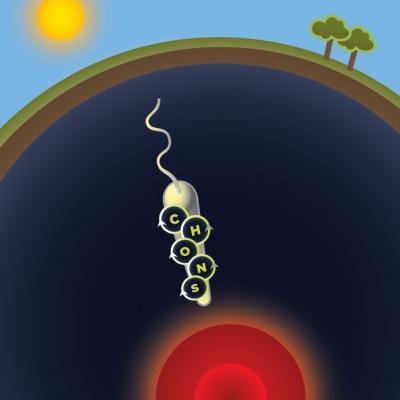
The first ecosystem ever found having only a single biological species has been discovered 2.8 kilometers (1.74 miles) beneath the surface of the earth in the Mponeng gold mine near Johannesburg, South Africa.

There the rod-shaped bacterium Desulforudis audaxviator exists in complete isolation, total darkness, a lack of oxygen, and 60-degree-Celsius heat (140 degrees Fahrenheit).

D. audaxviator survives in a habitat where it gets its energy not from the sun but from hydrogen and sulfate produced by the radioactive decay of uranium. Living alone, D. audaxviator must build its organic molecules by itself out of water, inorganic carbon, and nitrogen from ammonia in the surrounding rocks and fluid. During its long journey to the extreme depths, evolution has equipped the versatile spelunker with genes – many of them shared with archaea, members of a separate domain of life unrelated to bacteria – that allow it to cope with a range of different conditions, including the ability to fix nitrogen directly from elemental nitrogen in the environment.

Biomimetics is the application of biological methods and systems found in nature that could be used to design engineering systems and modern technology. Proponents of bionic technology believe that the transfer of technology between life forms and synthetic constructs is attractive because evolutionary pressure typically forces living organisms to become highly optimized and efficient. Therefore, they contend, designing engineering methods or tools that mimic such biological functions could be extremely efficient.

Examples of biomimetics in engineering include the hulls of boats imitating the thick skin of dolphins, as well as sonar, radar and medical imaging imitating the echolocation of bats. (Echolation involes emitting sound waves and listening to the echo in order to locate objects or to navigate).

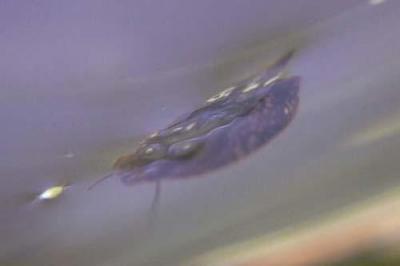
Eric Lauga, an assistant professor of mechanical and aerospace engineering at the Jacobs School of Engineering, recently published a paper in the journal Physics of Fluid called "Crawling Beneath the Free Surface: Water Snail Locomotion," that explains how and why water snails can drag themselves across a fluid surface that they can't even grip.

Scientists have used a technique originally developed for economic study, Granger causality, to become the first to overcome a significant challenge in brain research: determining the flow of information from one part of the brain to another.

For years, scientists have used scanners to identify the brain regions involved in particular mental tasks. But they cannot get that data fast enough to trace the flow of information from one area of the brain to another.

ozens of cars in the Boston area are testing the latest generation of an MIT mobile-sensor network for traffic analysis that could help drivers cut their commuting time, alert them to potential engine problems and more.

In the CarTel project, Professor Hari Balakrishnan and Associate Professor Samuel Madden of MIT's Department of Electrical Engineering and Computer Science use automobiles to monitor their environment by sending data from an onboard computer — which is about the size of a cell phone — to a web server where the data can be visualized and browsed. They do so via pre-existing WiFi networks passed during a trip.

You may have seen it last week. There were charges of fraud levelled at the Obama campaign because donations from names like 'Doodad Pro' were not reported by his campaign. In the last election, there were claims that Republicans invoked anti-fraud measures to suppress legitimate voting by groups that tend to vote Democratic.

In both cases, there was more hyperbole than substance. There is fraud, but the immediacy of the internet has magnified it into being much more substantial than it is and University at Buffalo Law School Professor James A. Gardner cautions against giving too much importance to charges of voter fraud in American elections and supposed incompetence in administering elections. The process in the overwhelming majority of elections, he says, is working well.

Babies make sense of the world long before they can talk, says Brigham Young University psychology professor and study author Ross Flom. Their new study shows that even babies as young as five months can distinguish an upbeat tune, like Beethoven’s “Ode to Joy” from the Ninth Symphony, from gloomier compositions like that minor key stuff by Chopin(1).

By age nine months, babies can also do the opposite and pick out the sorrowful sound of Beethoven’s Seventh Symphony from a pack of happy pieces.

What's the worst that could happen after eating a slice of pepperoni pizza? A little heartburn, for most people.

But for up to a million women in the U.S., enjoying that piece of pizza has painful consequences. They have a chronic bladder condition that causes pelvic pain. Spicy food -- as well as citrus, caffeine, tomatoes and alcohol-- can cause a flare in their symptoms and intensify the pain. It was thought that the spike in their symptoms was triggered when digesting the foods produced chemicals in the urine that irritated the bladder.

However, researchers from Northwestern University's Feinberg School of Medicine believe the symptoms -- pain and an urgent need to frequently urinate -- are actually being provoked by a surprise perpetrator. Applying their recent animal study to humans, the scientists believe the colon, irritated by the spicy food, is to blame.

Chances are that if you've even stepped near a health foods store in the past few months, you've heard tales of an amazing imported fruit claimed to be one of the greatest super-foods of our time; the Brazilian Acai/Açaí (ah-sigh-ee) berry. Rich in antioxidants and packed full of health benefits, the tiny berry sparked an obsession in the health food world, even without significant laboratory testing.

acai berry

