







New research provides support for the use of St. John’s wort extracts in treating major depression - Cochrane Systematic Review backs up previous research that showed the plant extract is effective in treating mild to moderate depressive disorders.

Extracts of the plant Hypericum perforatum, commonly known as St. John’s wort, have long been used in folk medicine to treat depression and sleep disorders. The plant produces a number of different substances that may have anti-depressive properties, but the whole extract is considered to be more effective.

There is no evidence probiotics can relieve the symptoms of eczema and there is evidence that they may occasionally cause infections and gut problems. These findings from The Cochrane Library come at a time when use of probiotics to treat eczema is increasing.

Eczema is an itchy skin condition that affects more than 1 in 20 people at some time in their lives and is especially common in children. Its cause is complex and not well understood, but sufferers do have different bacteria in their guts compared to unaffected people. Consequently, some nutritionists have suggested that eating live gut-dwelling bacteria, such as those found in probiotic yogurts and some infant formulas, could be beneficial.

Scientists at the University of Leicester, where genetic 'fingerprinting' was invented by Professor Sir Alec Jeffreys, say they are developing techniques which may one day allow police to work out someone’s surname from DNA alone.

Research by Turi King has shown that, unsurprisingly, men with the same British surname are highly likely to be genetically linked even in today's multicultural world. The results of her research have implications in the fields of forensics, genealogy, epidemiology and the history of surnames.

On Wednesday 8th October Dr King will present the key findings of her Ph.D. research in which she recruited over two and a half thousand men bearing over 500 different surnames to take part in the study. Carried out in Professor Mark Jobling’s lab, Dr Turi King’s research involved exploring this potential link between surname and Y chromosome type.

With the MLB League Championship Series beginning this week,  Twenty-six teams are wondering what it takes to reach the "final four" of baseball which leads to the World Series.  The Red Sox, Rays, Phillies and Dodgers understand its not just money and luck.  Over 162 games, it usually comes down to the fundamentals of baseball: pitching, hitting and catching.  That sounds simple enough.  So, why can't everyone execute those skills consistently?  Why do pitchers struggle with their control?  Why do batters strike out?  Why do fielders commit errors?  It turns out Yogi Berra was right when he said, "Baseball is 90% mental, and the other half is physical."  In this three part series, each skill will be broken down into its cognitive sub-tasks and you may be surprised at the complexity that such a simple game requires of our brains.

A couple of days ago I went to see Religulous, the investigative documentary by Bill Maher into why people believe weird things about religion. I enjoyed Maher’s laid back approach much better than the Dawkins-Hitchens style hard nose atheism, unfortunately so popular among some atheist groups. The difference is not one of substance (though Maher claims not to be an atheist, he comes very, very close), but of style. And yet style makes all the difference where belief isn’t just a matter of cold rational analysis, but also of messy human emotions.
Even small amounts of fluoride consumed from tap water can damage your bones, teeth, brain, disrupt your thyroid function, lower IQ and/or cause cancer, according to evidence revealed in a groundbreaking 2006 National Research Council (NRC) fluoride report produced by a panel of experts who reviewed hundreds of published fluoride studies. Fluoridation cheerleaders such as the American Dental Association (ADA) and the US Centers for Disease Control (CDC) claim this report has nothing to do with fluoridation (the addition of fluoride chemicals into public water supplies). However, because of the NRC report, both the ADA and CDC now recommend that infant formula NOT be mixed with fluoridated water.
Timo Hannay recently gave a talk "Scientific Researchers and Web 2.0: Social Not Working?", which is reproduced in this Nascent blog post. This is a sobering review of the state of social software in science and he lists several roadblocks to its widespread adoption. It is important to counterbalance the almost unavoidable hype that emerges from the enthusiasm of those energized by a movement. However, it can be a tricky endeavor to attempt to define success or failure, especially within systems that are evolving rapidly.

There's no love lost between open access PLoS (Public Library of Science) and print journals. Nature doesn't think much of PLoS, for example, and PLoS says they created the company to make science less insular so it isn't any surprise that that a new PLoS essay by Neal Young, John Ioannidis and Omar Al-Ubaydli claims that the current system of publishing medical and scientific research provides "a distorted view of the reality of scientific data that are generated in the laboratory and clinic."

They apply shade-tree-mechanic economics principles to support their idea of the distortion. There is an "extreme imbalance," they say, between the abundance of supply (science laboratories and clinical investigations) and the limited venues for publication (journals with sufficiently high impact to be valuable to the authors - let's come back to that part later). Scientific information, they say, is an economic commodity and the 'consumers' are other scientists, patients, funding agencies, etc.

The result of the imbalance, they note accurately, is that only a small proportion of all research studies are chosen for publication in the best journals, and these results are unrepresentative of scientists' overall work.

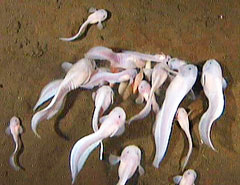
Scientists filming in one of the world’s deepest ocean trenches have found groups of highly sociable snailfish swarming over their bait, nearly five miles (7700 metres) beneath the surface of the Pacific Ocean. This is the first time cameras have been sent to this depth.

‘We got some absolutely amazing footage from 7700 metres. More fish than we or anyone in the world would ever have thought possible at these depths,’ says project leader Dr Alan Jamieson of the University of Aberdeen’s Oceanlab, on board the Japanese research ship the Hakuho-Maru.

‘It’s incredible. These videos vastly exceed all our expectations from this research. We thought the deepest fishes would be motionless, solitary, fragile individuals eking out an existence in a food-sparse environment,’ says Professor Monty Priede, director of Oceanlab.

Smell plays an important role in our lives: It influences the way in which we choose fruit and vegetables, perfume, and even a partner. And yet, smell is not just what we smell with our noses, it's also what we taste, explains Prof. Alexander Vainstein, who is heading the team at the Robert H. Smith Faculty of Agriculture, Food and Environment at the Hebrew University of Jerusalem. "Aroma is of major importance for defining the taste of food."

Scent in flowers and plants is used to attract pollinating insects like bees and beetles that pass on the pollen and help in the reproduction and creation of fruit. The intensity of the scent that the flower emanates is influenced by the time of day, depending on weather, age of the flower and the species.

Now Vainstein and others have found a way to genetically enhance the scent of flowers and implant a scent in those that don't have one.


