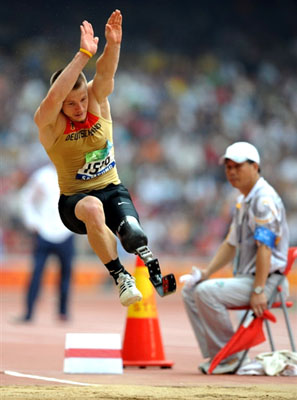







German athlete Wojtek Czyz, running with a space-tech enhanced prosthetic leg, set a new world record at the Paralympics 2008 in Beijing, reaching 6.50 m and beating the previous world record by 27 cm.

In spring 2004, ESA’s Technology Transfer Programme (TTP) technology broker MST Aerospace met with Wojtek Czyz and his trainer to perform a pre-screening of the most crucial elements of the prosthesis used by Czyz. Having lost part of his left leg three years before in a sports accident, he now uses a prosthesis in two athletic disciplines: long jump and sprint competitions.

The advantage of these space materials is that they are extremely strong and at the same time lighter than conventional products available, both important advantages for top athletes’ performance. The problem with Czyz’ previous prosthesis was that it tended to break when he performed to the maximum of his capacity.

Sarah Palin lost the room immediately after Joe Biden choked up, say Karen Kohn Bradley and Karen Studd, certified movement analysts who study the nonverbal and movement behaviors of political leaders.

They don't say (though it's easy to guess) their political party so you have to calibrate their analysis carefully, but they do say that on a movement level, both Vice-Presidential candidates showed a sense of urgency and the increasing speed of their deliveries meant that, halfway through, everyone in the huge nationwide audience was in some sort of trance, like watching a merry-go-round spin faster and faster, punctuated only by strange smiles.

A player can feel it during a game when they hit a game-changing home run or when they go 0 for 4 at the plate. A team can feel it when they come back from a deficit late in the game or when their lead in the division vanishes. A fan can feel it as their team "catches fire" or goes "as cold as ice". And, play-by-play announcers love to talk about it.

We know it as the "Big Mo", the "Hot Hand", and being "In The Zone" while the psychologists call it Psychological Momentum. But, does it really exist? Is it just a temporary shift in confidence and mood or does it actually change the outcome of a game or a season? As expected, there are lots of opinions available.

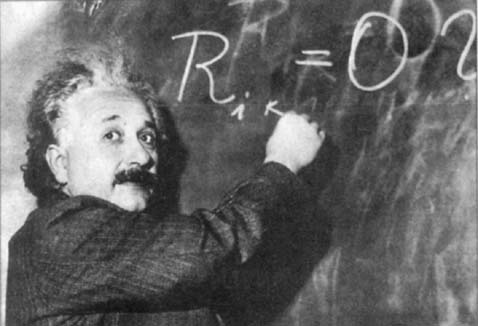
In the day to day hustle of our busy lives full of research, formulae, vats of coffee, etc. we often forget to think about those who walked this road before us and created many of the techniques we use. Without their contributions, it's difficult to imagine where we would be. With that said, here's my way of giving thanks and showing appreciation to all those who came before us in the field of science and to help inspire other people out there trying to do great things now; famous words from famous scientists. 
I. INTRODUCTION The histological structures of the mucous membrane of the small intestine. The micro-circulation of blood of the mucous membrane of the small intestine. The lymphatic circulations of mucous membrane of the small intestine. The sympathetic innervation of the intestinal uvulas. The sympathetic stimulation and micro-circulations of the mucous membrane of the small intestine. The model of the circulation of the mucous membrane of the small intestine in rabbits. Calculation of the flow of blood toward segments of circulation. The absorption’s model of the mucous circulation of the small intestine.

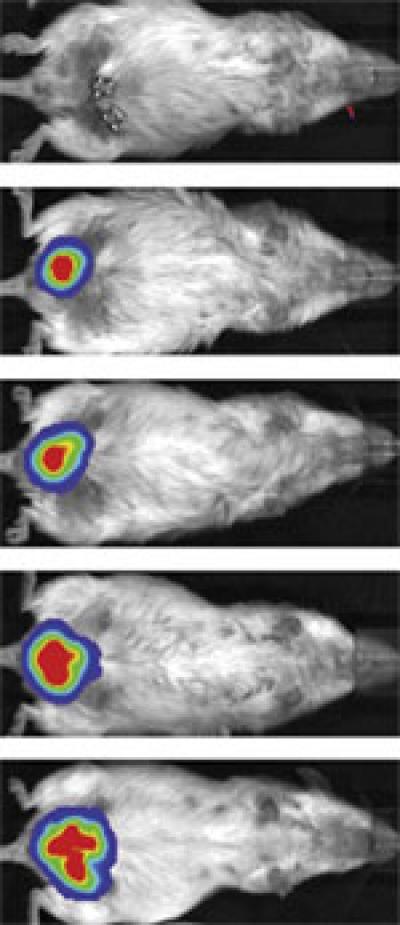
Obesity is a health problem in western countries in part from an increase in the mass and number of white fat cells. Because white fat cells are post-mitotic, meaning that they cannot divide, scientists have hypothesized that a population of fat precursor cells must exist in the fat depot in order to produce new fat cells. But identifying these fat precursor cells has been difficult.

Scientists at the Howard Hughes Medical Institute and Rockefeller University have discovered an important fat precursor cell that may in time explain how changes in the numbers of fat cells might increase and lead to obesity. The finding, published in Cell, could also have implications for understanding how fat cells affect conditions such as diabetes and cardiovascular disease.

Reading is good for the brain but researchers at Duke Children's Hospital say a good book can also help kids lose weight. It just has to be the right kind of book.

The Duke researchers asked obese females aged 9 to 13 who were already in a comprehensive weight loss program to read an age-appropriate novel called Lake Rescue (Beacon Street Press) - a book carefully crafted with the help of pediatric experts to include specific healthy lifestyle and weight management guidance, as well as positive messages and strong role models.

Want to cause a fight between anthropologists and evolutionary biologists? Throw out an opinion on whether early societies were heirarchical or egalitarian.

Great apes societies are very heirarchical despite the presence of alliances and 'political' maneuvering but a new paper in PLoS says the first coalition-based societies of equals (they use the term 'egalitarian') occurred tens of thousands of years ago, and that has implications for the context of social networks and cognitive evolution.

Great apes' societies have each animal occupying a particular place in the existing dominance hierarchy. A major function of coalitions in apes is to maintain or change the dominance ranking. When an alpha male is well established, he usually can intimidate any hostile coalition or the entire community.

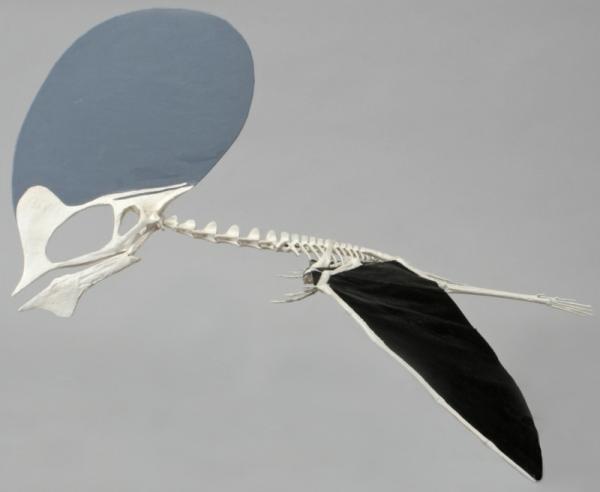
Paleontologist Sankar Chatterjee of Texas Tech University, aeronautical engineer Rick Lind of the University of Florida, and their students Andy Gedeon and Brian Roberts have reached back in time 115 million years to one of the most successful flying creatures in Earth’s history, the pterodactyl, to conjure a robotic spy plane with next-generation capabilities.

Mimicking the physical and biological characteristics of the Early Cretaceous Brazilian pterosaur Tapejara wellnhoferi -- skin, blood vessels, muscles, tendons, nerves, cranial plate, skeletal structure, and more -- the scientists are working to develop a Pterodrone -- an unmanned aerial vehicle that not only flies but also walks and sails just like the original.

In old movies we were going to improve society by making everything think like a computer. Now the goal is to make computers think like brains. Researchers at Missouri University of Science and Technology say they can make power network management more efficient by literally tapping brain cells grown on networks of electrodes.

The Missouri S&T group, working with researchers at Georgia Institute of Technology, plans to use the brain power to develop a new method for tracking and managing the constantly changing levels of power supply and demand.

