Researchers are looking to increase security at border controls by developing a computer system that can detect guilt. Obviously a successful prototype could be used in multiple other applications, like police interrogations and interview scenarios. “Who knows - it could even be used to enhance our real-time computer gaming experiences,” says Dr Hassan Ugail, Head of Visual Computing Research at the University of Bradford’s School of Informatics.

Ugail is part of a team working on a £500,000 project to develop technologies that would assist the border control agencies in identifying people trying to smuggle contraband goods or narcotics through customs.

Scientists at the University of Liverpool have tested an ‘invisibility cloak’ that could reduce the risk of large water waves overtopping coastal defences.

Mathematicians at Liverpool, working with physicists at the Centre National de la Recherche Scientifique (CNRS) and Aix-Marseille Universite have found that coastal defences could be made ‘invisible' when water is guided through a special structure made of metamaterials.

Metamaterial was first invented by Sir John Pendry at Imperial College London where scientists discovered that this unique structure could bend electromagnetic radiation – such as visible light, radar or microwaves – around a spherical space, making an object within this region appear invisible.

Researchers at the University of Toronto have shown that the EBNA1 protein of Epstein-Barr virus (EBV) disrupts structures in the nucleus of nasopharyngeal carcinoma (NPC) cells, thereby interfering with cellular processes that normally prevent cancer development. The study, published October 3rd in the open-access journal PLoS Pathogens, describes a novel mechanism by which viral proteins contribute to carcinogenesis.

EBV is a common herpesvirus whose latent infection is strongly associated with several types of cancer including NPC, a tumor that is endemic in several parts of the world. With NPC only a few EBV proteins are expressed, including EBNA1.

It's baseball playoff time and you know what that means; not just hot dogs and beer but also smelly men who refuse to change their socks lest they spoil their good luck. After all, they got this far with smelly socks, right? And

New research published in Science seeks to explain why people sometimes find and impose order in a chaotic world through superstition, rituals and conspiratorial explanations. The research finds that a quest for structure or understanding leads people to trick themselves into seeing and believing connections that simply don't exist.

A new study has concluded that musicians have IQ scores than non-musicians, supporting other recent research that intensive musical training is associated with an elevated IQ score.

Vanderbilt University psychologists Crystal Gibson, Bradley Folley and Sohee Park have found that professionally trained musicians more effectively use a creative technique called divergent thinking, and also use both the left and the right sides of their frontal cortex more heavily than the average person.

One possible explanation the researchers offer for the musicians' elevated use of both brain hemispheres is that many musicians must be able to use both hands independently to play their instruments.

There was an idea first proposed in 1916 — that plants with rapid reproductive cycles evolve faster - and a team of Yale scientists writing in Science say they have confirmed it using 2008 computing power.

Long involved with the Tree of Life Web Project, which is attempting to reconstruct the “tree” representing the genealogical relationships of all species on Earth, Michael Donoghue, the G. Evelyn Hutchinson Professor of Ecology & Evolutionary Biology and Curator of Botany at Yale’s Peabody Museum of Natural History, has spearheaded the study of flowering plant evolution. In animals, the variation in rate of molecular evolution has been ascribed to differences in generation time, metabolic rate, DNA repair, and body size; in plants, the differences have been more difficult to determine.

Bacteria are everywhere and can survive in almost anything. Finding out exactly how bacteria respond and adapt to stresses and dangers will further our understanding of the basic survival mechanisms of some of the most resilient, hardy organisms on Earth.

Toward that goal, a bacteria cell's 'crisis command center' has been observed for the first time swinging into action to protect the cell from external stress and danger, according to new research out today.

It's like Team America: World Police, except there are no animatronic puppets or Alec Baldwin impressions.

The crisis command center in certain bacteria cells is a large molecule, dubbed a 'stressosome' by the scientists behind today's research.

As the global demand for air travel increases, so too does the demand to decrease the environmental impact of flight. The answer may lie in the technological advances made by the next generation of short-haul commercial aircraft currently in development by British low-cost airline, EasyJet. The unique design of EasyJet’s “EcoJet” promises a 50% reduction in CO2 emissions by 2015.

The aircraft will incorporate the latest research by airframe and engine manufacturers around the world – all of which can be incorporated into an aircraft that should be in operation by 2015. The projection for the 50% CO2 reduction is based on the findings from the latest research by industry leaders and will come from the engines (25%), the lightweight airframe (15%) and from improvements to air traffic control technology and design (10%).

EasyJet EcoJet

"We are the most dangerous species of life on the planet, and every other species, even the earth itself, has cause to fear our power to exterminate."

*******

At least that's how Wallace Stegner, American novelist and environmentalist, puts it. And it certainly seems to be the word on the street in a lot of other places these days. Humans are at fault for everything under the sun - figuratively and maybe literally.  I don't disagree we can do better but, for the sake of humanity, someone needs to stick up for us.

Humans are the only species in 4.8 Billion years of planetary existence that has completely gone against the basic theory of evolution. Instead of adapting to our surroundings, we've made the environment adapt to us.

We like to think of ourselves as simple beings, living day by day doing what we believe is right, but when we finally take a moment to reflect, we still pursue higher issues like why are we here?

Of course, I can't answer that question, but it gives us a way to think about the real impact we've come to have. We are leaving a significant imprint by our behavior in the present and, I don't know about you, but I personally don't want the entire human race of the early 21st century to be looked down upon for the few mistakes we have made.

Let's begin at the beginning; wayyy back to the age of the Dinosaur.

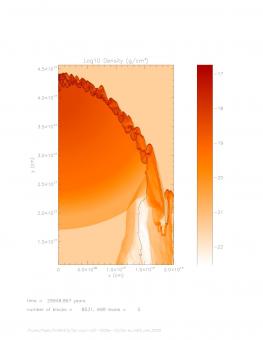
For several decades, scientists have thought that the Solar System formed as a result of a shock wave from an exploding star — a supernova — that triggered the collapse of a dense, dusty gas cloud that contracted to form the Sun and the planets.

Models of this formation process have only worked under the simplifying assumption that the temperatures during the violent events remained constant but astrophysicists at the Carnegie Institution’s Department of Terrestrial Magnetism (DTM) say their new model says that a supernova could indeed have triggered the Solar System’s formation under the more likely conditions of rapid heating and cooling.