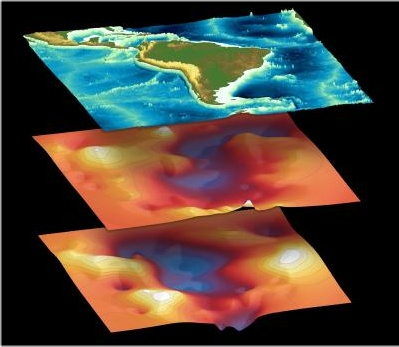







As the world looks for more energy, the oil industry will need more refined tools for discoveries in places where searches have never before taken place, geologists say. One such tool is a new sediment curve (which shows where sediment-on-the-move is deposited), derived from sediments of the Paleozoic Era 542 to 251 million years ago, scientists report in this week's Science. The sediment curve covers the entire Paleozoic Era.

"The sediment curve is of interest to industry, and also to scientists in academia," said Bilal Haq, lead author of the paper and a marine geologist at the National Science Foundation (NSF), "as the rise and fall of sea-level form the basis for intepretations of Earth history based on stratigraphy."

Belief in God encourages people to be helpful, honest and generous, but only under certain psychological conditions, according to University of British Columbia researchers who analyzed the past three decades of social science research.

Religious people are more likely than the non-religious to engage in prosocial behavior – acts that benefit others at a personal cost – when it enhances the individual's reputation or when religious thoughts are freshly activated in the person's mind, say UBC social psychologists Ara Norenzayan and Azim Shariff

A record two-hour observation of Jupiter using a new technique to remove atmospheric blur has produced the sharpest whole-planet picture ever taken from the ground. The series of 265 snapshots reveal changes in Jupiter's smog-like haze, probably in response to a planet-wide upheaval more than a year ago.

Being able to correct wide field images for atmospheric distortions has been a goal for decades. The new images of Jupiter prove the value of the advanced technology used by the Multi-Conjugate Adaptive Optics Demonstrator (MAD) prototype instrument mounted on ESO's Very Large Telescope (VLT), which uses two or more guide stars instead of one as references to remove the blur caused by atmospheric turbulence over a field of view thirty times larger than existing techniques.

Telescopes on the ground suffer from a blurring effect introduced by atmospheric turbulence. This turbulence causes the stars to twinkle in a way that delights the poets but frustrates the astronomers, since it smears out the fine details of the images. However, with Adaptive Optics (AO) techniques, this major drawback can be overcome so that the telescope produces images that are as sharp as theoretically possible, i.e., approaching conditions in space.

Eating too many calories throws critical portions of the brain out of whack, reveals a study in the journal Cell. That response in the brain's hypothalamus — the "headquarters" for maintaining energy balance — can happen even in the absence of any weight gain, according to new studies done in mice.

The brain response involves a molecular player, called IKKß/NF-?B, which is known to drive metabolic inflammation in other body tissues. The discovery suggests that treatments designed to block this pathway in the brain might fight the ever-increasing spread of obesity and related diseases, including diabetes and heart disease.

"This pathway is usually present but inactive in the brain," said Dongsheng Cai of the University of Wisconsin-Madison. Cai said he isn't sure exactly why IKKß/NF-?B is there and ready to spring into action in the brain. He speculates it may have been an important element for innate immunity, the body's first line of defense against pathogenic invaders, at some time in the distant past.

Obviously in the instance of a severe pandemic influenza outbreak, doctors, nurses, and firefighters are essential but so are truck drivers, communications personnel, and utility workers, according to the conclusions of a Johns Hopkins University article in Biosecurity and Bioterrorism.

The report, led by Nancy Kass, Sc.D, Deputy Director of Public Health for the Johns Hopkins Berman Institute of Bioethics, provides ethical guidance for pandemic planning that ensures a skeletal infrastructure remain intact at all times. Dr. Kass says, "when preparing for a severe pandemic flu it is crucial for leaders to recognize that if the public has limited or no access to food, water, sewage systems, fuel and communications, the secondary consequences may cause greater sickness death and social breakdown than the virus itself."

Dr. Costas Karageorghis of Brunel University’s School of Sport and Education today revealed a study stating that carefully selected music can significantly increase a person’s physical endurance and make the experience of cardiovascular exercise far more positive.

The study in the Journal of Sport & Exercise Psychology is the latest from a 20-year program of work into the motivational qualities of music in sport and exercise. The findings illustrate the considerable benefits associated with exercising in time to music: something that some elite athletes, such as marathon world record holder Haile Gebrselassie, have been doing for years.

The scientific principles that guided this piece of research are about to be put into action through an ambitious sporting event due to take place on October 5th in Greenwich, London. The Sony Ericsson Run To The Beat half-marathon will be the first to provide scientifically-selected live musical accompaniment along the entire length of the course. Dr. Karageorghis has selected and coordinated the music that will be played at 17 live music stations to accompany 12,500 runners.

Rigid television screens, bulky laptops and still image posters are one step close to being a thing of the past.

New research published by researchers from Sony and the Max Planck Institute in the New Journal of Physics demonstrate the possibility of bendable optically assessed organic light emitting displays for the first time, based on red or IR-A light upconversion.

The research makes feasible the design of computers that can be folded up and put in your pocket, the mass-production of moving image posters for display advertising, televisions which can be bended to view or, even, newspaper display technology which allows readers to upload daily news to an easy-to-carry display contraption.

You've heard the same cliche time and again: candidates will need to 'reach beyond' their respective political bases to appeal to a larger-than-usual body of independent voters.

In actuality, there are about five independent voters and the rest are just people who won't be bothered to vote unless they are inspired. With both parties emphasizing 'making history' or 'making a change' rather than actually having a good plan and a solid candidate, behavioral scholars have a solution to appeal to that magical broader audience - accentuate the negative in the other party.

It's not the same old negative politics, like attacking the other candidate by running ads showing kids being blown up in a nuclear holocaust or freed convicts who murdered again. It is instead 'negational identity' and it means building coalitions by reminding people who they do not want to be.

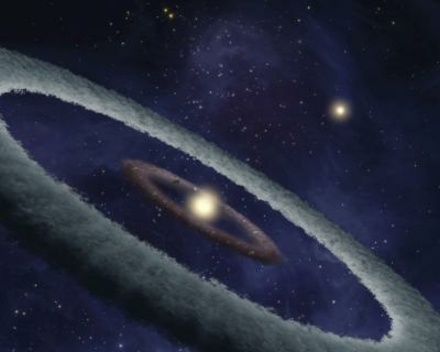
The “birth rate” for stars is certainly not easy to determine. Distances in the universe are far too great for astronomers to be able to count all the newly formed celestial bodies with the aid of a telescope so it is fortunate that emerging stars give themselves away by a characteristic signal known as “H-alpha” emissions.

The larger the number of stars being formed in a particular region of the firmament, the more H-alpha rays are emitted from that region.

More newborn stars are apparently emerging around the universe than previously assumed, say researchers at Bonn University who published a paper in “Nature” explaining that a systematic error in the method of estimation has resulted in a lower number.

Eye color and hair color play a role in human partner choice but visual stimuli can also determine mating preferences in the animal kingdom.

In many species, the male’s fortunes in the mating stakes are decided by a conspicuous breeding dress. A study of brightly coloured fish has now demonstrated that this has less to do with aesthetics than with the sensitivity of female eyes, which varies as a result of adaptation to the environment. Females more attuned to blue will choose a metallic blue mate, while those better able to see red will prefer a bright red male.

These mating preferences can be strong enough to drive the formation of new species – provided that habitat diversity is not reduced by human activities.

