Part 1 on The Plausibility of Life

Darwin is famous for convincingly arguing that natural selection can explain why living things have features that are well-matched to the environment they live in. In the popular consciousness, evolution is often thought of as natural selection acting on random mutations to produce the amazing tricks and traits found in the living world. But “random mutation” isn’t quite right - when we describe evolution like this, we pass over a key problem that Darwin was unable to solve, a problem which today is one of the most important questions in biology. This key problem is the issue of variation, which is what biologists really mean when they talk about natural selection acting on random mutations. Variation and mutation are not the same thing, but they are connected. How they are connected is the most important issue covered Kirschner and Gerhart’s The Plausbility of Life. It is an issue Darwin recognized, but couldn’t solve in those days before genetics really took off as a science.

Natural selection really works on organisms, not directly on mutations: a particular cheetah survives better than other cheetahs because it can run faster, not because it has a DNA base ‘G’ in a particular muscle gene. A domesticated yeast can survive in wine barrel because of how it metabolizes sugar, not because of the DNA sequence of a metabolism gene. I know what you’re thinking: this is just a semantic game over proximal causes. But this is not just semantics, it is a real scientific problem: what is the causal chain that leads from genotype to phenotype, that is, from an individual organism’s DNA sequence, mutations included, to the actual physical or physiological traits of the complete organism?


 Sometimes, during my daily browsing of the Web for news and interesting angles on the sport science world, I get lucky and hit a home run.  I stumbled on this great May 2007 Wired article by Jennifer Kahn, Wayne Gretzky-Style 'Field Sense' May Be Teachable.  It ties together the people and themes of several of my recent posts, focusing on the concept of perception in sports.

Wayne Gretzky is often held up as the ultimate example of an athlete with average physical stature, who used his cognitive and perceptual skills to beat opponents. Joining Gretzky in the "brains over brawn" Hall of Fame would be pitcher Greg Maddux, NBA guard Steve Nash and quarterback Joe Montana.  They were all told as teenagers that they didn't have the size to succeed in college or the pros, but they countered this by becoming master students of the game, constantly searching for visual cues that would give them the advantage of a fraction of second or the element of surprise.

With respect to binge-drinking, “shot-gunning” a beer involves inserting a hole in the beer can and drinking it FAST. The game is so popular that a shotgun beer opener is even available to interested enthusiasts through the "liquorsnob" website. Similarly, too much of this kind of consumption may eventually lead to a hole in the heart.

Drinking more than one or two drinks per day for women and men, respectively, excessive drinking, as defined in the U.S. Department of Health and Human Services Dietary Guidelines, may cause a debilitating condition involving the heart known as “metabolic syndrome.”

David Chalmers is a famous philosopher of mind. His fame rests in great part on his 1996 book, The Conscious Mind: In Search of a Fundamental Theory. It’s too bad that the crucial idea behind the book, dualism, is hopelessly flawed, and -- more surprising yet -- that Chalmers got away with one of the most idiotic thought experiments ever, which a lot of people inexplicably seem to think is oh-so-very clever. This all came back to (my) mind because of a recent article in Philosophy Now by Rebecca Hanrahan (an assistant professor of philosophy at Whitman College in Washington state), who’s finally got the chutzpah to point out the obvious, telling it like it is about Chalmers’ famous “zombie argument.”

I'm taking a moment away from crafting "Journey To The Center Of The Uterus", my opus on reproduction and culture, to discuss something of equal import - namely, orgasms.

It will shock you to know this, but nearly 50% of British women don't have orgasms. Are they frigid? No, not at all, as my 1999 layover at Heathrow can attest. Science funding is the issue, as we shall see.

As we have discussed in articles like The Science of Orgasms and Would Female Orgasms Kill Men?, (1) orgasms are tricky business but scientists know what they are doing. Fewer scientists means fewer orgasms. Britain is in the throes of a science funding meltdown so the problem for British women will only get worse. With fewer scientists there can be fewer studies on important stuff like this.

What are we talking about?

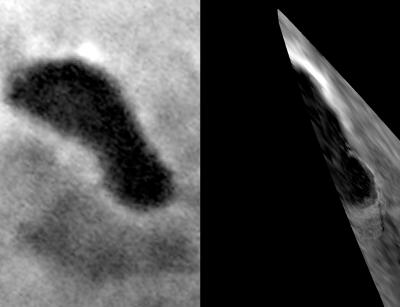
Titan, which is one-and-a-half times the size of Earth's moon and bigger than either Mercury or Pluto, is one of the most fascinating bodies in the solar system when it comes to exploring environments that may give rise to life.

Scientists have confirmed that it has just gotten more interesting - it has a surface liquid lake in the south polar region. Titan is truly wet. The lake is about 235 kilometers, or 150 miles, long, according to the visual and infrared mapping spectrometer, or VIMS, on NASA's Cassini orbiter, which identifies the chemical composition of objects by the way matter reflects light.

An insect that can dive as deep as 30 meters? Or Neoplea striola, a New England insect that can hibernate underwater all winter long?

Indeed, hundreds of insect species spend much of their time underwater, where food may be more plentiful, but until now scientists were unsure how they breathed.

It's by using a 'bubble' of air they create with their water-repellent skin as an external lung, according to John Bush, associate professor of applied mathematics at MIT, and Morris Flynn, assistant professor of mechanical engineering at the University of Alberta. When submerged these insects trap a thin layer of air on their bodies. These bubbles not only serve as a finite oxygen store, but also allow the insects to absorb oxygen from the surrounding water.

Lovastatin, a drug used to lower cholesterol and help prevent cardiovascular disease, has been shown to improve bone healing in an animal model of neurofibromatosis type 1 (NF1). The research, reported today in BMC Medicine, will be of great interest to NF1 patients and their physicians.

Many NF1 patients suffer from bowing, spontaneous fractures and pseudarthrosis (incomplete healing) of the tibias (shinbones). Mateusz Kolanczyk from Stefan Mundlos' laboratory in the Max Planck Institute for Molecular Genetics, Berlin, led a team that investigated lovastatin's ability to prevent pseudarthrosis in a new animal model of human NF1 disease.

Researchers have discovered new genes linked to schizophrenia, it has been revealed.

In two papers published in Nature today (July 30), scientists identify four mutated gene regions that may hold the key to producing new tailor-made drugs to treat the devastating mental illness.

It is hoped the finds, which are likely to galvanize the field of psychiatric genetics, could also lead to earlier diagnosis of the disorder, which affects around one in every 100 people.

Researchers at Yale School of Medicine have found the brain's appetite center uses fat for fuel by involving oxygen free radicals—molecules associated with aging and neurodegeneration. The findings suggest that antioxidants could play a role in weight control.

The study's lead authors were Sabrina Diano and Tamas Horvath, who are an associate professor and professor, respectively, in the Departments of Obstetrics, Gynecology & Reproductive Sciences and Neurobiology. Horvath is also chair of the Section of Comparative Medicine.

"In contrast to the accepted view, the brain does use fat as fuel," said Horvath. "Our study shows that the minute-by-minute control of appetite is regulated by free radicals, implying that if you interfere with free radicals, you may affect eating and satiety."